New paper says converting dollar prices at a stronger Liberian dollar rate makes inflation look lower than it is; suggests true rate could be above 9 percent
Monrovia – An independent Liberian economist is challenging the official view that inflation in Liberia is cooling. He argues that the way the country measures prices hides a cost of living that households feel rising every time they go to the market.
By Rodney D Sieh
In a policy research paper dated September 30, 2026, Dr. Paul Columbus Collins, a chartered accountant and independent economic policy researcher based in Monrovia, says the steady fall in headline inflation reported by the Central Bank of Liberia (CBL) and the International Monetary Fund (IMF) “is not an economic anomaly but a measurement artifact.”
Using what he describes as illustrative calculations, Dr. Collins estimates that inflation in September would stand at about 9.5 percent under his proposed method – more than double the roughly 4.3 percent he says the current method produces.
Prices up, inflation down
The paper sets out what it calls “the inflation paradox.” According to the figures it compiles, reported headline inflation eased from about 6.2 percent in January to about 4.3 percent in September. The September figure is provisional; the Liberia Institute for Statistics and Geo-Information Services (LISGIS) normally publishes it in mid-October.
Over the same period, the Liberian dollar strengthened from about L$187 to between L$172 and L$175 to the US dollar, an appreciation of about 7 to 8 percent.
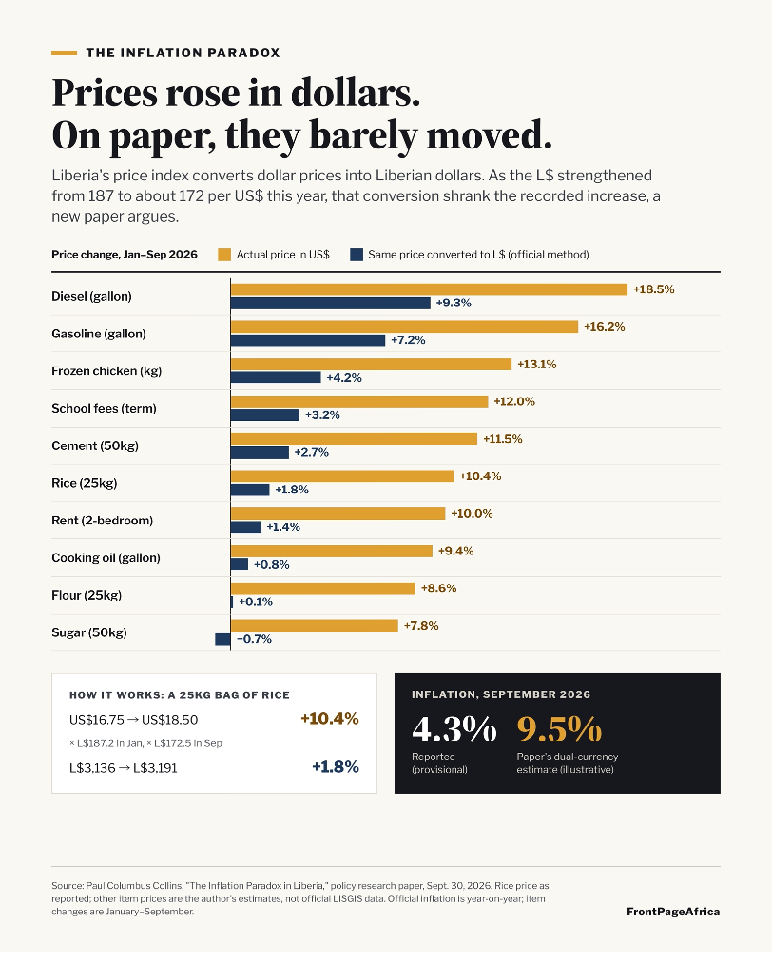
Yet the prices of everyday essentials kept climbing in US dollars. The paper cites a 25kg bag of rice rising from US$16.75 in January to US$18.50 in September, an increase of 10.4 percent. By the author’s estimates, gasoline rose about 16 percent, diesel about 18.5 percent, cement 11.5 percent and cooking oil 9.4 percent. Prices paid in Liberian dollars also went up: the paper estimates Monrovia transport fares rose from L$150 to L$165, and the fare from Monrovia to Gbarnga from L$800 to L$950.
“For the ordinary Liberian household – whose budget is split between LRD cash earnings and USD-priced essentials – the cost of living is unambiguously rising,” Dr. Collins writes.
How the numbers shrink
The problem, the paper argues, lies in how the Consumer Price Index (CPI) is put together. Many items in the basket – imported food, fuel, rent, school fees – are priced and paid for in US dollars. According to the paper, those dollar prices are converted into Liberian dollars at the going exchange rate before inflation is calculated.
When the Liberian dollar gets stronger, each US dollar converts into fewer Liberian dollars. That pulls the converted price down, even when the dollar price has gone up.
The bag of rice shows how it works. At January’s rate of about L$187.2, the US$16.75 bag was worth about L$3,136. At September’s rate of about L$172.5, the US$18.50 bag is worth about L$3,191. A 10.4 percent price increase in dollars becomes a 1.8 percent increase on paper.
The paper gives a second example: an item whose dollar price rises 5 percent between January and September would appear to have fallen 3.3 percent in price once converted.
“The statistic has ceased to measure the cost of living and instead measures the exchange rate with a price signal buried inside it,” the paper says.
Across 12 dollar-priced items in the paper’s extended table, prices rose by an average of about 12 percent in US dollars. Converted into Liberian dollars, the same items rose by only about 3 percent.
A dollar economy
Dr. Collins says the distortion matters more in Liberia than almost anywhere else. The IMF has described Liberia as one of the most highly dollarized economies in the world. Citing IMF studies, the paper notes that between 2007 and 2020 about 84 percent of bank deposits and 91 percent of bank lending were in US dollars, with overall dollarization estimated at 82 to 95 percent.
In such an economy, the paper argues, “the choice of measurement currency is not a technical detail – it determines what the index actually measures.”
Risk to policy
The paper warns that the stronger the Liberian dollar becomes, the lower measured inflation will fall, regardless of what happens to real prices. That, it says, could push policymakers to ease monetary policy when they should not.
It points to the CBL’s decision in July to cut its monetary policy rate to 16 percent, which the paper says may have been based on “a possibly distorted price signal.”
The CBL’s own statement on that cut, as reported in the local press, put headline inflation at an estimated 5.4 percent in the second quarter, up from earlier in the year, and projected it would ease to 4.4 percent, plus or minus two percentage points, in the third quarter.
Two numbers instead of one
Dr. Collins proposes that Liberia measure inflation separately in each currency. Price collectors, who already visit markets and shops, would record whether each price was quoted in US or Liberian dollars. LISGIS would then calculate one inflation rate for US-dollar prices and another for Liberian-dollar prices, without converting between them.
The official headline rate would be a weighted average of the two, based on how much of the economy runs in each currency. The paper suggests starting with 85 percent for the US dollar and 15 percent for the Liberian dollar, reviewed every year.
Applying this method to his September estimates, Dr. Collins arrives at 9.1 percent inflation for US-dollar prices and 11.8 percent for Liberian-dollar prices, giving a weighted headline of about 9.5 percent.
“No official exchange rate enters the computation at any point, so exchange-rate movements can no longer masquerade as price movements,” the paper says.
Recommendations
The paper calls on LISGIS and the CBL to pilot the two-currency index using existing price surveys, and to publish both currency rates alongside the headline figure. It urges the IMF to review Liberia’s CPI method under its Extended Credit Facility program with the country. Until any change is made, it says, the authorities should at least publish a US-dollar price index so that users can see the effect of the exchange rate.
The paper also argues that an accurate index matters for Liberia’s standing in ECOWAS, which sets a regional inflation target of 5 percent or less.
Estimates, not official data
The paper is careful to say that many of its numbers are estimates. Its price table is described as the author’s own compilation, anchored to reported market prices, and should be read as “indicative magnitudes rather than official statistics.” Where official monthly data for 2026 were not available, the paper fills gaps with interpolations. The 9.5 percent figure is described as an illustrative calculation meant to show how the method would work, not a full recalculation of the CPI.
The IMF’s own projection, cited in the paper, puts Liberia’s inflation at 6.7 percent by the end of 2026.
Support Independent Journalism
Your support helps FrontPage Africa continue delivering independent, credible, and impactful journalism. Every contribution strengthens our ability to investigate, inform, and hold power accountable while keeping quality journalism accessible to our readers.
Support our journalism or subscribe to receive the latest FrontPage Africa stories and updates.