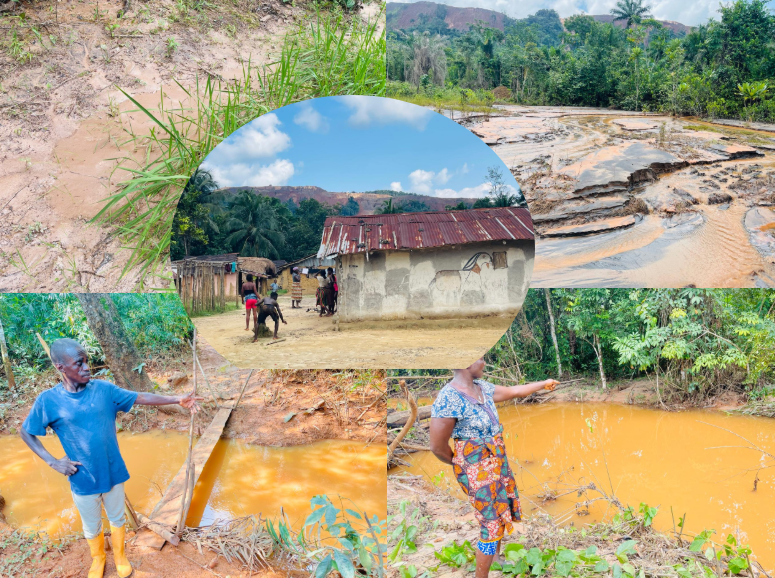
BONG MINES, Bong County— Residents of several villages bordering the China Union Mining Concession in Bong and Margibi Counties have accused the Chinese-owned mining company of causing widespread environmental damage, including the pollution of waterways and farmlands, destruction of feeder roads and excessive dust and mud deposits from its mining operations.
By Yawah Y. Jaivey
The affected residents, numbering more than 2,000 across several villages, including Neitasue, Gboryourmue, Benmue and Jack Village, say their livelihoods and access to clean water have been severely affected by activities associated with the iron ore mining operations.
The allegations were raised during a FrontPageAfrica(FPA) tour of the villages near the China Union Mining Area, where residents described what they said were deteriorating environmental and living conditions.
A FPA reporter, who visited the affected areas, found large deposits of mud and iron ore debris covering sections of vegetable gardens and rice fields.
Some waterways and surrounding farmland also appeared to have accumulated significant amounts of sediment and mining-related debris.
Residents told FPA that the situation has become particularly serious during periods of heavy rainfall, when muddy water and sediments reportedly flow from the mining areas into creeks and other water sources used by surrounding communities.
Residents Complain of Water Pollution
Moses Kollie, Town Chief of Gboryourmue Village in Margibi County, said residents have increasingly struggled to access safe drinking water since mining activities intensified in the area.
“In our villages, we ran out of drinking water. After the mine started, most of our backwaters have been polluted,” Kollie said.
He alleged that the pollution has also affected agricultural production, leaving farmers with fewer productive areas to cultivate.
“All our farming lands and waters have been polluted. Dust has covered all our plants. Productivity of the land is reduced. There’s less cultivable soil available,” Kollie told FPA.
The villagers alleged that the pollution is threatening both household food security and their ability to earn income from agricultural activities.
Tamba Philip, a resident of Neitasue Village in Fuamah District, Bong County, said their water source previously used by residents for drinking, bathing and washing clothes has become increasingly muddy.
“This is where we get drinking water, wash our clothes, and bathe, but now it has turned murky. There are already sediments, which were not here when there were no mining operations up in the mountain,” Philip lamented.
He said the problem becomes more severe during rainfall.
“You visit us here when there’s rain and see our body of waters. Murky water will go to several neighbouring villages,” Philip stated.
The residents have also accused China Union of contributing to the deterioration of the only feeder road connecting some of the affected villages to surrounding communities.
According to the residents, large quantities of mud and iron ore debris flowing downstream from the mining area have accumulated on sections of the road, making transportation difficult and at times, nearly impossible.
The condition of the road, they said, has made it harder for farmers to transport agricultural produce to markets and for residents to access essential services.
Samuel K. David, a resident of Gboryourmue Village, alleged that China Union resumed mining operations nearly four years ago and that the renewed activities have been followed by increased pollution of creeks and farmlands.
David said residents have repeatedly called for assistance, including the provision of hand pumps and rehabilitation of damaged roads, but claimed their concerns have not received adequate attention.
Blasting Raises Health, Structural Concerns
Residents are also expressing concern over what they describe as loud blasting associated with the company’s mining activities.
They alleged that blasting, particularly at night, has disrupted their sleep and created fear among residents living close to the mining areas.
Some residents further claimed that repeated blasting has caused cracks in the walls of their homes, although those claims would require independent technical assessment to establish whether the mining activities were responsible.
Amara Tate, a Gboryourmue Village resident, said the combination of water pollution and blasting has created anxiety among residents, particularly those concerned about their health.
“With the blasting that’s going on, our backwaters are not just polluted, but our houses are being damaged and we, especially those with hypotension, are left to endure those loud explosions. So we’re mostly concerned about our health,” Tate said.
Residents Question Social Development Benefits
Beyond environmental concerns, residents say they have yet to see meaningful social benefits from the company’s presence in their communities.
Samuel David, a resident of Gboryourmue Village, alleged that although the affected communities are located within areas directly impacted by mining activities, they have not benefited sufficiently from social development initiatives associated with the concession.
He cited the absence or inadequacy of basic services, including clinics, safe drinking water, schools and employment opportunities.
According to David, communities directly affected by mining operations should receive tangible development benefits, particularly where their lands, waterways, roads and livelihoods are being affected.
Activist Calls for Accountability
Ambassador Joseph Orland Beyan, a social justice activist, has joined calls for greater accountability, arguing that Liberia’s mineral resources should be developed without compromising the rights and dignity of people living in mining areas.
Ambassador Beyan said the Mineral Development Agreement between the Government of Liberia(GoL) and China Union should ultimately protect the lives, dignity, health and livelihoods of Liberians living within the concession area.
He said he finds it difficult to believe that the Liberian government would knowingly enter into an agreement that places citizens at risk.
“Yet, the reality on the ground is deeply troubling. Our brothers and sisters living around the company’s operational areas are facing serious challenges. Their farmlands, sources of water, crops, homes, roads, and overall health and well-being are being affected, while many communities continue to live in conditions that deserve urgent attention,” Ambassador Beyan said.
He emphasized that the concerns should not be treated merely as statistics or administrative issues.
“These are not just statistics or issues written on paper. These are our people. These are families. These are communities whose lives and livelihoods matter,” he said.
Ambassador Beyan said he believes affected communities should be given a meaningful platform to seek redress.
“We cannot remain silent when the people who are supposed to benefit from our natural resources are instead left struggling to protect their land, homes, health, and future,” he said.
He added that his group was preparing to pursue what he described as a new approach centered on advocacy, accountability and the peaceful pursuit of justice for affected communities.
“Our natural resources must not come at the cost of the lives and dignity of our people,” Ambassador Beyan intimated.
Residents Accuse Lawmakers of Inaction
The affected residents have also criticized their elected representatives, accusing them of doing little to address their complaints despite being informed of the problems.
Among those named by residents are Bong County District Seven Representative Foday Fahnbulleh and Margibi County District Four Representative Emmanuel Yahr whose districts are situated in the affected areas.
Tamba Philip of Neitasue Village alleged that residents have raised their concerns with local authorities but have received little feedback.
“The problem is the authorities do not fully support us. We can complain, the community can complain, but we never hear anything back,” Philip alleged.
Rep. Fahnbulleh Does Not Response to Inquiry
When contacted via WhatsApp for a response to the residents’ allegations, Bong County District Seven Representative Foday Fahnbulleh saw FPA’s inquiry but did not response.
Rep. Yahr Meets Affected Residents
Meanwhile, Margibi County District Four Representative Emmanuel Yahr on Saturday, September 12 held a town hall meeting with residents of Gboryourmue and other affected communities.
The residents presented concerns surrounding water pollution, agricultural land, roads, blasting and the broader impact of mining activities on their communities.
Rep. Yahr assured the residents that he would use efforts within his legislative authority to engage the management of China Union and seek solutions to the concerns raised by the affected communities.
The residents’ complaints now place renewed attention on the environmental and social responsibilities of mining companies operating in Liberia and the government’s responsibility to ensure that communities hosting the country’s natural resources are protected and receive the benefits promised under concession agreements.
The allegations made by residents regarding pollution, property damage and health impacts have not been independently established in this report. They could be subject to further investigation by relevant environmental, health and regulatory authorities.
Support Independent Journalism
Your support helps FrontPage Africa continue delivering independent, credible, and impactful journalism. Every contribution strengthens our ability to investigate, inform, and hold power accountable while keeping quality journalism accessible to our readers.
Support our journalism or subscribe to receive the latest FrontPage Africa stories and updates.