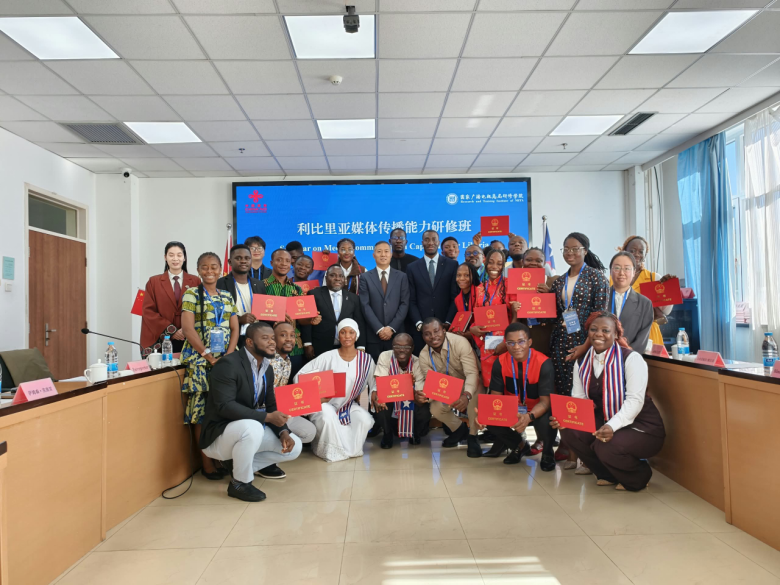
Monrovia-Twenty-three Liberian journalists have returned from a two-week media training program in China with new professional insights, international connections and a challenge that could prove more difficult than the journey itself, turn what they have learned into better journalism for Liberia.
By Willie N. Tokpah
The challenge came from Bai S. G. Best, leader of the Liberian media delegation, and Vice President of the Publisher Association of Liberia, whose closing remarks at the end of the October 14–28 seminar went beyond the usual expressions of gratitude that accompany international training programs.
Instead, Best left his colleagues with a question rooted in a familiar idea of growth, responsibility, and accountability.
“If I plant you, will you grow?”
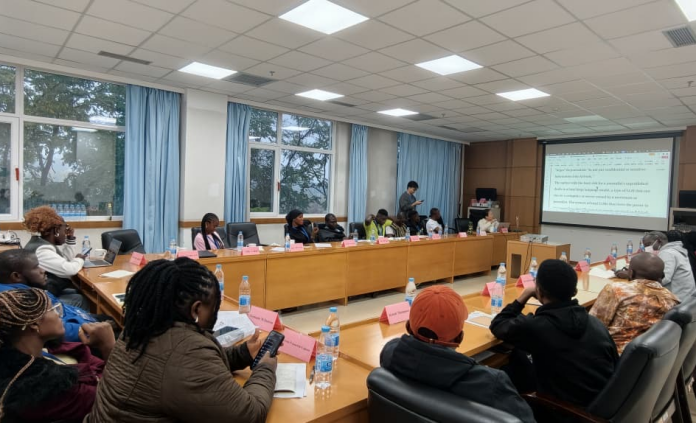
It was a question directed at 23 media practitioners drawn from Liberia’s state-run and private media institutions who had spent two weeks in China studying media communication, international reporting, cultural exchanges, media convergence and approaches to combating fake news.
For Best, the significance of the trip would not be determined by the certificates participants received in Beijing, the institutions they visited, or the experiences they shared abroad.
It would be measured by what happens when they return to their newsrooms, face editorial deadlines, and resume reporting on the problems confronting ordinary Liberians. “Our Chinese hosts have planted seeds of knowledge, friendship, and possibility in each of us.
The question now is what we will do with them,” Best told the gathering. “To our Chinese friends, thank you for planting these seeds. To my Liberian colleagues, let us return home determined to make them bear fruit.”
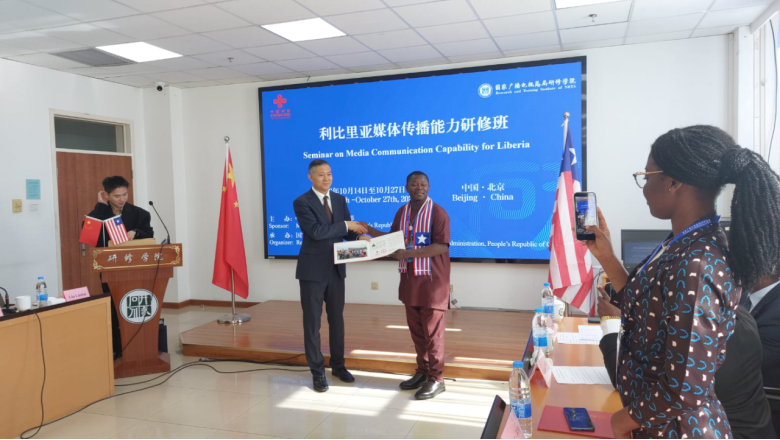
The seminar, organized by the Research and Training Institute of China’s National Radio and Television Administration, concluded on October 27, with participants receiving certificates and gifts.
Gabriel Mills, Minister Counselor for Press at the Liberian Embassy in China, also urged beneficiaries to put the knowledge and practical skills acquired during the program to use.
He commended the Chinese government and the Chinese Embassy through the Ministry of Commerce for providing the training opportunity.
But beyond the official speeches and closing ceremony, the central concern remains relevant to Liberia’s media landscape, what changes will the training produce in the way Liberian journalists report, question those in power and serve the public.
Beyond Certificates and Photographs
Best’s address was notable for its emphasis on the work waiting for participants at home. He described the two-week experience as physically demanding, intellectually challenging, and culturally enriching.
Participants had to adjust to Beijing’s autumn weather, an eight-hour time difference with Monrovia, unfamiliar foods and customs, and a demanding schedule of lectures, excursions, and professional discussions.
At the same time, they were expected to keep up with responsibilities in Liberia, including filing stories and meeting newsroom deadlines. Yet Best said the most important transformation was not simply what participants had learned about China, it was what they had learned about themselves, their profession, and one another.
The delegation brought together journalists from different institutions, backgrounds, and professional circles. Some arrived knowing little about one another; they leave, Best said, with deeper friendships, greater mutual respect, and a stronger sense of shared purpose.
“We arrived as colleagues, some of us barely acquainted. We leave with deeper friendships, greater mutual respect, and a stronger sense of shared purpose,” he said.
He described the experience as an opportunity to look beyond the distance separating Liberia and China and engage directly with another country’s institutions, culture, and media environment.“And somewhere along this journey, it ceased to be simply about Liberians coming to learn from China. It became about all of us, Liberians and Chinese alike, exchanging perspectives on our professions, our cultures, our nations, our people, and our ways of life,” Best said.
For a profession that often operates under intense deadlines, institutional pressures, and competing demands, the exchange offered participants an opportunity to reflect on the broader purpose of journalism and the responsibilities that come with it.
A Call for Journalism That Does More Than Find Fault
Best called on his fellow journalists to embrace constructive journalism, an approach that examines public problems while also investigating possible solutions.
He said he hoped participants would return to their newsrooms with a renewed determination to produce reporting that helps society understand its challenges rather than simply identifying what is wrong.
“I hope we return to our respective newsrooms with renewed determination to practice constructive journalism, journalism that does not merely identify problems, but helps society understand them and explore solutions,” he said.
He also stressed that constructive journalism must not mean avoiding difficult questions or protecting powerful interests from scrutiny. Instead, he argued that journalism must continue to challenge prevailing narratives, ask uncomfortable questions, and ensure that the voices of the least heard are not drowned out.
The distinction is important for Liberia, where journalists play a critical role in informing citizens, scrutinizing public institutions, and bringing issues affecting communities to national attention.
A focus on solutions, if applied rigorously, can complement investigative and accountability reporting by examining whether proposed interventions work, who benefits, who is left behind, and what evidence supports claims of progress.
But the test will be whether the lessons from the seminar can be incorporated into everyday newsroom decisions without compromising editorial independence, accuracy, or the media’s watchdog role. He warned that participants could face skepticism, pushback, and resistance when attempting to introduce new ideas in their newsrooms, communities, and institutions.
“Meaningful change has never been easy,” he said. That acknowledgment gave his message a practical edge international exposure may introduce new ideas, but implementing them requires commitment, professional discipline, and an environment in which journalists can put those ideas into practice.
The Leaf, the Seed, and Liberia’s Next Chapter
Best’s most memorable message came when he drew on an idea associated with Chinese President Xi Jinping’s development philosophy, using the image of a leaf to describe how one small contribution can help enrich an entire community.
“One leaf. One person. One idea. One commitment to doing things differently,” he said.
He then turned to what he described as a simple but powerful Liberian proverbial question, “If I plant you, will you grow?” The imagery captured the responsibility accompanying the opportunity offered to the delegation.
Training, he suggested, is only the beginning.
Knowledge must be applied, professional relationships must be sustained, and new ideas must produce results beyond the conference room.
The question is whether the experience will lead to more rigorous reporting, stronger newsroom practices, more informed public, debate, and greater attention to the concerns of Liberian communities. Those outcomes cannot be guaranteed by certificates or international exchanges alone.
They depend on how participants use what they have learned, the support they receive from their employers, and the professional standards they uphold.
For Best, however, the responsibility is clear. The participants have received an opportunity, and what they do with it is now up to them.
China-Liberia Media Ties
The closing ceremony also highlighted the broader relationship between Liberia and China, particularly cooperation in media, communication, and cultural exchange.
Liu Linhai, Vice President of the Research and Training Institute of the National Radio and Television Administration, described the seminar as an important platform for deepening exchanges between the two countries.
He said the 14-day program brought participants into discussions with experts and scholars from China’s National Radio and Television Administration, China Media Group, the Chinese Academy of Social Sciences, the Communication University of China and China Foreign Affairs University.
Topics included international communication, cultural exchange, innovation in media convergence, and combating fake news.
Liu expressed hope that the participants would share their experiences with colleagues in Liberia and help strengthen practical cooperation between the two countries in media and culture.
He also encouraged the journalists to continue serving as cultural ambassadors, building bridges of friendship and understanding between Liberia and China.
The program forms part of a series of training opportunities the Chinese government has provided to Liberian media practitioners over several years.
Such initiatives offer participants exposure to China’s governance structures, media institutions, and approaches to communication.
For Liberia, the value of these exchanges will depend not only on the knowledge acquired but also on how journalists critically assess and apply relevant lessons within the country’s own political, social, and media environment.
Lessons From Anji
The seminar extended beyond lectures and classroom discussions, with participants spending a week visiting Anji County in China’s Zhejiang Province.
The delegation visited Yucun Village, associated with China’s philosophy that “lucid waters and lush mountains are invaluable assets,” as well as the Bamboo as a Substitute for Plastic Center and the White Tea Cultural and Creative Complex.
The visits offered a look at how local initiatives connect environmental protection, economic activity, cultural promotion, and community development.
Participants also visited Anji’s County-level Governance Center and Public Creative Platform, where they learned about the use of integrated media in local governance and the development of new media and creative industries.
Liu said he hoped the delegation would take home lessons on green development and the use of media to support social development.
Liberia’s natural environment and ecological resources provide a local context for examining such experiences, particularly in environmental reporting and public communication.
But any application of lessons from China would need to reflect Liberia’s own institutions, resources, and development priorities.
The visits offered examples for reflection, but their longer-term value will depend on whether participants can translate what they observed into reporting that helps Liberians better understand environmental challenges, public policy, and community development.
Support Independent Journalism
Your support helps FrontPage Africa continue delivering independent, credible, and impactful journalism. Every contribution strengthens our ability to investigate, inform, and hold power accountable while keeping quality journalism accessible to our readers.
Support our journalism or subscribe to receive the latest FrontPage Africa stories and updates.