Monrovia – The Congress for Democratic Change (CDC) has announced it will filed an appeal to the Supreme Court of Liberia, seeking a stay of enforcement following a Civil Law Court ruling ordering the party to vacate its national headquarters in Congo Town.
By Willie Tokpah, [email protected]
On Monday, the Civil Law Court “A” at the Temple of Justice ordered the Congress for Democratic Change to immediately vacate its national headquarters in Congo Town, outside Monrovia, following its ruling in favor of the Barnards Family Estate, the legally affirmed owners of the 4.23-acre property.
Judge George Smith handed down the decision, granting a motion for summary judgment filed by the estate’s legal representatives and affirming there were no genuine issues of material fact in dispute to warrant a trial.
The ruling effectively enforces a 2016 Supreme Court Judgment that had earlier declared the land to be the rightful property of the Barnards Family, represented by Estate Administrator Ebrima Varney Dempster.
“The evidence before the court supports the legitimacy of the sale and purchase agreement entered into between the CDC and the administrators of the estate,” Judge Smith stated in open court.
“However, that transaction does not override the Supreme Court’s final ruling affirming ownership in favor of the Barnards Family.”
The judge emphasized that while the CDC had entered the premises based on contractual arrangements, the legal title to the property remains with the estate, and any continued occupation by the party is unlawful.
Just three days prior, on Friday, August 1, the court had denied a separate motion from CDC lawyers seeking to compel the estate to complete a sale of the property.
The court maintained that no legal grounds existed to force the transaction, especially in light of the Supreme Court’s earlier verdict.
In the wake of the judgment, CDC’s legal counsel announced they intend to file an appeal to the Supreme Court, requesting a stay of enforcement and further review through Justice in Chambers Cieana Clinton-Johnson.
The party argues that it entered into good-faith negotiations with the estate and has made huge investments in the property since acquiring possession.
The rule permits judgment without trial when the facts are undisputed and the law overwhelmingly favours one party. But property’s owners say the ruling validates a nearly decade-long legal battle to reclaim family land, and they expect full compliance with the court’s order.
“Not Giving Up”
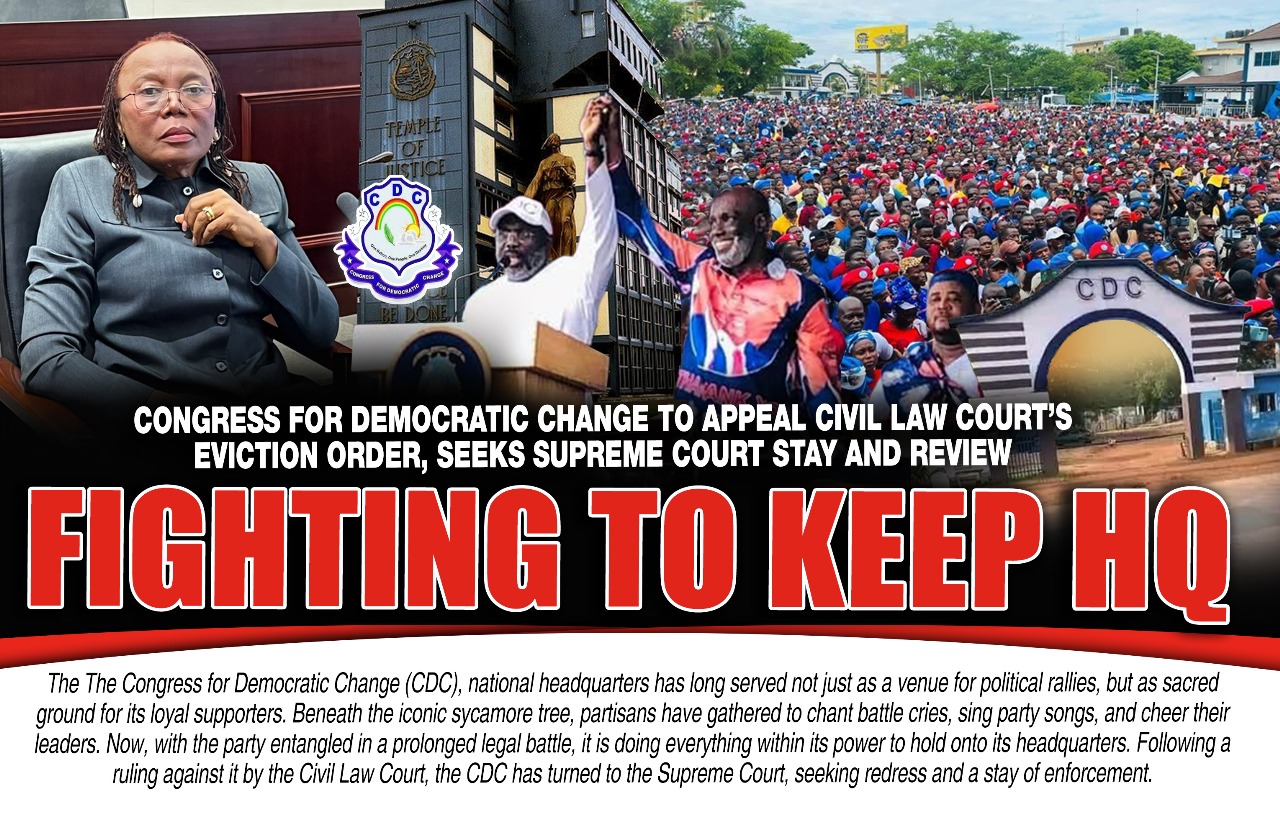
The CDC’s national headquarters has long served not just as a venue for political rallies, but as sacred ground for its loyal supporters. Beneath the iconic sycamore trees, partisans have gathered to chant battle cries, sing party songs, and cheer their leaders. Now, with the party entangled in a prolonged legal battle, it is doing everything within its power to hold onto its headquarters. Following a ruling against it by the Civil Law Court, the CDC has turned to the Supreme Court, seeking redress and a stay of enforcement.
The legal dispute centers on ownership claims to the property that has for years served as the symbolic and operational nerve center of the CDC.
“The CDC’s national headquarters is not just a building. It is a monument of our political struggle,” said a party official, speaking on condition of anonymity. “We will exhaust all legal means to ensure that our supporters are not displaced from a space that has become a second home.”
Beneath the Sycamore trees at the compound, party loyalists have, for nearly two decades, rallied in large numbers—especially during election seasons—to express solidarity, receive political direction, and engage in community mobilization.
Sources close to the party say the decision to seek the Supreme Court’s intervention was swift, as party lawyers argue that the lower court failed to consider key pieces of evidence. The CDC is requesting a stay order to delay the eviction until the Supreme Court can fully review the case.
The legal fight comes at a challenging time for the CDC, which is still reeling from its loss in the 2023 presidential elections and working to maintain its base ahead of the 2029 President and Legislative elections. The potential eviction from its headquarters, many believe, could shake morale among supporters and disrupt party cohesion.
Still, party executives remain hopeful. “We believe justice will prevail,” said another senior official. “This is about more than property—it’s about preserving the legacy and future of our movement.”
A Déjà Vu?
As the Congress for Democratic Change battles to retain its national headquarters, many observers are drawing comparisons to the ordeal faced by the ruling Unity Party following its 2017 election defeat.
In 2021, the Unity Party was evicted from its national headquarters in Congo Town after failing to settle US$150,000 in rent owed to McClain Enterprises, the property’s owner. The party’s legal team openly admitted the debt in court, paving the way for the eviction.
In contrast to the CDC, which is actively seeking negotiations and legal redress to maintain its premises, the Unity Party at the time struggled to meet its financial obligations. The Civil Law Court reduced McClain Enterprises’ initial US$250,000 claim for damages to US$20,000 before formally ordering the Unity Party’s eviction.
With the CDC now appealing a similar ruling and seeking a stay of enforcement, political analysts say history may be repeating itself—though the outcomes, circumstances, and legal strategies differ.
Support Independent Journalism
Your support helps FrontPage Africa continue delivering independent, credible, and impactful journalism. Every contribution strengthens our ability to investigate, inform, and hold power accountable while keeping quality journalism accessible to our readers.
Support our journalism or subscribe to receive the latest FrontPage Africa stories and updates.