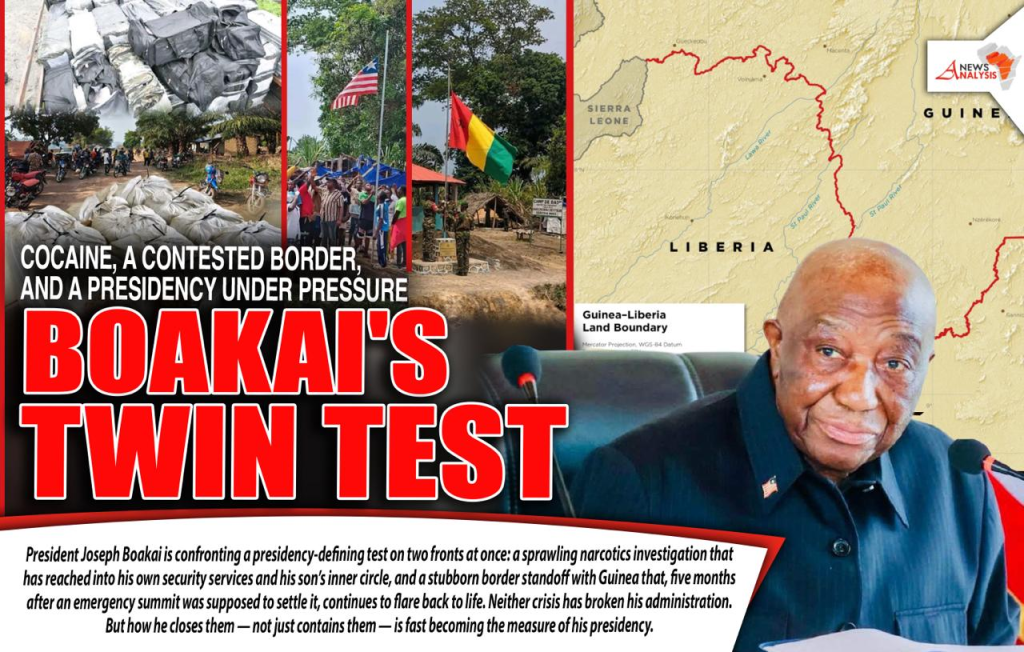
MONROVIA — Six weeks apart, two crises have converged on the desk of President Joseph Nyuma Boakai, each testing a different pillar of his authority. One is a sprawling narcotics investigation that has reached into his own security services and, uncomfortably, his own family. The other is a border standoff with Guinea that has simmered, flared, and simmered again since March without a final resolution. Neither crisis threatens to topple the administration on its own. Together, they are shaping how Liberians — and Liberia’s neighbors — read the strength of a presidency now roughly halfway into its term.
By Rodney D. Sieh, [email protected]
The Narcotics Reckoning
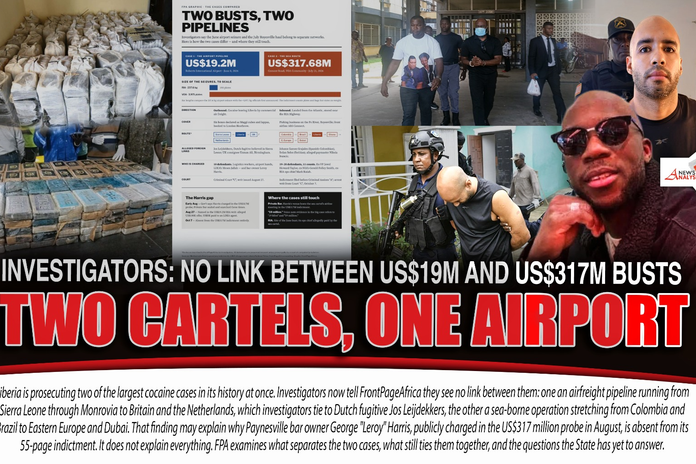
The drug investigation has moved with unusual speed for Liberian institutions. It began building in June, when authorities intercepted roughly 238 kilograms of cocaine disguised as seasoning-cube cargo at Roberts International Airport, then escalated dramatically in July with the seizure of nearly four metric tons of suspected cocaine — one of the largest drug busts in the country’s history, with an estimated street value north of $300 million.
What has followed looks less like a single case and more like a slow excavation of how deeply trafficking networks had embedded themselves in state institutions. Boakai has dismissed and suspended more than a dozen officials since late July, including senior figures at Roberts International Airport, a police commissioner overseeing criminal investigations and Interpol liaison work, and a deputy director at the National Security Agency. Two police officers were separately dismissed over allegations they used government vehicles to move a narcotics shipment across Bomi Highway. As recently as this weekend, Boakai ordered a 48-hour investigation into the Liberia Drug Enforcement Agency’s own officer-in-charge, Fitzgerald Biago, after Biago recused himself amid allegations he received a vehicle from someone linked to a trafficking organization.
The case has also brushed against the president’s own household. Boakai’s son, Joseph Boakai Jr., issued a public denial in late July after a video circulating on social media sought to tie him to an alleged cartel, insisting he has never trafficked drugs, taken money for influence, or leaned on his father’s office to shield anyone. He invited anyone with evidence to bring it to Liberia’s security institutions rather than social media. The U.S. Department of Justice has since joined the probe, underscoring both its scale and its international dimensions.
Civil society groups have, so far, credited Boakai’s response rather than criticized it. The Center for Transparency and Accountability in Liberia welcomed his swift order of the Biago investigation, while noting that public trust in security institutions remains thin and urging that the probe be broadened to strengthen its credibility. That reaction captures the peculiar dynamic of this crisis: the scandal itself is corrosive to institutional confidence, but Boakai’s visible willingness to fire his own appointees — including officials tied to agencies under his direct authority — has so far been read as decisive rather than damning. Justice Minister Oswald Tweh has framed the effort as targeting not just individual smugglers but the transnational criminal architecture behind them, a considerably harder and slower undertaking than the arrests and dismissals made so far.
The Border That Won’t Settle
While the narcotics case has unfolded in Monrovia’s courtrooms and press briefings, a quieter but equally persistent crisis has played out nearly 300 kilometers away, at the Sorlumba crossing in Foya District, Lofa County.
The dispute there dates to March 2, when Guinean soldiers confronted road workers at the border and seized equipment. Within a week it had escalated into a sovereignty crisis: Guinean troops allegedly advanced roughly eight kilometers into Liberian territory, tore down a Liberian flag that had flown for decades, and raised their own. A Liberian civilian was shot near the Makona River amid the unrest, schools closed across Foya District, and a subsequent rights commission investigation found that at least 26 towns and villages had been affected by displacement.
Boakai’s government answered with summit diplomacy — an emergency meeting in Conakry on March 17 with Guinean President Mamadi Doumbouya and Sierra Leonean President Julius Maada Bio, witnessed by Côte d’Ivoire, that produced pledges of joint technical commissions on border demarcation. Five months on, those commissions have yet to resolve the underlying line dispute, even as the two sides have proven able to de-escalate specific incidents through local dialogue, as they did again this week when Foya officials mediated a fresh standoff over LIS officers being ordered off their post. That pattern — flare, mediate, calm, repeat — has become the border’s rhythm, and it leaves the core territorial question exactly where it stood in March.
*Two Crises, One Governing Test*
The two situations differ in almost every particular — one is a domestic law-enforcement scandal with international trafficking links, the other a foreign-relations dispute rooted in colonial-era boundary ambiguity. But they share a common test of governance: whether Boakai’s administration can convert crisis management into durable institutional fixes, rather than a string of individually resolved incidents.
On narcotics, that means whether dismissals and prosecutions actually dismantle trafficking networks rather than simply replacing the officials who enabled them. On the border, it means whether the joint technical commissions promised in March produce an actual demarcation agreement, rather than another round of commander rotations and local dialogue sessions each time tensions spike. Both crises have, so far, been contained rather than resolved — a distinction that will matter more the longer either one drags on.
For a president elected in part on promises of reform and stronger institutions, the coming months on both fronts will likely say more about his legacy than either crisis has said so far on its own.
FrontPageAfrica will continue monitoring both the narcotics investigation and the Liberia–Guinea border situation.
Support Independent Journalism
Your support helps FrontPage Africa continue delivering independent, credible, and impactful journalism. Every contribution strengthens our ability to investigate, inform, and hold power accountable while keeping quality journalism accessible to our readers.
Support our journalism or subscribe to receive the latest FrontPage Africa stories and updates.