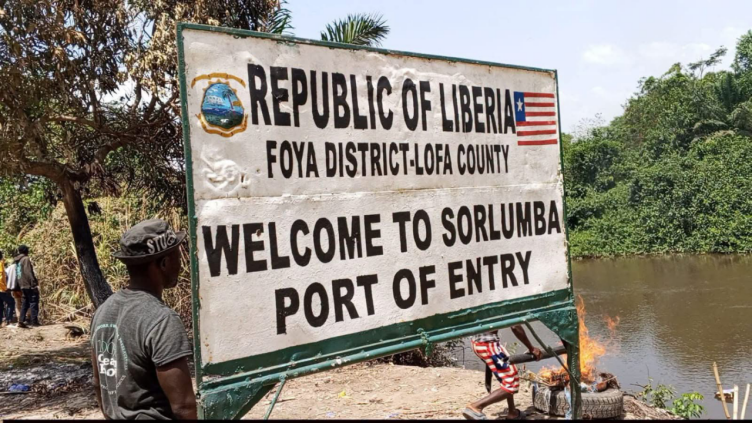
Since February, Liberia’s border with Guinea has seen repeated incursions, a flag removal, troop deployments, and the displacement of thousands of residents in Lofa County. President Boakai has pursued the right diplomatic path — tripartite summits, joint technical commissions, a special envoy — but the public has received only sporadic updates since. This editorial argues that quiet diplomacy without public transparency risks eroding trust at home and, given West Africa’s history, could let a manageable dispute harden into something far more dangerous. It calls on the government to communicate more regularly and plainly with affected communities, not just with counterparts in Conakry.
FOR NEARLY a year now, communities along Liberia’s border with Guinea have lived with a question their government has not fully answered: what exactly is happening on our land, and what is being done about it?
PICTURE A FAMILY in Sorlumba, in Foya District, going about an ordinary morning — tending a farm plot, walking to a river crossing they’ve used their whole lives — when armed soldiers from across the border appear and declare the ground beneath their feet belongs to someone else. That is not a hypothetical. It is close to what residents there say happened earlier this year, when Guinean soldiers reportedly crossed into Liberian territory, seized construction equipment from a Liberian road contractor, and — most provocatively — ordered the removal of the Liberian flag that had flown at the riverbank for decades, even through the years of civil war.  For people who lived through that war, watching their flag come down was not an abstract diplomatic incident. It was personal.
THE BARE FACTS, as they have trickled out through news reports rather than official candor, are troubling enough on their own. Alleged incursions in February sent panic through border communities. Guinea responded to the rising tension not with reassurance but with troop deployments to the frontier, and Liberia’s own rights commission later found that the affair had displaced thousands of residents and exposed serious gaps in both border protection and regional diplomacy. Thousands of displaced people is not a statistic to file away — it is thousands of individual decisions to grab what could be carried and walk away from home, uncertain when, or whether, it would be safe to return.
TO ITS CREDIT, the Boakai administration did not let the crisis spiral into confrontation. President Boakai joined his Guinean and Sierra Leonean counterparts in Conakry in March for a tripartite summit that produced commitments to dialogue, joint technical commissions on border delimitation, and a pledge to convene a full Mano River Union summit within a month to “revitalize” the organization. In June, Information Minister Jerolinmek Piah reaffirmed that Liberia remained committed to resolving the dispute through diplomacy, and that a special presidential envoy had been dispatched to follow up on the Conakry commitments.
THESE ARE THE RIGHT instincts. Nobody serious wants Liberia and Guinea shooting at each other over a riverbank in Foya.
BUT GOOD INSTINCTS are not the same as good governance, and here is where the government’s approach has fallen short: the Liberian public still does not know, in any real detail, where things stand. The promised MRU summit, floated for July, has come and gone without a clear public accounting of whether it happened, what it produced, or why it may have slipped. The joint technical commissions on border delimitation — the actual mechanism that would settle, once and for all, whose land is whose — have operated largely out of public view. The people of Lofa County did not get to choose whether their homes sat on contested ground. The least they are owed is honesty about what their government is doing to protect them.
THIS MATTERS for reasons beyond transparency as a good-governance principle. West Africa has spent the better part of four decades relearning, at enormous human cost, how quickly a border dispute can metastasize into something far worse. Liberia’s own seven-year civil war and Sierra Leone’s decade of conflict were not born in a vacuum — porous, poorly governed borders and cross-border grievances were accelerants for both. Analysts tracking the current tensions have noted that all four Mano River Union countries have emerged from civil conflict, yet peace remains fragile due to weak border governance, contested territorial claims, and shifting political transitions  — a diagnosis that should concentrate minds in Monrovia as much as in Conakry.
THERE IS ALSO a very human political risk in silence. When government communication goes quiet, the space fills with rumor, opposition point-scoring, and — as nearly happened in Foya, where young residents reportedly moved to confront Guinean soldiers directly rather than wait for diplomacy to work — with ordinary citizens deciding to defend their own communities because no one has told them help is coming. A government that explains its strategy clearly gives frightened people a reason to trust the process instead of taking matters into their own hands.
WE ARE NOT calling for saber-rattling, nor for the kind of “inflammatory rhetoric” the government has rightly said it wants to avoid. We are calling for the opposite: more information, delivered more often, in language ordinary Liberians in Foya and Vahun can understand and act on — not just diplomatic communiqués aimed at regional bodies and foreign audiences.
PRESIDENT BOAKAI has said, correctly, that this is “not a matter for confrontation, but for calm, facts and sustained engagement.” We agree entirely — provided that “facts” reach the farmers, traders, and families living along that border, and not only the diplomats in closed-door rooms in Conakry. Liberia has been here before. The region does not need reminding of what happens when land disputes are left to fester unexplained. Let this government show, through consistent and honest public communication, that it has learned that lesson.
Support Independent Journalism
Your support helps FrontPage Africa continue delivering independent, credible, and impactful journalism. Every contribution strengthens our ability to investigate, inform, and hold power accountable while keeping quality journalism accessible to our readers.
Support our journalism or subscribe to receive the latest FrontPage Africa stories and updates.