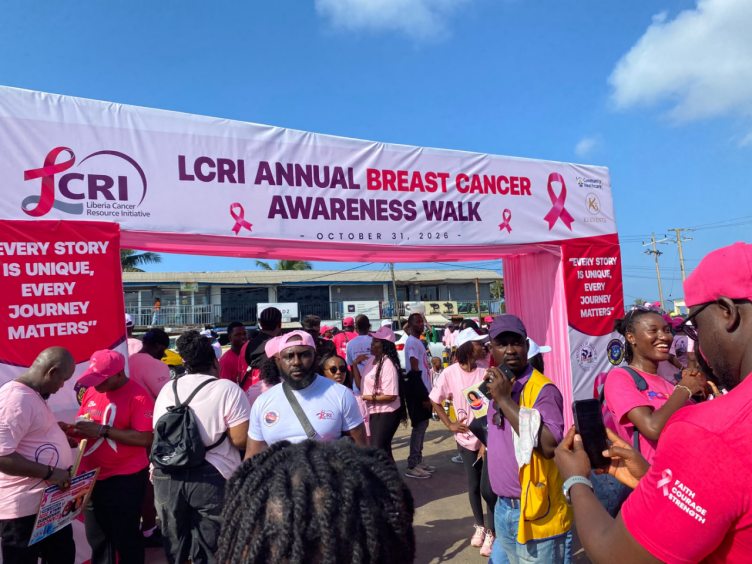
On the last day of Breast Cancer Awareness Month, Liberia’s survivors and advocates did what a health system is supposed to do: they told women that cancer is not a death sentence if it is found early. They did it on a short timeline and on goodwill. It is now the government’s turn to match them with money, practical support and imagination.
ON SATURDAY, WOMEN who had been told they were dying walked to show otherwise. Benejane Shaw, ten rounds of chemotherapy behind her, called herself “a living testimony that early detection saves lives.” Florence Tugbeh, who once had no hair, said she could now “shake my head.” They were not asking for sympathy. They were asking their fellow Liberians to get screened.
THEY DESERVE MORE than applause.
Credit Where It Is Due
THE LIBERIA CANCER Resource Initiative, led by Christine E. Brooks-Jarrett, planned this year’s walk on a short timeline and still drew an encouraging crowd. It runs this campaign every year, and insists that awareness must be a year-round effort. Its stated aim is to “break the stigma surrounding cancer and encourage women to prioritize their health and get screened.” In a country where a cancer diagnosis is still whispered about, that is not a small ambition.
DR. DEDDEH SUPUWOOD, a medical oncologist at the John F. Kennedy Medical Center, carries a different kind of weight. She lost her own mother to breast cancer, and she now spends her days trying to make sure fewer Liberian daughters lose theirs. “When you save one woman’s life,” she said, “you are probably saving a whole family.” She is right, and a country that can count on doctors like her, and survivors who will stand up in public and tell their stories, should not leave them to carry the load alone.
A Walk Cannot Carry This Alone
THE LATEST INTERNATIONAL estimates put Liberia’s toll at 4,217 new cancer cases and 2,745 deaths a year. Breast cancer is the most common: 885 new cases and 421 deaths in 2024, roughly 48 deaths for every 100 women diagnosed. Estimated cases are up about 50 percent since 2018. Those figures are modeled, because Liberia has no cancer registry to count its patients properly, and that gap is itself a failure of public health.
THE SYSTEM THOSE women enter is thin. As of the World Health Organization’s last country profile, Liberia had no radiotherapy machines, no radiation oncologists, no mammography units and no national breast or cervical cancer screening program. The Kennedy hospital is described as the only public facility offering specialized cancer treatment. Many patients arrive late, and some stop chemotherapy because they cannot pay. One woman told the Liberian Observer: “My children and I were deciding what to sell next.”
What Government Should Do
THE GOVERNMENT HAS made a start, and it should be credited. Ground was broken in July 2025 for the country’s first radiotherapy center. Officials have bought mammography and imaging equipment, donated chemotherapy drugs to the Kennedy hospital in June, and told the Liberian Observer they are discussing a dedicated cancer medicines budget line. A start is not a system. We urge the President, the Ministry of Health and the Legislature to go further:
Fund cancer by name. Create a dedicated, published line in the national budget for cancer drugs, screening and the completion of the radiotherapy center, and report every quarter on what was spent. Liberia joined other African governments in pledging in Abuja in 2001 to devote 15 percent of national budgets to health; citizens are entitled to know how close the country is, and what share reaches cancer.
Take screening beyond Monrovia. Most of the new equipment sits at one hospital. Mammography, clinical breast exams and cervical screening must reach the counties, with trained staff to read the results and refer the women who need treatment.
Stop making families choose what to sell. Move the key cancer drugs onto the national essential medicines list, as officials say they are considering, and subsidize chemotherapy so that no woman stops treatment because she cannot pay.
Back the advocates in practice.
Groups like the Liberia Cancer Resource Initiative should not have to plan a national campaign on a few weeks’ notice. Offer them grants, free airtime on state media, help with permits and logistics, and a seat at the table when programs are designed.
Count the problem and publish it. Build a cancer registry and release the numbers every year, so that Liberians know how many of their neighbors are being diagnosed and dying, and so that policy follows evidence.
CLLR. TIAWAN SAYE Gongloe told Saturday’s crowd that “corruption starts with C, cancer starts with C.” The budget is where the two meet. Every dollar lost to waste is a drug not bought and a screening machine not installed.
Room for Creativity
THE FIGHT WILL not be won with money alone. The people best placed to reach Liberian women are already in their communities, and government should make room for them to be inventive.
MARKET WOMEN’S ASSOCIATIONS, churches, mosques and radio stations broadcasting in local languages reach women the clinic never sees. Community health workers could be trained to perform clinical breast exams and refer women early. Survivors like Benejane Shaw and Florence Tugbeh could serve as peer guides, walking the newly diagnosed through a system they have just survived. Schools, football clubs and musicians could carry messages about screening and cervical cancer prevention to young Liberians. Mobile teams could visit county towns on market days. None of this has to wait for a new hospital.
THE GOVERNMENT CAN invite these ideas rather than wait for them. A modest innovation fund for community cancer projects, open to local groups as well as hospitals, would let the best ideas grow, and a requirement to measure results would show which ones deserve to be copied.
SATURDAY’S WALK ENDED with games and a plate of dry rice, and a crowd that went home glad. Christine E. Brooks-Jarrett said the fight “requires collective and sustained action.” Government is the largest part of that collective. The advocates have shown the way. It should follow, and it should fund them.
Support Independent Journalism
Your support helps FrontPage Africa continue delivering independent, credible, and impactful journalism. Every contribution strengthens our ability to investigate, inform, and hold power accountable while keeping quality journalism accessible to our readers.
Support our journalism or subscribe to receive the latest FrontPage Africa stories and updates.