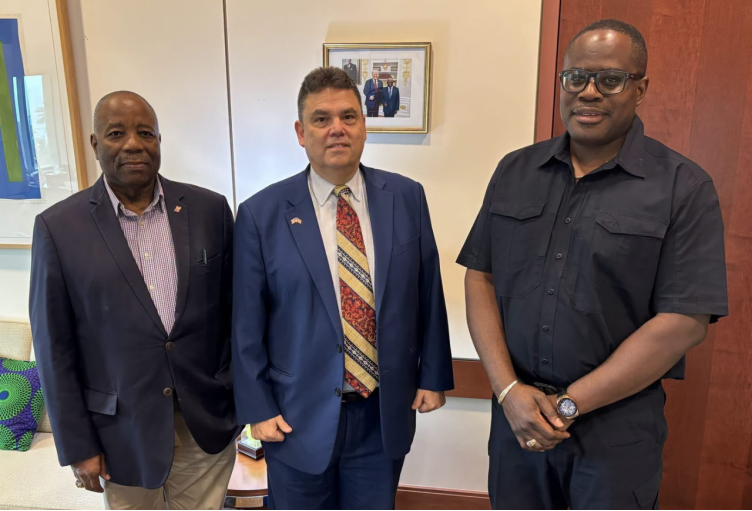
The U.S. Embassy meeting between Chargé d’Affaires Joe Zadrozny and Liberia’s top police officials — Inspector General Gregory Coleman and EPS Director Sam Gaye — comes at a fraught moment: a $19 million cocaine bust in July was followed by a record $317 million seizure implicating senior police officers themselves, some now facing charges. Coleman has also faced unproven allegations of ties to the trafficking network, making the embassy’s emphasis on “accountability” read as pointed encouragement rather than blanket endorsement.
By Rodney D. Sieh, [email protected]
Monrovia- By any measure, U.S. Chargé d’Affaires Joe Zadrozny’s meeting with Liberia National Police Inspector General Gregory O.W. Coleman and Executive Protection Service Director Sam Gaye should have been a routine diplomatic courtesy. Instead, it lands at one of the most consequential moments in Liberia’s modern anti-narcotics effort — and its timing, coming just as President Boakai reshuffles the LDEA’s leadership for the third time in two years, makes it read as something closer to a signal than a formality.
Why the timing matters
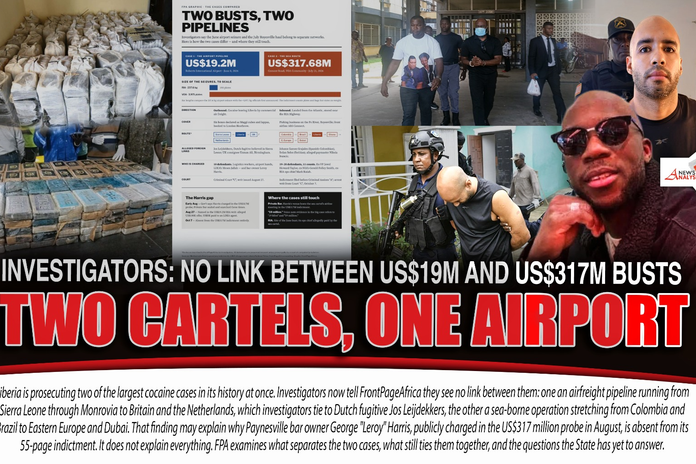
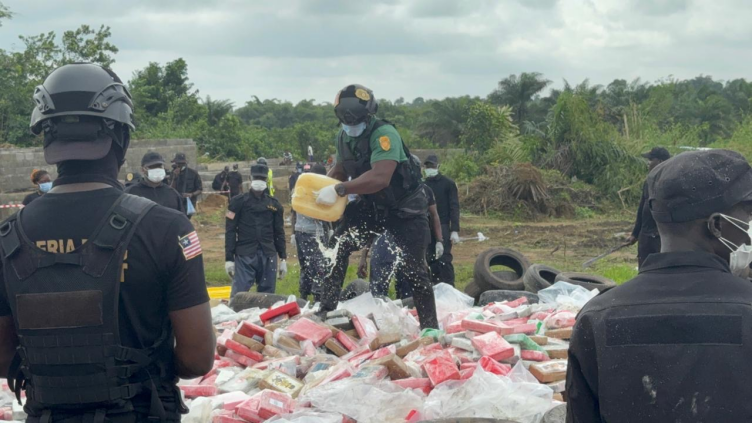
The meeting follows two extraordinary seizures in the space of a few weeks. In July, security personnel intercepted six cargo boxes at Roberts International Airport disguised as textiles and seasoning cubes; inside were nearly 200 compressed blocks of cocaine, ultimately valued around $19 million — a case that drew public criticism after delays in identifying suspects raised fears that individuals connected to the shipment had already fled the country. Weeks later came a seizure of a different order of magnitude entirely: nearly four tonnes of cocaine, worth an estimated $317.7 million, recovered from what investigators described as an organized, sophisticated, and well-funded trafficking network that may have operated in Liberia for more than six years. Authorities later incinerated 4.2 metric tons of the drug, sending what Coleman called a message that Liberia was no longer “a place of comfort” for traffickers.
What has made the second bust politically explosive, however, is who it implicated. Coleman confirmed that Liberia’s chief of highway patrol and the head of the major crimes unit face charges, with a deputy police commander at the main airport also under suspicion — meaning the very institution now meant to lead enforcement, the Liberia National Police, has senior officers accused of facilitating the trafficking it is supposed to stop.
The credibility problem the U.S. visit runs into
That is precisely why Zadrozny’s meeting cannot be read purely as encouragement. Coleman himself has become a subject of serious, if unproven, allegations. In a July 15 letter to Zadrozny, CDC Secretary General Jefferson Koijee requested U.S. backing for an international investigation, alleging that Coleman took vehicles from a drug cartel and distributed them to President Boakai, Vice President Koung, and the presiding officers of the Legislature, and separately that the 2024 removal of former LDEA head Abraham Kromah was orchestrated by Coleman to protect a cartel he was allegedly connected to, and that Coleman later maneuvered Fitzgerald Biago — his own deputy at the police — into the LDEA’s top job. Koijee’s broader argument was structural: that repeatedly installing senior police officers atop the drug agency has blurred the LDEA’s independence and concentrated excessive influence within Liberia’s security apparatus.
Notably, Boakai’s own government has now partly validated that structural critique without validating the corruption allegation. Monday’s Executive Mansion release states that the Justice Ministry’s probe into Biago “did not establish any involvement… in illegal narcotics trafficking” but did identify unspecified “ethical concerns” — landing in a gray zone that neither clears the LDEA leadership pipeline of suspicion nor confirms the most serious claims against it. Biago’s own departure now repeats the very pattern Koijee flagged: a police-to-LDEA pipeline replaced, once again, by another appointee — this time a retired general rather than a police officer, which may itself be read as an attempt to break that cycle.
What the U.S. statement does — and doesn’t — say
Read against this backdrop, Zadrozny’s language is carefully calibrated. It reaffirms partnership and frames Liberian institution-building as serving “regional stability” and the “enduring friendship” between the two countries — standard diplomatic register. But it also pointedly addresses itself to “law and order” and “a just and accountable legal system,” phrasing that functions as quiet pressure on Coleman and Gaye specifically to see the investigations — including into their own ranks — through to a credible conclusion, rather than as an unqualified vote of confidence in current leadership.
The U.S. has skin in this game beyond diplomacy: earlier reporting has linked American law enforcement, including the Department of Justice, to the broader trafficking investigation tied to the record cocaine seizure, and West Africa’s role as a transit corridor — now carrying an estimated 30 percent of Europe-bound cocaine, according to the Global Initiative Against Transnational Organized Crime — makes Liberia’s enforcement capacity a matter of direct interest to Washington and European partners alike, not just Monrovia.
The stakes for the investigation ahead
For Ziankahn’s incoming LDEA leadership, the practical effect of the U.S. engagement is likely to be twofold: continued technical and possibly intelligence-sharing support for dismantling the trafficking network behind the record bust, paired with implicit international scrutiny of whether Liberia’s own police leadership — the officials the U.S. just met with — can be trusted to police itself.
Whether Coleman and Gaye emerge from the ongoing probes as central figures in prosecuting this case, or as subjects of it, may do more than any embassy statement to determine whether Liberia’s “war on drugs” produces lasting institutional reform or simply another rotation of the same personnel through different chairs.
Support Independent Journalism
Your support helps FrontPage Africa continue delivering independent, credible, and impactful journalism. Every contribution strengthens our ability to investigate, inform, and hold power accountable while keeping quality journalism accessible to our readers.
Support our journalism or subscribe to receive the latest FrontPage Africa stories and updates.