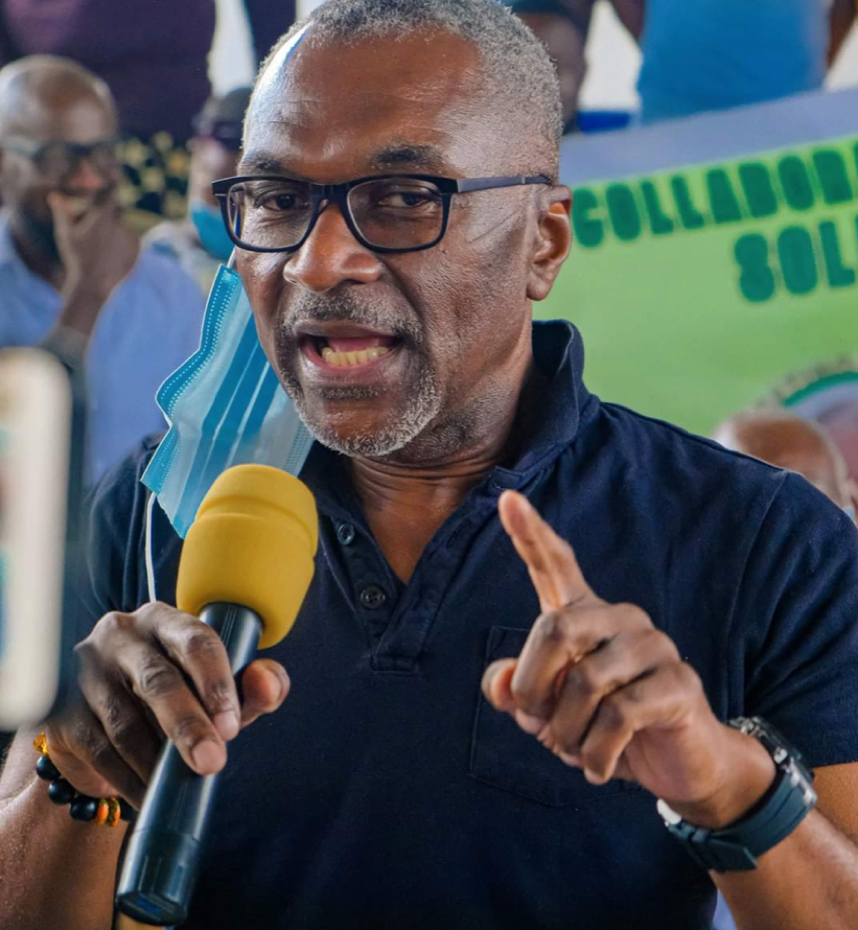
MONROVIA – In a recent statement, Alexander Benedict Cummings, the Standard Bearer of the Collaborating Political Parties (CPP) in Liberia, has expressed his disappointment with the state of governance in Liberia under the leadership of President George Manneh Weah. Cummings’s statement was issued in response to outgoing United States Ambassador to Liberia Michael McCarthy’s assertion that Liberia is a failed state. In his statement, Ambassador McCarthy detailed the multiple ills in Liberian society ranging from corruption, bad governance, and the government’s failure to address them.
By Obediah Johnson
Cummings described governance in Liberia as becoming so “rotten” that traditional allies must raise these concerns in the press, which is a serious blow to the nation’s image. According to Cummings, Liberia is quickly becoming a pariah state under the failed CDC government, which is turning away credible investors and partners.
Cummings pointed out that unemployment continues to increase, food prices continue to rise, insecurity worsens, and thousands of Liberians continue to lose their lives to easily preventable diseases. He maintained that President Weah and his cronies continue to enrich themselves, while ordinary Liberians continue to suffer. He warned that another six years of a Weah administration would severely damage Liberia’s credibility in the international community and leave Liberians stuck in a cycle of poverty and suffering.
Cummings also disclosed that under his leadership, Liberia would get back on track through the building of functional systems to ensure a functioning public service. He said his government would aggressively fight corruption by empowering the courts to prosecute corruption cases swiftly and fully, especially for officials at the highest levels of government. Cummings maintained that his government would also implement an aggressive strategy to make Liberia an attractive investment destination for international investors that align with a long-term vision for real change in Liberia.
Liberians are expected to go to the polls on October 10 this year to elect their new leaders, according to a timetable realized by the National Elections Commission (NEC). Cummings pointed out that these elections are about choosing between the old “politics as usual” that has led the country to where it is today versus real results-driven transformational leadership that will make an actual difference in the lives of the people.
Ambassador McCarthy’s bombshell statement on Liberia has been a topical issue on various radio stations, street corners, and intellectual centers in the country. His statement was issued following the completion of his tour to Bomi, Gbarpolu, and four counties in the Southeast, which completes his visit to all 15 counties of Liberia.
“Unfortunately, on the trip I was startled and deeply troubled to encounter multiple county hospitals that received not one penny of what they were promised in the 2022 budget. Hospitals on which lives depend, where outbreaks are prevented and suffering is alleviated, did not receive any portion of the US$100,000 or more appropriated by the legislature for them to operate,” he said in a strong-worded press statement issued by the U.S. Embassy on Monday. Continuing, he said: “Lest you think this is the work of one political party, that notion was quickly dispelled by Liberians I talked to. The blocking of resources is so complete that it must be institutional: and the lack of any alarm being raised indicates a syndicate involving players at the legislature, the Ministry of Health, and the Ministry of Internal Affairs.”
Liberia is rich in mineral resources, abundant water, and large forests, but the majority of its citizens live below the poverty line. Its politics is in the framework of a presidential representative democratic republic modeled after the United States, whereby the President is the head of state and head of government. However, unlike the United States, Liberia is a unitary state with one fiscal budget that is controlled and expended by the Executive through the Ministry of Finance and Development Planning, but with the approval of the Legislature which makes the appropriation, and monitors the expenditure of the appropriated funds through its oversight responsibilities.
In the last five years, public facilities including hospitals, schools and civil centers which should have been the main drivers of the government’s decentralization policy, complained of not receiving all of its approved budget, making the operation of these facilities difficult.
And while these constraints have been reported from time to time by the media and civil society organizations, the U.S. Ambassador’s tour has shone the light on the harsh reality of life for civil servants in these leeward counties – public “facilities currently survive on the backs of incredibly dedicated health professionals, making do with whatever they can scrape together.”
Amb. McCarthy did not mince his words in expressing his feelings and thoughts following his face-to-face encounter with the harsh condition grappling rural dwellers. “In one town administrators look with anticipation mixed with fear at the brand-new, modern hospital that sits vacant, knowing that they can barely keep the existing makeshift facility going, and running the new one will require ten times the resources,” he recounted.
He revealed that the United States Government is about to spend a total of over US$40 million constructing Liberia’s state-of-the-art National Reference Laboratory (NRL) that, when completed, will require US$3 million to US$4 million a year from the Government of Liberia to operate.
However, he said if the Liberian “Government is failing to deliver statutory appropriations of only US$100,000 to existing hospitals, why would we ever trust annual pledges of US$3 million for the future NRL?”
Since the devastating Ebola outbreak and later the COVID-19 pandemic, the United States, through USAID and the Center for Disease Control (CDC), has supported Liberia in strengthening its health sector.
When built, the NRL will, among other things, facilitate public health surveillance, contact tracing, and case hospitalization, all of which can reduce the risk of disease spreading locally and across borders. National Reference Laboratories are at the pinnacle of diagnostic service provision.
Support Independent Journalism
Your support helps FrontPage Africa continue delivering independent, credible, and impactful journalism. Every contribution strengthens our ability to investigate, inform, and hold power accountable while keeping quality journalism accessible to our readers.
Support our journalism or subscribe to receive the latest FrontPage Africa stories and updates.