- U.S. President Donald Trump calls the situation “a very bad thing”
- Global attention grows over alleged religious discrimination under a post-impeachment government
- President and Prime Minister accused of stigmatizing a specific religious group
- Repeated investigations into Shincheonji raise questions about compliance with international human rights standards
Seoul – The South Korean government is facing intensifying domestic and international criticism following public statements and actions by senior officials that name and stigmatize a specific religious group, prompting allegations of religious persecution and abuse of state power.
Critics say recent remarks by top government officials—coupled with orders for investigations and references to the “eradication” of certain religious groups—undermine constitutional protections and fuel social hostility. International observers warn that such actions may erode democratic norms, particularly freedom of religion and the separation of powers.
The controversy has drawn attention abroad, including from U.S. President Donald Trump, and stands in sharp contrast to South Korea’s global image as a cultural powerhouse celebrated for K-Pop and K-Drama.
President, Prime Minister Label Specific Religion “Cult,” Call for “Eradication,” Drawing Widening Criticism
On January 12, President Lee Jae Myung publicly referred to Shincheonji Church of Jesus, the Temple of the Tabernacle of the Testimony (hereafter “Shincheonji”), and other religious groups, stating that “the harm they cause to society has been left unchecked for too long, resulting in serious damage.”
The following day, Prime Minister Kim Min-seok echoed those remarks during a Cabinet meeting, using terms such as “pseudo-religion” and “cult,” and ordering a joint investigation aimed at their “eradication.”
In the wake of these statements, a multi-agency investigative task force has been established, and investigations are now underway. Lawmakers are also discussing the possible appointment of a special prosecutor, raising expectations that coercive measures—including search-and-seizure operations—could follow.
Article 20 of the Constitution of the Republic of Korea guarantees freedom of religion as a fundamental right. Legal scholars and civil society groups argue that repeated statements by the executive branch, made prior to any judicial determination, effectively brand a specific religion as a social threat, encouraging stigma and hostility through the use of state authority.
Observers further note that President Lee assumed office following the impeachment of a former president for unconstitutional conduct, heightening concerns that renewed rhetoric perceived as undermining constitutional principles may signal democratic regression.
Shincheonji Responds:
“Repeated Targeted Investigations Amount to Religious Discrimination”
Shincheonji Church of Jesus, founded in 1984 by Chairman Lee Man-hee, is a Christian religious organization that has reported rapid growth in recent years, citing annual increases of more than 100,000 members. Analysts suggest the group’s expanding size and visibility may have contributed to increased political and social scrutiny.
The church first became a major focus of state action during the COVID-19 outbreak in 2020, when authorities launched large-scale investigations and administrative measures over alleged violations of infectious disease laws. Shincheonji says more than ten search-and-seizure operations were carried out against its headquarters and affiliated churches during that period.
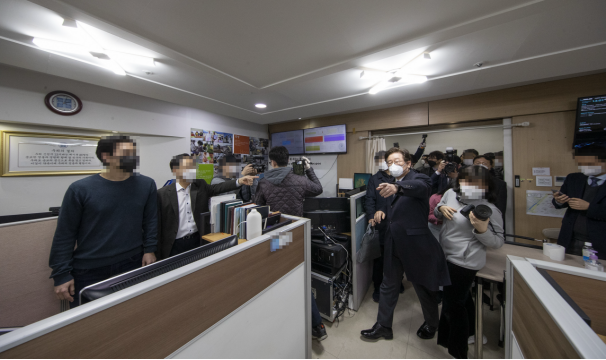
At the time, then-Governor of Gyeonggi Province Lee Jae Myung personally led a forced entry into Shincheonji’s headquarters, a move that came to symbolize the government’s hard-line approach.
Subsequently, South Korean courts acquitted Shincheonji of major charges, including alleged violations of the Infectious Disease Control and Prevention Act. In response, the church stated that “although numerous complaints and accusations have been filed against us, courts have consistently ruled no charges or not guilty,” adding that “issues already resolved by the judiciary are now being recycled as tools for political and public attacks.”
Shincheonji emphasized that it is “a religious community with no intention of engaging in political conflict,” and urged authorities to “stop using a specific religion as a scapegoat while speaking of national unity.”
International Scrutiny Intensifies as Trump and Democracy Groups Voice Concern
International concern has continued to grow. In August 2025, U.S. President Donald Trump said he had received reports that the South Korean government was conducting “very vicious raids” on churches and even entering U.S. military bases to gather information, suggesting that “a purge or a revolution may be taking place.”
After learning of additional large-scale raids on churches, Trump described the situation as “a very bad thing.” Analysts note that it is highly unusual for the leader of an allied nation to publicly criticize another country’s internal law-enforcement practices.
The International Democracy Union (IDU) stated in December that continued monitoring of South Korea’s adherence to democratic principles and the protection of fundamental rights is warranted, describing the adoption of a formal resolution on democracy and the rule of law in South Korea as a rare step.
International human rights instruments, including the International Covenant on Civil and Political Rights (ICCPR), guarantee freedom of religion and require that any state intervention meet strict standards of legality, proportionality, and minimal impairment.
As scrutiny intensifies, the situation in South Korea raises broader questions for liberal democracies worldwide: how far can state power go in regulating religion without infringing on fundamental civil liberties? For now, international attention on South Korea’s democratic trajectory continues to grow.
Support Independent Journalism
Your support helps FrontPage Africa continue delivering independent, credible, and impactful journalism. Every contribution strengthens our ability to investigate, inform, and hold power accountable while keeping quality journalism accessible to our readers.
Support our journalism or subscribe to receive the latest FrontPage Africa stories and updates.