Let me borrow the words of our revolutionary brother, Captain Ibrahim Traoré of Burkina Faso: “I will not sugarcoat it.”
Part II(As promised, final).
Secure borders are not just about closing off a nation but about creating a safe, orderly environment for both domestic growth and positive international relations.
Strong border security is essential for national development and sovereignty, ensuring safety, law enforcement, and economic stability by controlling the flow of goods and people.
It protects citizens, facilitates trade, and fosters good neighborliness by creating orderly, cooperative relationships.
A secure border is a foundation of a stable nation.
“Liberia’s Border security should be a national security priority! Whenever the security of Liberian is threatened internally or externally, it means that the security of the nation is at risk.” — Hon. Edward Wesee.
“A country with a perfect border is a place where the people can live freely without fear…..the safest heaven…” home sweet home.” — Tun Than via
“Without a border, Liberians don’t have a nation.” — Dr. Anthony Fallah Swaray.
“Effective border security allows a nation to monitor better and regulate who can enter the country and what materials they are transporting,” which is crucial for preventing threats and managing resources.- International Association of Chiefs of Police
“A nation without borders is a nation without order.” —U.S. National Guard.
“States… are obligated to maintain their international commitments in border spaces and to work cooperatively to solve border problems with neighboring states where necessary to do so,” says the University of Chicago Legal Forum
“Border strengthening is effective, but not if done in isolation. We also need to give priority to establishing public institutions that deliver a sustained level of security and justice for citizens.” — Ban Ki-moon
“Once a friend, always a friend. Why should borders stop that?” — The University of Chicago Legal Forum.
“By controlling and managing the flow of people and goods across national boundaries… strong border security can help reduce crime, protect citizens, and disrupt the activities of organized crime syndicates.” — International Association of Chiefs of Police.
“If we fail to lead, we will cede influence to others.” — Thomas J. Donohue.
By: Austin S Fallah – A True Son of the Planet Earth Soil: [email protected].,
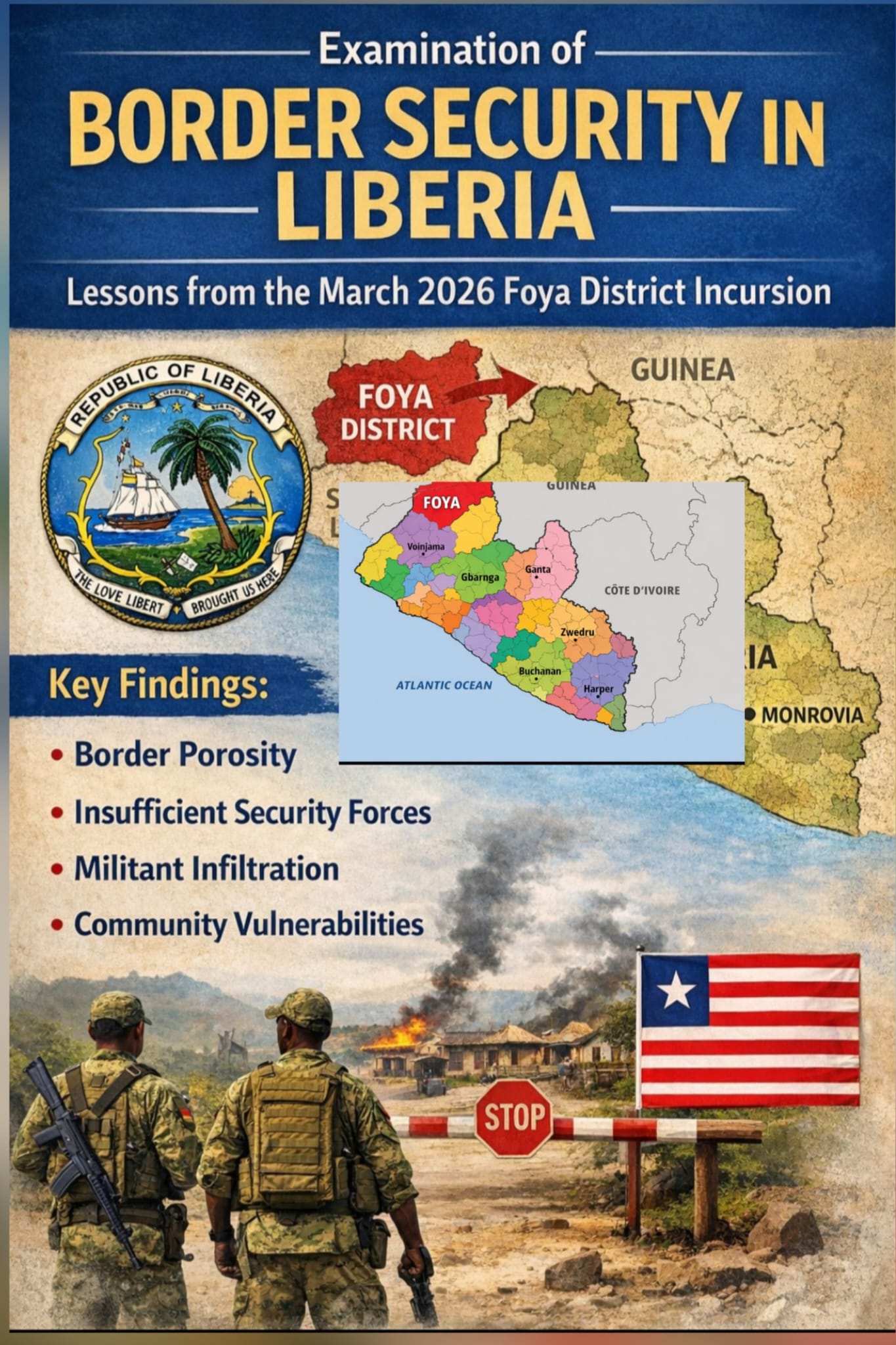
The Foya District Wahala of March 2, 2026 serves as a sobering reminder of Liberia’s ongoing vulnerabilities in border protection.
Located along the border with the Republic of Guinea, this incident highlights a frighteningly persistent issue in Liberia’s national security apparatus, a failure to learn from historical precedents and to adapt to contemporary security challenges.
As we examine the implications of the incursion, it becomes clear that Liberia’s security forces must undergo a significant transformation to meet the demands of the 21st century and protect its citizens effectively.
The date December 24, 1989, marks a pivotal moment in Liberia’s tumultuous history, as it precipitated a brutal civil conflict that wreaked havoc across the nation.
The chaos that followed exposed not only the political instability stemming from internal strife but also the glaring inadequacies of national defense and border security.
The inability of the Liberian government to secure its borders led to widespread chaos and violence, which the nation has struggled to recover from to this day.
Decades later, one would hope that the lessons learned from these dark times would lead to significant improvements in national security and border protection; however, the Foya District incident lays bare that this has not yet come to fruition.
For Liberia, the incursions from Guinea represent a critical test as the nation grapples with its identity and security framework.
On several fronts, the March 2, 2026, imbroglio draws a parallel between past mistakes and current inadequacies.
The repeated failures in managing border security indicate a lack of resources, training, and intelligence-gathering capabilities essential to thwarting cross-border threats.
The Foya District wahala is not merely a localized event; it encapsulates a broader crisis of confidence and capability within Liberia’s security structures.
The Guinean military’s unabsorbed entry into Liberian territory underscores the necessity for Liberia to invest in comprehensive security reforms.
The government must recognize that an effective border security strategy extends beyond mere physical presence; it requires integrating advanced technology, contemporary intelligence methodologies, and proficient personnel.
An intelligence-gathering apparatus that meets the requirements of 21st-century national security and policing can bolster Liberia’s ability to prevent such incursions, thereby maintaining national sovereignty and integrity.
Detecting potential threats before they escalate is not merely a desirable outcome; it is a fundamental requirement for national stability.
In examining Liberia’s border vulnerabilities, it is essential to contrast them with those of nations that have successfully implemented robust security initiatives.
Countries across the globe have advanced their border enforcement capabilities by deploying sophisticated surveillance systems, uncrewed aerial vehicles (UAVs), and rapid-response teams specifically trained to address cross-border incursions.
While many of these nations face unique challenges, their proactive approach to border security represents an industry standard that Liberia must aspire to.
Moreover, a comprehensive security strategy necessitates not only the incorporation of modern technologies but also the development of human capital within the national security framework.
Professionalism among security forces cannot be embroidered; a well-trained, disciplined, and effectively led military and security apparatus is crucial to the legitimacy and efficacy of any government.
In Liberia, there is much work to be done.
Training programs should be tailored to meet contemporary security demands.
They must incorporate elements of civil-military relations to foster trust between the security apparatus and the citizenry, as underscored by President Joseph Nyumah Boakai during a general national broadcast and by Liberia’s Inspector General of Police, Inspector Gregory Coleman, during a recent visit to Foya District, Lofa County, Liberia.
This is not just a matter of efficacy; it is also about ensuring a societal environment where citizens feel sufficiently protected and secure.
The urgency of these reforms is underscored by the potential ramifications of continued inattention to border security.
The geopolitical landscape surrounding Liberia is fluid and complex.
Political instability in neighboring countries, coupled with internal challenges, creates a volatile context for Liberia’s security framework.
Therefore, timely and effective adjustments are imperative to avert further “WAHALAs”, potential human rights violations, and cross-border trafficking of arms, drugs, and persons.
As stated in Part I of my first article.
As the events of the Foya District illustrate, these issues are interrelated and represent a significant threat to Liberia’s national security.
Furthermore, one must consider the implications of the international framework concerning border security.
Global norms and standards have evolved to address modern security concerns, with an emphasis on cross-border cooperation among nations to combat issues like terrorism, human trafficking, and smuggling.
The recent Mano River Union summit held in Guinea is a clear statement of this.
We salute the Mano River Union leaders for their wisdom in maintaining regional and global peace. participating
Liberia stands to benefit from actively participating in regional security dialogues and forging partnerships with neighboring countries.
Cooperation can facilitate the exchange of intelligence and best practices, which are crucial in a world where threats often transcend national borders.
Such collaboration, however, is contingent upon the establishment of a credible national security framework within Liberia.
As the government moves towards bolstering its capacity for border protection, it should be cognizant of the importance of civil society in promoting security accountability and transparency.
Involving citizens in the conversation about national security issues fosters a sense of ownership and cooperation, thereby enhancing the effectiveness of border security initiatives and nurturing trust between the public and government entities.
A renewed commitment to national and border security in Liberia hinges on pragmatic planning, resource allocation, and a recognition of global trends in security technologies.
As Liberia enters the critical decade of the 2020s, particularly the second quarter of the 21st century, there remains significant potential to develop a sophisticated, responsive sectoral defense framework that empowers its citizens against external incursions and threats.
The Foya District Wahala serves as a wake-up call, urging policymakers to take decisive steps to remedy the vulnerabilities that have persisted for far too long.
The March 2, 2026, incursion into Liberia’s Foya District underscores a pressing need for enhanced border security and national defense capabilities.
Drawing on historical lessons, the Liberian government must urgently invest in modern intelligence-gathering systems, professionalize its security forces, and foster international collaborations to defend against emerging threats (locally or externally).
By embracing a comprehensive approach that prioritizes well-trained personnel, advanced technologies, and inclusive citizenship engagement, Liberia can build a robust national security framework that safeguards its citizens today and into the future.
The stakes are high, but with a decisive action, Liberia can emerge from the shadow of historical inadequacies and embark on a path toward sustained national security and stability.
The Foya District Wahala should not only be a moment of reflection but also a catalyst for meaningful change in Liberia’s security landscape.
Support Independent Journalism
Your support helps FrontPage Africa continue delivering independent, credible, and impactful journalism. Every contribution strengthens our ability to investigate, inform, and hold power accountable while keeping quality journalism accessible to our readers.
Support our journalism or subscribe to receive the latest FrontPage Africa stories and updates.