https://www.facebook.com/share/r/19ZwR6gJfz/
https://www.facebook.com/share/r/1Dz8bdZCiV/
“Older men declare war. But it is the youth who fight and die.” – Herbert Hoover.
“Do not let those who had the opportunity but failed politically sway you into going against nationhood.” – Austin S. Fallah.
By: Austin S Fallah – A True Son of the Planet Earth Soil:[email protected]
“If power is entrusted to you and you misuse it by merry-making, womanizing, corruption, or abuse of power, the only remedy is for those who handed you power to come back and liberate you and future generations, and, if possible, give you back the power.”
A new generation does not prove its readiness to lead simply by criticizing the old. It proves its readiness through responsible public service, respect for entrusted authority, integrity, accountability, and the ability to use power for the common good.
The Burden of Entrusted Power: “Young generations were given the power to lead, not the privilege to abuse; yet when responsibility is replaced by arrogance, and service by personal ambition, they give older generations another reason to hold on to power.”
The failure of leadership: “Age does not automatically make someone a better leader, but neither does youth guarantee progress. When young people misuse the opportunities entrusted to them, they turn the promise of generational change into a warning against irresponsible leadership.”
The Crisis of Political Responsibility: “The greatest tragedy of youth leadership is not the absence of opportunities, but the abuse of opportunities earned through the sacrifices of those who came before. A generation that cannot protect the trust placed in its hands cannot demand the authority to lead.”
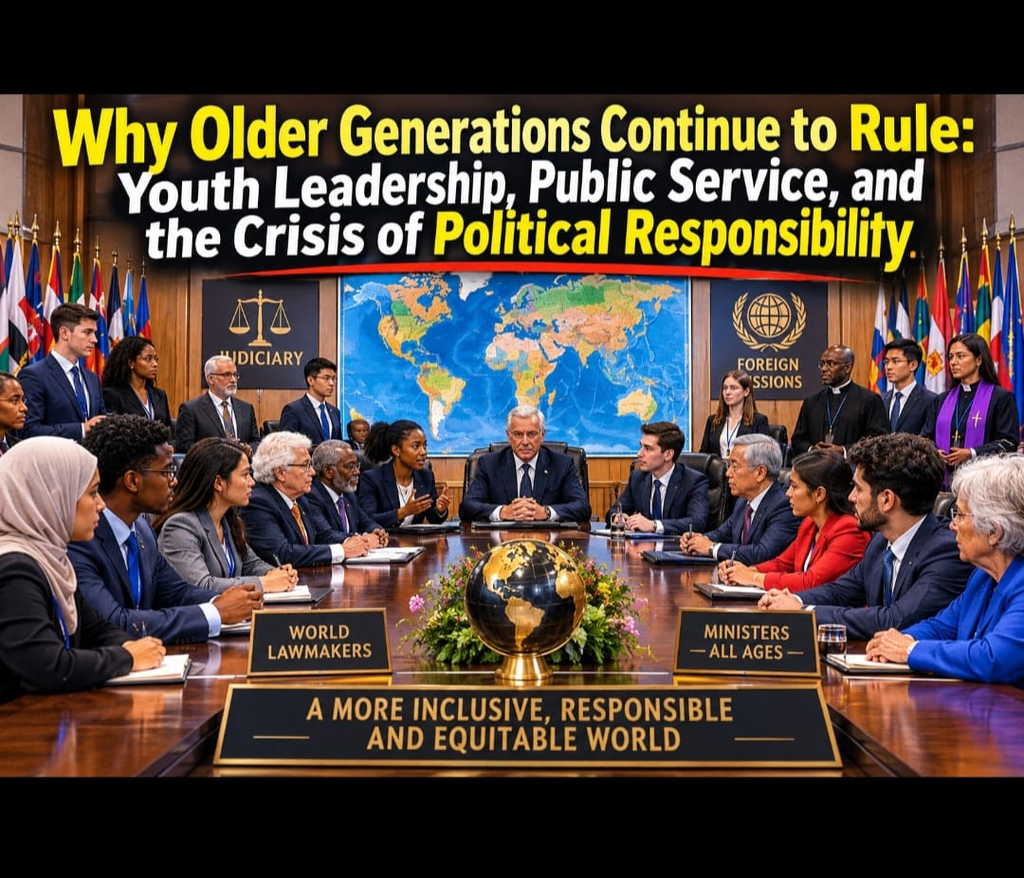
The Right to Lead Must Be Earned: “Older generations continue to rule not always because they refuse to surrender power, but sometimes because those who inherit it fail to demonstrate the wisdom, discipline, integrity, and accountability required to govern. Leadership is not a reward for being young; it is a responsibility that must be earned.”
Across Africa and many other parts of the world, political power remains concentrated in the hands of leaders who were born in the 1930s, 1940s, and 1950s.
In several countries, presidents, cabinet ministers, party leaders, and influential lawmakers have governed for decades, sometimes long after their generation has retired from most other professions.
This reality has frustrated young citizens who believe older leaders do not fully understand modern unemployment, technological change, education, climate challenges, migration, or the cultural expectations of a youthful population.
Since Africa has one of the youngest populations in the world, the continued dominance of older politicians seems especially contradictory.
However, it is too simple to say that older generations remain in power only because they refuse to leave.
Older leaders often hold power because political systems reward experience, wealth, connections, and control over institutions.
At the same time, many young people have not consistently built the discipline, integrity, organization, and public-service mindset necessary to replace them.
Where young leaders have received opportunities, some have indeed repeated the same destructive behavior they condemn in older politicians: corruption, selfish ambition, misuse of public money, abuse of power, and a desire for personal luxury rather than national progress.
The central issue, therefore, is not merely whether leaders are old or young.
It is whether political leadership is understood as service to the people or as a pathway to wealth, fame, and privilege.
The older generation continues to rule in many countries because it possesses institutional control, political experience, financial resources, and networks that younger citizens have not yet effectively challenged.
Yet this should not excuse youth passivity.
Young people must reject corruption, reckless lifestyles, and personality-based politics and replace them with patriotism, competence, accountability, and organized civic action.
Only then can generational change become meaningful, not symbolic.
First, older political leaders remain dominant because they control the structures that let them gain and maintain power.
In many countries, political parties are led by people who have spent decades building loyal networks.
They know regional leaders, business owners, traditional authorities, military figures, religious leaders, and party organizers.
They have access to campaign funds, media platforms, and government institutions.
A young candidate may have popular ideas and strong social media support, but elections are rarely won on online popularity alone.
Elections require party structures, local organization, financial discipline, legal knowledge, trained volunteers, and a clear message that reaches citizens in both cities and rural communities.
Older politicians also benefit from the belief that age automatically means wisdom.
In some societies, respect for elders is an important cultural value.
Respect itself is not a problem; in fact, it can promote humility and social stability.
The problem begins when respect for older people is used to silence younger citizens or prevent them from participating in public affairs.
A country cannot move forward if young people are told to wait quietly for leadership while the same individuals govern indefinitely.
Respect for elders should not mean surrendering the future to them.
Rather, it should mean learning from their experience while insisting that every generation has a right and duty to contribute to national development.
Nevertheless, young people must honestly examine their own weaknesses.
Blaming older leaders for every political failure is not enough.
In many cases, young citizens are highly energetic during election seasons but become disengaged after voting.
Some are easily manipulated by politicians who offer small amounts of money, alcohol, entertainment, or temporary employment in exchange for political loyalty.
Others defend corrupt leaders simply because those leaders belong to the same ethnic group, religion, region, or political party.
This behavior weakens democracy because it turns citizenship into a transaction.
When voters accept short-term rewards instead of demanding long-term policies, they help maintain the same political culture they claim to oppose.
The problem becomes even more serious when young people who enter leadership positions copy the worst habits of the people they replace.
Young ministers, legislators, party officials, activists, and business leaders have begun with promises of change but later become involved in bribery, favoritism, embezzlement, or abuse of office.
Their youth did not protect them from greed.
Their education did not necessarily make them honest.
Their modern language and fashionable appearance did not guarantee moral character.
This demonstrates an important truth: generational change without ethical change is not real change.
A nation does not benefit merely because a 35-year-old replaces a 75-year-old in power; it benefits if the constitution, the rule of law, and the national resources are well managed for the common good of its citizens.
If the younger leader steals public funds, intimidates opponents, rewards friends, neglects people experiencing poverty, and treats government as a private business. The country has gained a younger ruler but not better leadership.
Citizens should therefore avoid the dangerous assumption that every young politician is automatically progressive or every older politician is automatically harmful.
Age matters because leaders must understand the future, but character matters even more.
The question should be: Who has the competence, integrity, vision, and commitment to serve the people?
Corruption is one of the greatest reasons why meaningful youth leadership has struggled to emerge.
Corruption destroys public trust and weakens national development.
When public resources are stolen, schools remain underfunded, hospitals lack equipment, roads deteriorate, jobs disappear, and young people lose hope.
Corruption also creates a culture in which success is measured by the size of a politician’s house, the number of expensive cars they own, or the wealth they display at parties.
In such an environment, public office becomes attractive not because it offers a chance to solve problems but because it offers access to money.
Young people must reject this understanding of politics.
Government should not be viewed as a marketplace for personal enrichment.
It should be viewed as a public trust.
A minister is not a king.
A legislator is not a celebrity.
A president is not the owner of a country.
Public officials are servants whose authority comes from citizens.
This principle must be taught in schools, universities, religious institutions, community organizations, and families.
If young people grow up believing that political power is a shortcut to wealth, they will reproduce the failures of previous generations.
If they grow up believing that political power is an obligation to improve people’s lives, they can transform society.
The discussion of youth responsibility must also include personal discipline.
Young people, like all human beings, have the right to enjoy music, dance, friendship, fashion, social gatherings, and entertainment.
These activities are part of human culture and should not be treated as evil.
However, they become harmful when they promote irresponsibility, exploitation, addiction, violence, disrespect, or the objectification of women and men.
A society that glorifies reckless behavior while ignoring education, work, family responsibility, and civic duty will struggle to produce principled leaders.
The issue is not that young people should never celebrate or enjoy life.
The issue is balance and purpose.
A generation that wants political power must demonstrate that it can manage its own responsibilities.
Leadership requires self-control, emotional maturity, and respect for othersd the ability to make difficult decisions.
A person who cannot resist a bribe, control destructive habits, or respect the dignity of others cannot be trusted with public resources.
Young men in particular must reject forms of masculinity that treat women as trophies, objects, or tools for status.
The degradation of womanhood is incompatible with national development.
No country can claim progress while half of its population is disrespected, marginalized, or denied equal opportunity.
Women must also be included fully in the conversation about youth leadership.
Too often, discussions about political change speak about “young people” while still imagining leadership primarily as the responsibility of young men.
This is a serious mistake.
Young women are among the most active citizens, entrepreneurs, professionals, educators, organizers, and community leaders in many countries.
They understand the daily consequences of poor health care, weak education, unemployment, insecurity, and discrimination.
A genuine generational transformation must create space for young women to lead without harassment, intimidation, or cultural prejudice.
A nation cannot renew its politics by excluding the intelligence and energy of its daughters.
Another reason older generations remain in control is that youth movements are often fragmented.
Young people may agree that they want change, but they disagree about what kind of change they want and how to achieve it.
Some focus only on criticizing leaders online. Others support political parties without questioning those parties’ failures.
Some activists demand reforms but do not participate in local government, community meetings, voter registration, or policy discussions.
Anger alone cannot build a political movement.
Social media posts alone cannot replace institutions.
For young people to take power responsibly, they must move from complaint to organization.
This means joining and reforming political parties, forming issue-based coalitions, supporting credible candidates, monitoring elections, studying public policy, attending local meetings, and holding leaders accountable after elections.
It also means building leadership skills long before seeking high office.
Young people can begin by serving in respectful student unions/associations/organizatios, well-culturaled professional groups, local charities, cooperatives, well-informed neighborhood organizations, and civic movements.
Leadership is learned through practice.
Those who cannot organize a small community project without being corrupt may struggle to manage a ministry or a nation.
Education is also essential.
Young people should understand not only political slogans but also the practical realities of governance.
They should study budgets, laws, public administration, economics, health policy, agriculture, technology, and international relations.
A leader who promises jobs must understand how jobs are created.
A leader who promises free education must know how it will be funded.
A leader who promises to fight corruption must understand judicial independence, procurement systems, auditing, and transparency laws.
Patriotic speeches may inspire people, but competent policies change their lives.
National patriotism must therefore become more than waving flags or repeating slogans.
True patriotism means protecting public resources, paying attention to the needs of vulnerable people, respecting national institutions, and refusing to support wrongdoing simply because it benefits one’s group.
It means asking what is good for the country, not only what is beneficial for oneself, one’s family, or one’s ethnic community.
It means refusing to celebrate a thief because the thief is from one’s village or political party.
It means caring about the child who cannot attend school, the patient who cannot afford treatment, the farmer whose crops cannot reach the market, and the graduate who cannot find work.
Older leaders should also recognize that they have a responsibility to prepare the next generation.
It is unfair for established politicians to complain that young people lack experience while refusing to give them meaningful opportunities to gain experience.
Mentorship, transparent party primaries, youth representation, leadership training, and fair access to public institutions are necessary.
The older generation should not treat youth as campaign tools who sing, dance, post slogans online, and fill rallies, only to be ignored when decisions are made.
Young people deserve a seat at the table, not merely a place in the crowd.
At the same time, young leaders must earn public confidence through conduct.
They must show that they are different not only in age but also in values.
They should disclose campaign funding, reject vote-buying, respect opposing views, include women and marginalized communities, and accept criticism.
They should avoid the temptation to become social-media celebrities whose popularity is based on insults, drama, and empty promises.
The future belongs not to the loudest young politician but to the most responsible one.
The continued rule of older generations in Africa and other regions cannot be explained by one factor alone.
Older leaders remain powerful because they control political systems, resources, and networks, but youth leadership has also been weakened by corruption, disorganization, poor civic engagement,rudeness,and the mistaken belief that power is mainly a route to personal wealth.
The solution is not to replace every older leader simply because of age.
The solution is to create a new political culture in which leadership is defined by service, competence, accountability, discipline, and patriotism.
Young people must step up to the plate, but stepping up means more than demanding positions.
It means preparing for responsibility.
It means rejecting corruption, refusing exploitation, respecting the dignity of women, pursuing education, organizing communities, and putting the nation above personal pleasure or private gain.
When young citizens understand government as a sacred duty to serve rather than an opportunity to make money, they will become capable of leading their countries into a more just, prosperous, and democratic future.
Support Independent Journalism
Your support helps FrontPage Africa continue delivering independent, credible, and impactful journalism. Every contribution strengthens our ability to investigate, inform, and hold power accountable while keeping quality journalism accessible to our readers.
Support our journalism or subscribe to receive the latest FrontPage Africa stories and updates.