The Liberian National Flag: Freedom, Sovereignty, and Patriotism: “The flag is a symbol of our sovereignty, independence, national pride, and dignity; its eleven stripes remind us of the eleven signatories of our Declaration of Independence.” — Original civic interpretation based on the Liberian Ministry of Foreign Affairs’ official description of the national flag.
Message: Every Liberian must protect the freedom, dignity, and sovereignty represented by the Lone Star and the eleven stripes.
By: Austi,n S Fallah – A True Son of the Planet Earth Soil:[email protected]
The Liberian National Seal — Liberty, Peace, and the Dignity of Labor: “THE LOVE OF LIBERTY BROUGHT(MET THE OWNERS OF THE LAND, THE INDIGENOUS HERE) US HERE.” — Inscription on the National Seal of the Republic of Liberia.
Message: Liberty must mean more than independence. It must mean justice, peace, productive labor, opportunity, and the responsibility to build a nation in which every citizen can prosper.
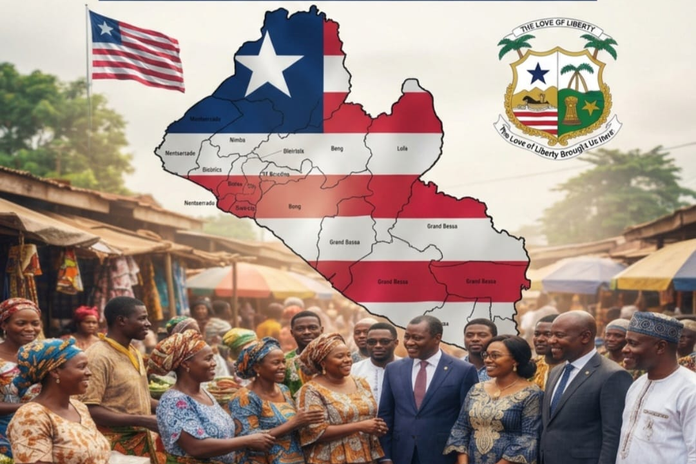
The Map of Liberia — National Unity and Equal Development: “Fifteen counties, one Republic, one people, and one shared responsibility: to ensure that development reaches every community, from the capital to the most remote rural village.” — Original civic quotation inspired by Liberia’s fifteen-county administrative structure.
Message: No county should be forgotten, no community abandoned, and no citizen excluded from national
development.
President Joseph Nyuma Boakai — Rule of Law and National Responsibility: “We must restore respect for the rule of law, and respect for officers of the law across our three branches of government.”
— President Joseph Nyuma Boakai, Inaugural Address, January 22, 2024.
Message: The rule of law must be the foundation of responsible leadership, institutional integrity, and national development.
Former President Ellen Johnson Sirleaf — Development and Transformation: “We are bound to face criticism as we attempt to apply and respect the rule of law, as we challenge entrenched social habits, but we must change old mindsets and attitudes, and we remain strong in this resolve, for it is the right thing to do.” — President Ellen Johnson Sirleaf, Address to the 68th United Nations General Assembly, September 24, 2013.
Message: Liberia cannot achieve meaningful development without institutional reform, accountability, and the courage to challenge practices that obstruct progress.
Former President George Manneh Weah — Democracy and Constitutional Governance: “This Inaugural gathering also celebrates an important precedent: that we Liberians can, and will, rely on established institutions and the rule of law to resolve our political disagreements.” — President George Manneh Weah, Inaugural Address, January 22, 2018.
Message: Democracy requires strong institutions, respect for the constitution, peaceful political competition, and a commitment to national unity.
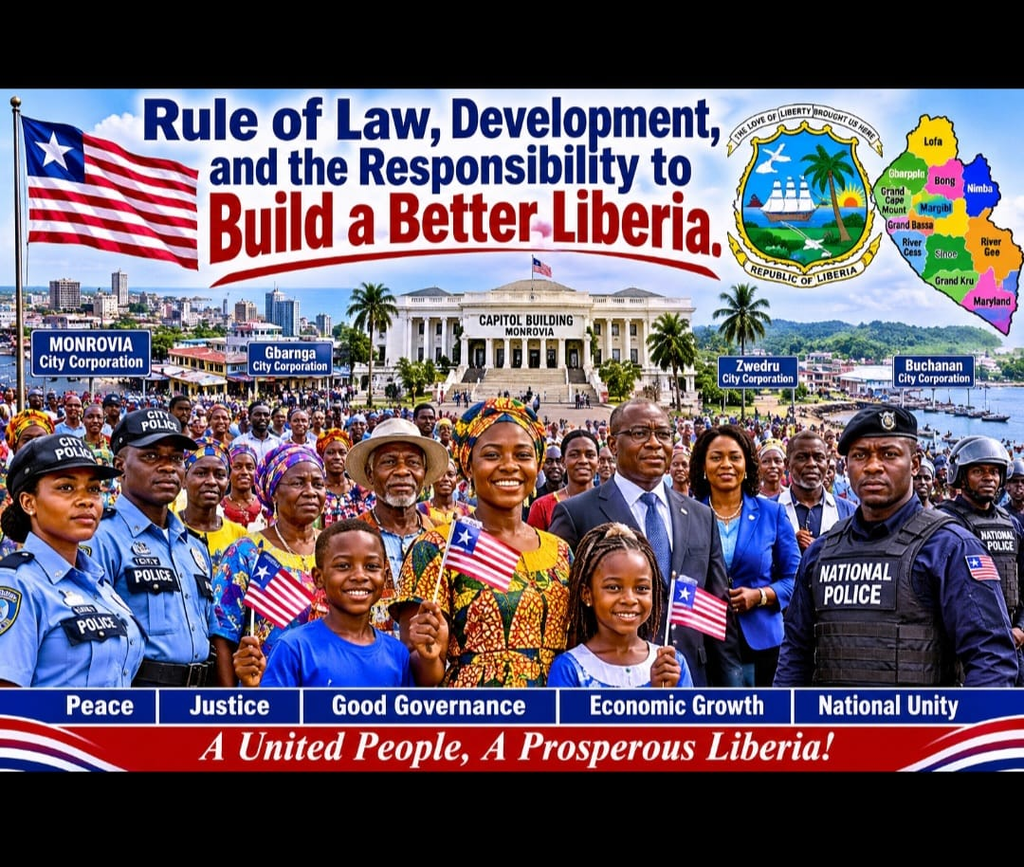
Hon. Edward Wesee: “Liberia’s future cannot be secured by political slogans alone. It requires leaders who respect the rule of law, policymakers who understand development, institutions that protect democracy, and citizens who accept the responsibility to build a better Liberia. From the national capital to all fifteen counties, our freedom must translate into justice, opportunity, and meaningful ,transformation for every Liberian.”
Liberia’s future depends not onlythe promises political lforers make but also on the willingness of citizens, institutions, and communities to support practical measures that improve daily life.
In a natilow-income familiesmiliesmiliesmiliesmiliesmiliesndured civil conflict, economic hardship, institutional weakness, and persistent poverty, development cannot be reduced to speeches, slogans, or social media arguments.
It must be reflected in roads that connect communities, schools that educate children effectively, public spaces that are clean and safe, markets that operate fairly, and laws that are applied consistently.
Enforcing laws and city ordinances should therefore not be viewed automatically as anti-people or anti-poor.
When enforcement is lawful, fair, transparent, and humane, it is one of the most important ways a government can protect its people’s well-being and uphold Liberia’s Constitution.
The Constitution exists not merely as a document to be quoted during political debates.
It is the foundation of national order, rights, responsibilities, and governance.
It protects citizens from state abuse, but it also establishes the principle that no individual is above the law.
A democratic society cannot function where laws are treated as optional, public authority is disregarded, and every attempt at regulation is portrayed as oppression.
Respect for constitutional government means recognizing both rights and obligations.
Citizens have the right to speak, organize, work, worship, and seek justice.
At the same time, they must respect others’ rights, comply with lawful regulations, protect public property, and contribute to social order.
This balance is especially important in cities.
A city is a shared space.
Roads, sidewalks, drainage systems, markets, schools, parks, public buildings, and transportation routes serve millions of people with different needs and interests.
When city ordinances are ignored, the consequences are felt most severely by ordinary citizens.
Street vending may block major roads and sidewalks, causing congestion and accidents.
Improper waste disposal can clog drainage systems, worsen flooding, contaminate water, and spread disease.
Illegal construction can weaken urban planning, create unsafe buildings, and obstruct access to public facilities.
Reckless driving, noise pollution, unregulated businesses, and the destruction of public property all undermine the quality of life for everyone.
The idea that enforcing laws is automatically anti-people often comes from a misunderstanding of what public order is meant to achieve.
The population must receive daily, weekly, or monthly education on radio stations, in different dialects, about the importance of city ordinances and the rule of law.
This will help inform the people on their responsibilities as citizens, their health, and the beauty of their cities and the nation.
The purpose of sound law enforcement is not to humiliate poor people or punish citizens for being economically vulnerable.
Its purpose is to create conditions in which all people, including people with low incomes, can live with greater dignity, safety, and opportunity.
A market woman needs clean streets, safe transportation, working drainage, and protection from criminals.
A student needs a peaceful learning environment, reliable roads, and schools that maintain standards.
A small business owner needs predictable regulations and fair competition.
A family needs access to health services, sanitation, and a community where public rules are respected.
These are not elite concerns.
They are basic conditions of human development.
However, support for enforcement must never mean support for cruelty, corruption, or selective justice.
The government must enforce laws in a manner consistent with constitutional rights and human dignity.
A police officer who extorts money from a struggling vendor is not serving the rule of law.
A government official who applies regulations only against political opponents is not advancing development.
A city authority that destroys people’s livelihoods without notice, consultation, relocation plans, or alternative arrangements is not demonstrating responsible governance.
Law enforcement becomes legitimate when it is predictable, impartial, and guided by public interest rather than political favoritism or personal gain.
For this reason, Liberia needs both stronger enforcement and more humane public policy.
If a city govet must remove unlawful structuthroughoadway, it should first communicate clearly with affected residents and business owners.
It should explain the legal basis for the action, provide reasonable notice, and, where possible, identify safer or more appropriate places for commercial activity.
If street vending causes dangerous congestion, the answer should not always be to chase vendors from one place to another.
Government should also work to establish organized markets, affordable stalls, sanitation facilities, storage spaces, and transportation access.
Enforcement without planning can create hardship; planning without enforcement can create disorder.
Sustainable development requires both.
Liberia cannot afford to lag in the 21st century, given the speed of its road development and other infrastructure improvements.
Countries worldwide compete for investment, technological advancement, educational opportunities, and regional influence.
A nation that cannot maintain clean cities, functional roads, effective schools, reliable public institutions, and lawful commercial practices will struggle to attract investors and create jobs.
Development is not simply about constructing buildings or making announcements.
It is about building systems that work.
It is about ensuring that roads are maintained after they are paved, schools are staffed after they are built, laws are followed after they are passed, and public funds are accounted for after they are allocated.
Road infrastructure offers a clear example.
Good roads are more than symbols of government activity.
They connect farmers to markets, students to schools, patients to hospitals, and workers to employment opportunities.
Poor roads increase transportation costs, delay emergency services, discourage business investment, and isolate rural communities.
When roads are damaged by unregulated construction, illegal parking, overloaded vehicles, or poor waste management, everyone suffers.
A government that invests in road construction and maintenance should be supported, but citizenss must also understand their responsibility to protect public infrastructure.
It makes little sense to demand development while tolerating behavior that destroys the very infrastructure the nation needs.
The same principle applies to education. Liberia’s young people deserve an educational system that prepares them for modern economic life.
This requires more than school enrollment.
It requires qualified teachers, strong academic standards, safe facilities, updated curricula, proper supervision, and serious student effort.
A country cannot compete globally if education is treated as an afterthought or if political arguments replace meaningful reforms.
Liberians should respectfully demand investments in teacher training, science and technology education, vocational programs, libraries, digital access, and accountability in school administration.
Parents, teachers, students, communities, and government officials all have a role to play.
Educational progress also requires honesty.
It is not enough to say that education is a right while ignoring the conditions that prevent children from learning.
A child who attends school hungry, walks long distances on unsafe roads, studies in overcrowded classrooms, or lacks books and qualified teachers is not receiving the full benefit of that right.
Many of us who were born or schooled in concession areas particularly my hometown of birth, Bong Mines can attest that we were fed daily at every recess period at school.
Even though there was segregation, but that is another article for another day.
Social justice must be connected to practical improvements.
It must ask whether policies are actually improving the lives of poor families, rural communities, women, young people, persons with disabilities, and those historically excluded from opportunity.
Justice is not achieved by repeating popular language; it is achieved through institutions and policies that expand real access to education, health care, employment, and security.
Economic empowerment must also be at the center of Liberia’s development agenda.
Poverty cannot be defeated by political slogans.
It is defeated through productive work, access to capital, fair markets, skills development, infrastructure, agricultural investment, and responsible public administration.
The Liberian government should support small businesses, farmers, artisans, women entrepreneurs, and young innovators.
It should reduce unnecessary bureaucratic obstacles while maintaining standards that protect consumers, workers, and the environment.
It should promote transparency in public procurement and ensure that national resources benefit the broader population rather than a small group of politically connected individuals.
At the same time, citizens should be careful about the kind of political leadership they choose to support.
In the age of social media, it is easy for individuals to gain attention by making inflammatory statements, spreading misinformation, attacking opponents, or presenting themselves as champions of the people without offering workable solutions.
Social media can be a valuable tool for civic engagement, public education, and accountability.
It can give ordinary Liberians a platform to raise concerns that powerful institutions might otherwise ignore.
But it can also become a space where falsehoods spread rapidly and where anger is mistaken for leadership.
Liberians should not follow political voices merely because they are loud, entertaining, or insulting.
A serious political leader should be evaluated by evidence: What has the person built?
What policies has the person proposed?
Has the person helped create jobs, improve schools, support health care, defend constitutional rights, or strengthen public institutions?
Does the person encourage peace and national unity, or does the person profit from division and resentment?
Does the person offer facts and solutions, or only accusations and slogans?
A nation cannot develop if its political culture rewards those who do nothing but mislead the public.
Empty rhetoric may generate applause, online followers, and temporary popularity, but it cannot pay school fees, create employment, improve hospitals, or construct roads.
It cannot stop flooding, strengthen the justice system, or provide electricity to communities.
Citizens must demand more than speeches.
They must ask leaders to present budgets, plans, timelines, and measurable results.
They must support leaders who are willing to make difficult but necessary decisions, even when those decisions are not immediately popular.
This does not mean that citizens should accept every government action without criticism.
Democratic progress requires criticism, protest, journalism, and civic participation.
Governments must be held accountable when they waste public resources, violate rights, neglect communities, or fail to deliver promised services.
But criticism should be informed and constructive.
It should aim to correct failures, not merely to create chaos.
There is a difference between holding leaders accountable and rejecting every effort to govern.
There is a difference between defending the poor and encouraging lawlessness.
There is a difference between demanding justice and seeking revenge.
The call to seek justice rather than revenge is especially important for Liberia.
The country’s history includes wounds that cannot be ignored.
Many people have suffered from violence, corruption, exclusion, and economic hardship.
Those experiences understandably produce anger and distrust.
Yet a society cannot heal if every disagreement becomes an opportunity for retaliation.
Revenge divides communities and keeps citizens trapped in old conflicts.
Justice, by contrast, seeks truth, accountability, fairness, and restoration.
Justice requires that wrongdoing be addressed through lawful institutions.
It requires that victims be heard and that offenders be held responsible according to due process.
It does not permit collective punishment, mob action, political persecution, or the abuse of power.
Liberia’s progress will depend on whether the country can replace a culture of personality-based politics with a culture of institutions.
Strong institutions are more important than powerful individuals.
Courts must be independent. Police and security agencies must be professional.
Schools must maintain standards.
Municipal authorities must enforce ordinances fairly.
Public officials must be accountable for public funds.
Elections must be credible. The media must be free but responsible.
Citizens must be active but law-abiding.
When institutions function, people do not have to depend on the goodwill of a single politician or the influence of a particular group.
Ultimately, development is a shared national responsibility.
Government must lead with integrity, competence, and compassion.
Citizens must obey lawful rules, reject misinformation, protect public property, and participate in democratic life.
Community leaders must promote peace and cooperation.
Young people must pursue education and skills rather than being manipulated by those who benefit from disorder.
Political leaders must stop treating citizens as crowds to be excited and begin treating them as people to be served.
Liberia deserves clean and safe cities, quality schools, better roads, economic opportunity, accountable leadership, and respect for the Constitution.
These goals will not be achieved through empty slogans or endless conflict.
They require discipline, honest debate, fair law enforcement, thoughtful policy, and a collective commitment to the common good.
Supporting development does not mean abandoning human rights, and enforcing laws does not mean opposing the people.
Properly understood, the rule of law is one of the strongest protections the people can have.
It creates the order in which freedom, opportunity, justice, and national progress can grow.
Support Independent Journalism
Your support helps FrontPage Africa continue delivering independent, credible, and impactful journalism. Every contribution strengthens our ability to investigate, inform, and hold power accountable while keeping quality journalism accessible to our readers.
Support our journalism or subscribe to receive the latest FrontPage Africa stories and updates.