Monrovia – When Liberia agreed in August to take in up to 1,200 people deported from the United States, people who are not Liberian and, in most cases, have never set foot in Africa, the government in Monrovia described the arrangement as an act of hospitality. Information Minister Jerolinmek Piah said the arrivals would be received as “guests.”
By Rodney D. Sieh
In Washington, at least one senator wants to know what kind of welcome they are actually getting.
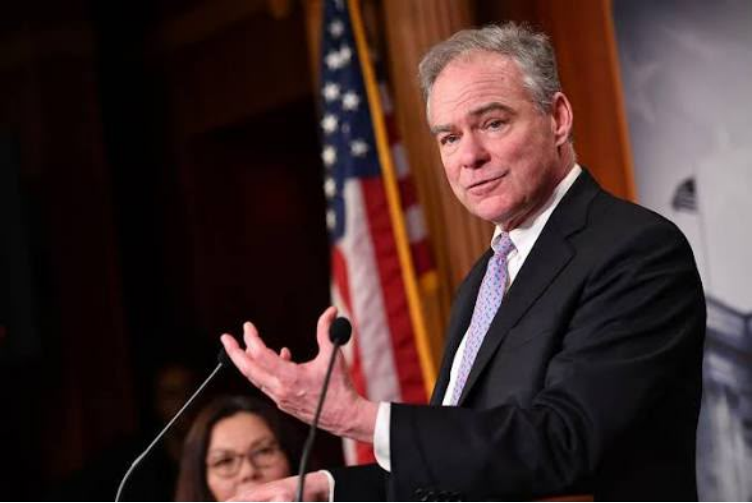
On September 23, U.S. Senator Tim Kaine, a Virginia Democrat on the Senate Foreign Relations Committee, filed Senate Resolution 886. It asks the U.S. Secretary of State to give Congress, within 30 days of the resolution’s adoption, a formal statement on Liberia’s human rights practices. The measure was referred to the Foreign Relations Committee, and Liberia is now among a growing list of countries whose role in President Donald Trump’s “third-country” deportation programme has drawn this kind of congressional scrutiny.
What the resolution demands
The two-page resolution has no preamble and no accusations. It is a list of questions, and the questions reveal what U.S. lawmakers suspect.
It asks the State Department for all credible information on alleged abuses by the Government of Liberia: arbitrary arrest and detention, torture, denial of due process, enforced disappearances, extrajudicial killings, and human trafficking or forced labour. It asks specifically about how non-citizens removed to Liberia by the U.S. are treated.
It goes further. Washington would have to disclose:
• whether U.S. security assistance could end up supporting abusive practices;
• conditions in the places where deportees are held;
• every agreement and financial transaction between the two governments relating to removals;
• information on everyone sent to Liberia in 2025 and 2026;
• what assurances on their treatment the U.S. sought or received;
• a summary of meetings between Liberian officials and Washington-based U.S. officials over the same two years.
The legal tool is Section 502B(c) of the Foreign Assistance Act of 1961, a Cold War-era law. It lets Congress, through a simple resolution, demand a human rights report on any country. The penalty is what gives it force: if the State Department misses the 30-day deadline, U.S. security assistance to that country is frozen until the report is delivered. The resolution is also privileged, which means its sponsor can force a floor vote even if Senate leaders would prefer to avoid one.
One of the largest deals of its kind
The Liberia arrangement stands out even within an aggressive global programme. Rights monitors count at least 35 countries that have signed third-country deportation agreements with the Trump administration. By their count, about 22,000 people had been sent to 26 countries other than their own by early August, and Liberia’s deal is the largest by number.
The two governments reached a six-page agreement in September 2025. It became public in March 2026 and does not say how many people Liberia would take or from which countries. The figure of 1,200 surfaced only in August, when Monrovia announced it days before the first flight landed.
The arrival on August 20 at Roberts International Airport did not go smoothly. Several of the 20 deportees, mostly Latin Americans including Cubans and Venezuelans, refused to leave the plane. U.S. agents restrained some of them. Six were later flown on to Equatorial Guinea, a fourth country none of them came from. It was the first reported case of deportees refusing to disembark in a third country and being moved on to another.
Money and the ‘no compensation’ claim
Section 1(b)(3) of the resolution seeks disclosure of every financial transaction linked to removals, and this is where Monrovia is most exposed.
The Liberian government has said repeatedly that it neither demanded nor received any compensation for accepting deportees. Yet the U.S. awarded Liberia US$5 million this year for “migration management,” and The New York Times, citing federal data, reported that US$7.5 million was wired to the country. Liberian officials have said accommodation, food and onward travel would be paid for by Washington and an international partner organisation.

Monrovia may well argue that support for running the programme is not the same as payment for agreeing to it. But a State Department report delivered under oath-like statutory obligations would put the exact figures on the public record, in Washington, for the first time.
The constitutional question at home
The Senate resolution also lands on a dispute inside Liberia that has not been settled. Article 34(f) of Liberia’s Constitution gives the Legislature the power to approve treaties and “other international agreements.” Critics, among them Nimba County Senator Samuel Kogar and the Liberian scholar Robtel Neajai Pailey, argue that the deportation deal never came before either House and is therefore unconstitutional. Kogar asked publicly whether the arrangement had been brought before both Houses of the Legislature.
If the State Department is compelled to produce a full list of agreements with Monrovia, Liberian lawmakers would be handed, from a foreign capital, documents their own executive has not formally submitted to them.
Why Liberia, and why it matters
For a global readership, the context matters. Liberia was founded in the 19th century by freed Black Americans and has been one of Washington’s closest partners in Africa. In court filings during the 2025 attempt to deport Salvadoran Kilmar Abrego Garcia to Liberia, the U.S. Department of Homeland Security described Liberia as “a thriving democracy” and said its constitution provides strong human rights protections. Abrego Garcia’s mistaken deportation had made him a symbol of the immigration crackdown.
Resolution 886 would test that description against the State Department’s own evidence. That is awkward for both governments. Washington’s annual human rights reports on Liberia have in past years documented harsh prison conditions, lengthy pre-trial detention and weak courts, the same conditions deportees could face if they are held or charged.
Will it pass?
Probably not, at least not soon. Kaine filed Resolution 886 alongside 14 other new 502B resolutions covering countries from Belize to El Salvador, following earlier ones on Ghana, Eswatini, Rwanda, South Sudan and others. Previous attempts to force them through have failed on largely party-line votes. In May 2025, the Senate rejected a motion to discharge his El Salvador resolution 45–50, and in June 2026, a similar motion on Honduras failed. Republicans have dismissed the efforts as political theatre.
Even so, the resolutions keep the deals in the news, set out on the record what Congress wants to know, and could matter if the balance of power in Washington changes. Kaine’s office says the administration has pledged at least US$410 million to build its network of deportation partners.
The bottom line
Resolution 886 is unlikely to stop a single deportation flight to Liberia. It does make the arrangement harder for either government to keep quiet. The questions it asks (who was sent, what was paid, what was promised, and where the deportees are now) are the questions Liberians have been asking since August. The Boakai administration can answer them now, in Monrovia, or wait for the answers to come out in Washington.
Support Independent Journalism
Your support helps FrontPage Africa continue delivering independent, credible, and impactful journalism. Every contribution strengthens our ability to investigate, inform, and hold power accountable while keeping quality journalism accessible to our readers.
Support our journalism or subscribe to receive the latest FrontPage Africa stories and updates.