
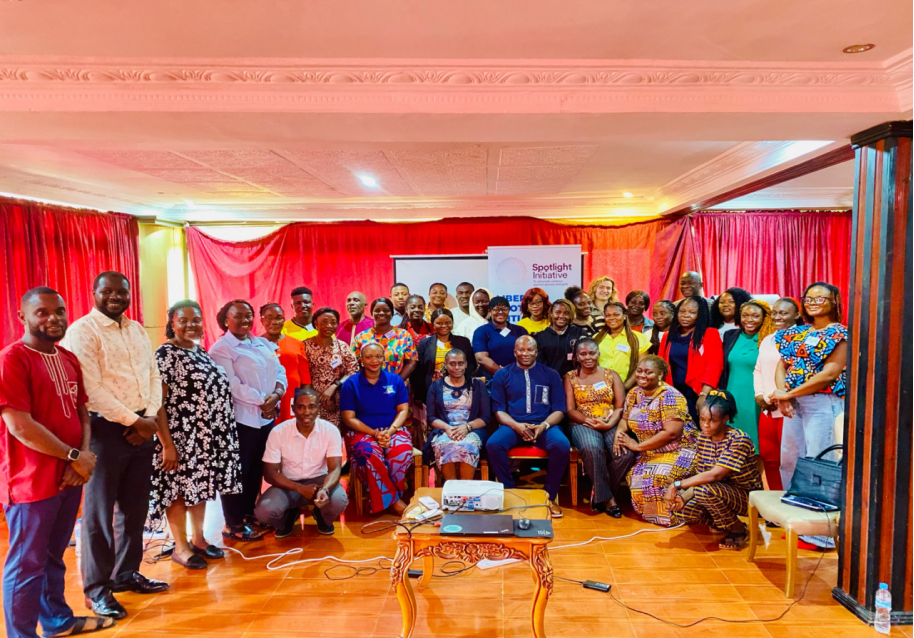
MONROVIA — Medica Liberia has commenced a nine-day SASA! Together Set-Up and Start Phase Training of Trainers in Montserrado County, bringing together government representatives, civil society organizations, community actors, media practitioners and grassroots groups to strengthen efforts to prevent violence against women and girls and promote gender equality.
By Patience M. Jones
The training is being implemented under the Liberia Spotlight Initiative 2.0, funded by the European Union to the Government of Liberia through UN Women. It seeks to build a pool of skilled facilitators who will support the rollout of the SASA! Together approach across the initiative’s eight target counties.
The Montserrado training brings together participants from Montserrado, Grand Bassa and Grand Cape Mount Counties as the first geographical cluster of the national training process.
SASA! Together, which stands for Start, Awareness, Support and Action, is a community-driven approach that addresses violence against women and girls by examining power, gender inequality and harmful social norms while encouraging individuals and communities to use their influence to support positive change.
The training focuses on the Set-Up and Start phases, preparing participants to facilitate community dialogue, build partnerships, engage community stakeholders and support the identification and mentoring of Community Activists.
Participants include county gender and SGBV focal persons, community mobilizers, media practitioners, traditional and community leaders, and representatives of civil society organizations, including Helping Our People Excel (HOPE), Youth Crime Watch Liberia, Rising Youth Mentorship Initiative (RYMI) and the National Coalition Against Harmful Practices (NACAHP), among others.
Medica Liberia Calls for Community-Level Impact
Speaking at the opening, Cllr. Yah V. Parwon, Country Director of Medica Liberia, described the training as an important foundation for strengthening stakeholders’ capacity to implement the SASA! Together approach in communities.
She acknowledged the European Union’s support to Spotlight Initiative 2.0 and emphasized that the success of the intervention should be measured by tangible changes in communities rather than simply completing training activities.
“Our purpose is not fulfilled when we complete the agenda, receive a certificate and submit our reports. Those are the steps along the way. Our purpose is to help build communities where women and girls can live safely, exercise their rights and participate in decisions that affect their lives.”
Cllr. Parwon stressed that SASA! Together is a sustained community mobilization approach rather than a one-time awareness campaign, requiring continued engagement with individuals, community leaders and institutions.
She disclosed that 72 participants from the eight Spotlight target counties are expected to benefit from the training, which is being conducted in two geographical clusters.
The first cluster is being held in Montserrado, while the second is expected to take place in Bong County, bringing together participants from Bong, Lofa, Nimba, Grand Gedeh and Maryland Counties.
UN Women Highlights Social Norms
Dhogba G. Mabande, Programme Analyst at UN Women Liberia, said the training is designed to address harmful social norms, promote behavior change and advance positive masculinity as part of broader efforts to prevent sexual and gender-based violence.
He described SASA! Together as a key methodology under the prevention and social norms component of Spotlight Initiative 2.0.
Mabande also referenced work conducted under Spotlight Initiative 1.0, including the development of a comprehensive prevention strategy and action plan, and encouraged participants to use the strategy alongside SASA! Together.
He urged participants to remain actively engaged throughout the nine-day training, noting that they will be responsible for rolling out the approach in their respective communities.
Gender Ministry Backs Community Engagement
Edward E. Gboe, Spotlight Coordinator at the Ministry of Gender, Children and Social Protection, speaking on behalf of the Ministry’s leadership, said the government recognizes the importance of engaging local communities in development and response mechanisms.
He commended Medica Liberia for investing in the training and partnering with the Government of Liberia and UN agencies under Spotlight Initiative 2.0.
Gboe said communities should not only be viewed as beneficiaries but should also be involved as stakeholders in decision-making and in sustaining development results.
He said the SASA methodology was particularly important because of its focus on community engagement and practical implementation.
CSOs Commit to Community-Level Change
Lisa Tenneh Diasay, President of the Female Journalists Association of Liberia (FeJAL), pledged the association’s support to Medica Liberia, particularly in documenting and telling impact stories emerging from communities.
Diasay said SASA! Together is already taking root in some Liberian communities and urged participants to ensure that knowledge gained during the training translates into tangible results.
“FeJAL stands ready to support Medica Liberia, especially in telling the impact stories that your work in the community looks forward to, because we want to make sure that Spotlight 2.0 can have the change that it desires.”
Meanwhile, Marian G. Deah, National Administrator of NACAHP, said her organization had participated in SASA-related training in 2018 but did not complete the process.
She said the current training provides an opportunity for NACAHP to strengthen its work on harmful practices and social norms and integrate SASA! Together into its community interventions.
For Shamella E. Matthews, Executive Director of RYMI, the training is particularly relevant to the organization’s work with young people.
She said RYMI plans to apply the approach through its school clubs and mentorship programs, particularly in promoting behavior change among young people.
Alfreda Foboi Nmah, Executive Director of HOPE, also welcomed the opportunity to participate, recalling that the organization was part of a SASA-related training in 2018–2019 that was not completed.
Nmah said the approach is relevant to HOPE’s livelihood programs and would help the organization engage beneficiaries on broader social and community issues.
Training to Produce County-Specific Action Plans
The training includes interactive discussions, reflection exercises, case studies, role plays, storytelling, simulations, group work, peer learning and practical facilitation sessions.
The activities are designed to equip participants with practical skills to engage communities on issues relating to power, gender equality, violence, healthy relationships and social norms.
At the end of the training, participants are expected to develop county-specific action plans outlining stakeholder engagement, community entry processes, partnership-building, recruitment of Community Activists, key milestones and timelines for initiating SASA! Together Start Phase activities.
The plans are expected to guide the transition from training to practical community-level action.
The Ministry of Gender, Children and Social Protection and County Gender Coordinators are key government collaborators, providing strategic guidance and supporting alignment with national priorities on gender equality, GBV prevention and women’s empowerment.
The Montserrado training is the first of two geographical training clusters under the activity. The second cluster will be held in Bong County later in September and early October.
Across both clusters, the activity is expected to train participants from all eight target counties and strengthen their readiness to lead community dialogues, awareness activities and mobilization efforts.
Following the training, Medica Liberia will provide ongoing mentorship, supportive supervision, coaching and technical support as trained participants begin community entry and other Start Phase activities.
Regular follow-up, peer learning, field monitoring and experience-sharing are expected to support quality and consistency as SASA! Together moves from the training room into communities.
Support Independent Journalism
Your support helps FrontPage Africa continue delivering independent, credible, and impactful journalism. Every contribution strengthens our ability to investigate, inform, and hold power accountable while keeping quality journalism accessible to our readers.
Support our journalism or subscribe to receive the latest FrontPage Africa stories and updates.