
MONROVIA — George Manneh Weah’s return to Liberia was always likely to carry political significance. But his first major intervention after months abroad has revealed something more consequential than the former president’s homecoming: he appears ready to re-enter the country’s political conversation at a moment when one of his closest political allies, former Vice President Jewel Howard Taylor, is facing serious criminal charges and detention.
By Selma Lomax, [email protected]
For Weah, the Howard Taylor case is no longer simply a legal matter involving a former member of his administration. It has become a test of how far he is willing to go for a political partner he has repeatedly treated as family, and whom he now publicly calls his “sister.”
Standing before reporters and supporters at his Rehab residence in Monrovia following his return from abroad, Weah delivered an unusually forceful denunciation of the government’s handling of Taylor’s case.
He described the charges as “bogus and unacceptable,” accused authorities of tampering with the rule of law and warned that Liberia cannot afford a justice system that appears selective. “What’s happening to the former Vice President is wrong. The rule of law is being tampered with,” Weah said.
The language was unmistakably political. But it also exposed the difficult position in which the former president now finds himself. Taylor is not merely a former vice president. She was Weah’s constitutional partner throughout his presidency from 2018 to 2024, serving beside him through the triumphs, controversies and political battles that defined his administration.
Now she is facing allegations connected to Liberia’s investigation into a major cocaine seizure, including drug trafficking and money laundering charges that she has denied.
Weah’s decision to publicly challenge those proceedings places him in a potentially delicate confrontation with the administration of President Joseph Nyuma Boakai.
His remarks suggest that his answer may extend beyond visiting Taylor in detention or issuing public statements of solidarity. “I intend to visit her,” Weah said, making clear that he wants to personally empathize with his former vice president. But the former president also linked Taylor’s situation to what he sees as a broader threat to Liberia’s democratic order.
By placing the Taylor prosecution inside a larger argument about the rule of law, Weah is attempting to transform what could otherwise remain an individual criminal case into a national political debate about justice, democracy and the conduct of government.
His argument is that Liberia cannot afford a justice system in which political identity determines who is prosecuted and who is protected. “We need to be honest with the law,” he said. “We have to be fair.”
If Weah’s position is interpreted as opposition to the prosecution simply because Taylor served in his administration, his democratic argument could lose force. But if he succeeds in separating his demand for due process from the question of Taylor’s guilt or innocence, he could establish a broader political argument capable of resonating beyond the Coalition for Democratic Change.
Weah and Taylor entered Liberia’s highest political office together after the 2017 elections, forming one of the country’s most consequential political partnerships in recent history. Whatever disagreements may have emerged during or after their administration, Taylor remained closely associated with the Weah presidency.
Now, with Taylor facing prosecution, Weah’s public defense can be viewed as a measure of political loyalty. The former president’s return comes at a particularly sensitive moment because his political influence remains significant within the opposition community.
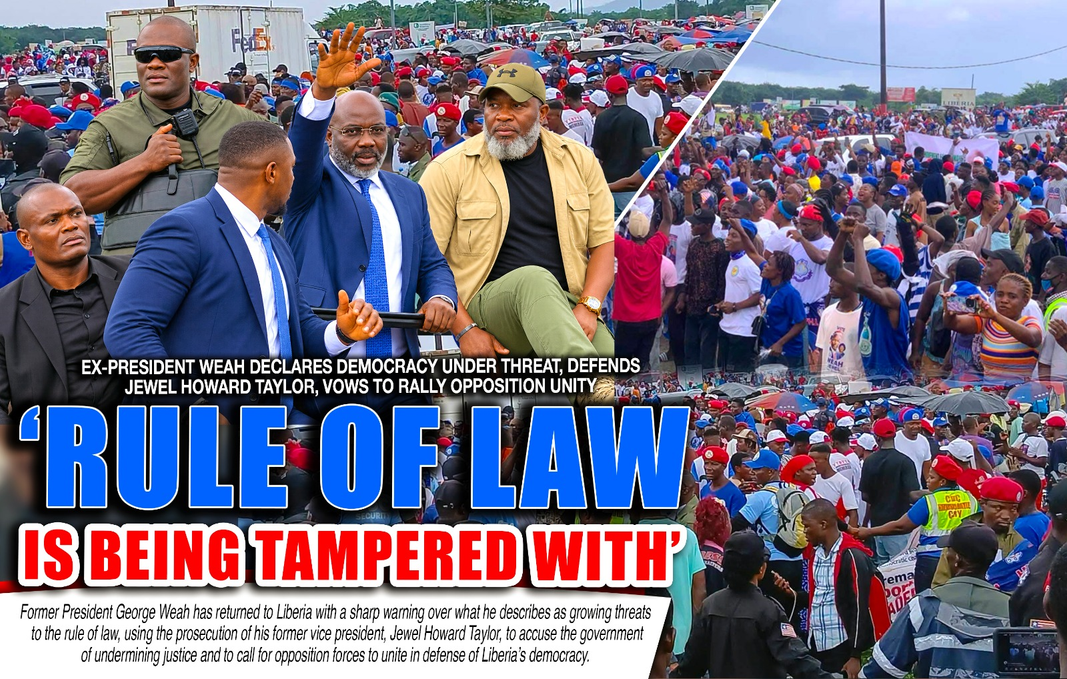
The reception he received at Roberts International Airport was, in itself, a political statement. Supporters turned out in large numbers to welcome him home, giving Weah an opportunity to demonstrate that his political base has not disappeared despite his absence from Liberia. He interpreted the reception as evidence of the continuing strength of the opposition. “The strength of our opposition political parties,” he said, referring to the supporters who came to receive him.
Beyond defending Taylor, the former president used his return to call for a broader opposition gathering. He wants opposition actors to sit around a table, listen to one another and develop a common approach to what he describes as threats to Liberia’s democracy. “The voice of the people, the opposition, we need to listen to each other and find a way to move forward,” he said.
Liberia’s opposition has often been stronger in numbers than in cohesion. Political parties and personalities have historically competed for influence, sometimes making it difficult to construct a sustained opposition coalition outside election cycles.
Weah now appears to be arguing that the moment requires something different. He wants the opposition to organize around democratic principles rather than simply around the next presidential election.
Weah remains the most prominent figure associated with the CDC, but his effort to rally a wider opposition community will require him to work with politicians whose ambitions may not necessarily align with his own.
Some may see him as the natural leader of the opposition. Others may regard his political dominance as precisely the problem that a broader coalition would need to overcome. That makes Weah’s call for unity both necessary and complicated. “We all need to stand up to protect democracy,” he said.
His message is particularly significant because he framed his own conduct following the 2023 presidential election as evidence of his commitment to democratic continuity. Weah recalled that he accepted the election result after losing to Boakai by a relatively narrow margin.
His point was clear that he believes his acceptance of defeat demonstrated that Liberia’s democratic institutions can function even when political competition is intense.
That argument could become a central part of his political narrative as he seeks to reassert himself. If Weah wants to present himself as a defender of democratic institutions, his supporters and political opponents alike will expect his proposed opposition movement to operate according to those same principles.
And perhaps most importantly, it means convincing opposition leaders that his call for unity is about strengthening the opposition rather than simply restoring his own political influence.
The former president’s proposed meeting will have to confront the practical questions that have often weakened opposition politics: Who speaks for the opposition? What issues unite the various parties? How will disagreements be resolved? Will the coalition support a single candidate in 2029? And, perhaps most importantly, can political leaders subordinate individual ambitions to a common objective?
For now, Weah appears to be building the argument that Liberia needs an organized political counterweight to the Unity Party-led government. His criticism of the administration over Taylor’s prosecution gives that effort an immediate rallying point. But the former president is also taking a significant political risk.
The harder he pushes the Taylor issue, the more the government may frame his intervention as an attempt to shield a former administration official from accountability.
The more he broadens the matter into a democracy debate, however, the more he places himself in a position where he must explain precisely what reforms or safeguards he wants.
His strongest position would be to insist that Taylor receive a fair and transparent judicial process while allowing the courts to determine the merits of the allegations. That would enable him to defend his former vice president without appearing to place her beyond the reach of the law.
His weakest position would be one in which political loyalty is allowed to substitute for evidence. Weah’s own words appear designed to avoid that trap. He did not simply say Taylor should be released because she served as his vice president.
The former president also raised questions about developments within the government’s own system, suggesting that reports of officials being removed while remaining connected to prosecutions raise concerns about the credibility of the process.
His comments indicate that he intends to scrutinize not only Taylor’s case but the broader machinery through which the government is pursuing its investigations. That could place Weah on a collision course with the administration in the months ahead. And if that happens, Taylor’s case could become the first major issue around which Liberia’s opposition begins to regroup.
Support Independent Journalism
Your support helps FrontPage Africa continue delivering independent, credible, and impactful journalism. Every contribution strengthens our ability to investigate, inform, and hold power accountable while keeping quality journalism accessible to our readers.
Support our journalism or subscribe to receive the latest FrontPage Africa stories and updates.