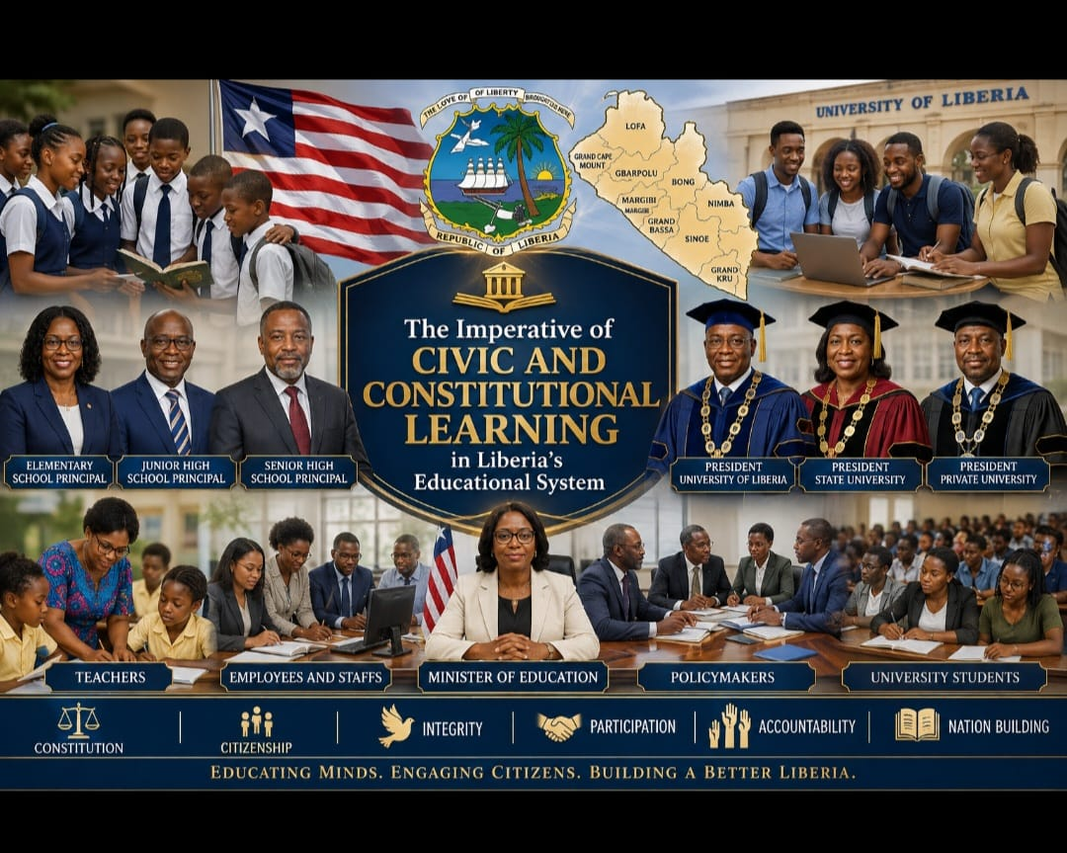

“A nation that does not teach its children how government works, what the Constitution protects, and what citizenship demands leaves democracy vulnerable to manipulation.
Machiavelli reminds us that political power must be understood; Socrates teaches that wisdom begins with questioning; and Achebe reminds us that a people who lose command of their own story can have their future narrated by others.
Liberia must therefore make civic and constitutional education the bedrock of national development.”
Reflection: In the spirit of President Joseph Nyuma Boakai’s emphasis on national renewal and institutional development, education should produce citizens who understand not only their rights, but also their responsibilities to the Republic.
“The Constitution should not live only in the offices of lawyers, legislators, judges, and politicians; it must live in the minds of Liberian students.
Socrates taught that an examined life is essential to wisdom, while Machiavelli demonstrated that ignorance of power can leave citizens vulnerable to those who understand it better.
Liberia’s schools must therefore teach constitutional principles early, so that every generation can recognize both the limits of government and the duties of citizenship.”
Reflection: Thinkers such as John Dewey and Paulo Freire similarly emphasized education as preparation for meaningful participation in society. Civic knowledge transforms passive subjects into informed citizens.
“Where citizens lack civic knowledge, political slogans can replace constitutional principles, personalities can replace institutions, and loyalty can replace reason.
Machiavelli teaches us to study the realities of power; Socrates challenges us to question assumptions; and Chinua Achebe teaches us to examine the stories through which societies understand themselves.
Liberia’s greatest defense against political manipulation is therefore an educated citizenry capable of asking questions, examining evidence, understanding the Constitution, and demanding accountability.”
Reflection: President Joseph Nyuma Boakai’s national development agenda can be strengthened when Liberia invests not merely in educated workers, but in constitutionally literate citizens who understand how their institutions are supposed to function.
“The future of Liberia will not be secured by political leadership alone; it will be secured by generations educated to understand justice, constitutional government, civic responsibility, and the dignity of every citizen.
Socrates gives us the discipline of inquiry, Machiavelli the realism of political understanding, Achebe the power of history and identity, and modern educational thinkers such as John Dewey and Paulo Freire the conviction that education must prepare people to participate intelligently in society.
In the spirit of national renewal associated with President Joseph Nyuma Boakai, Liberia must place civic and constitutional learning at the heart of its educational system.”
Reflection: A truly educated Liberian should know how to think, how government should work, what the Constitution guarantees, and how citizens can peacefully hold institutions accountable. That is not merely education—it is nation-building.
Ministers of Education, Presidents of Universities, Principals of Schools, Teachers, Professors, Instructors, Staff and Employees, please note: Civic and constitutional education is not an optional subject in a democracy; it is the intellectual foundation upon which responsible citizenship, accountable government, and sustainable national development are built.
By: Austin S Fallah – A True Son of the Planet Earth Soil:[email protected]
Phil Musa Handz-On-Barbershop and Phil Musa Intellectual Center, a place where Liberians of all persuasions meet in the afternoons after work and on weekends for haircuts and coffee, and sit together as intellectuals to discuss issues of interest to their motherland, promoted this article.
Over the past several weeks, discussions about Liberia’s educational framework have focused on pivotal issues affecting the nation’s youth.
These conversations often intersect with questions of civic responsibility, constitutional awareness, and the implications of these concepts for future generations.
As Liberia continues to recover from a turbulent history, the urgent need to implement civic and constitutional learning as a core curricular requirement for junior high, senior high school, and university students emerges as an impactful solution.
Discussants at the Phil Musa Intellectual Center agreed that this initiative would not only equip students with knowledge about their rights and responsibilities but also foster a sense of national pride and accountability.
The transformative effects of such an educational approach are immense and can raise Liberia’s future generations as responsible citizens, better prepared to contribute positively to society.
Understanding Civic and Constitutional Learning:
Civic education is fundamentally about teaching the values, principles, and practices essential to participating in a democratic society.
This includes understanding the Constitution, the rule of law, civil rights, and the duties citizens owe to their communities and their nation.
In Liberia, where historical and systemic issues have often undermined civic engagement, students must understand not just their rights, but also their obligations as members of society.
Constitutional learning complements civic education by providing the legal framework that governs a nation.
By understanding the Constitution, students can appreciate the significance of civil liberties and are better equipped to navigate the complexities of civic life.
The Current Educational Landscape in Liberia:
Currently, Liberia’s educational framework does not sufficiently emphasize civic and constitutional learning.
Students graduate with limited awareness of their civic duties and little understanding of how the government operates.
This gap has contributed to a cycle of disengagement where young people are less likely to participate in civic activities, respect the rule of law, or recognize their capacity to effect change.
This situation has allowed detrimental influences, such as drug abuse and involvement in criminal activities, to take hold among the youth.
Designing an educational curriculum that integrates civic and constitutional learning could break this cycle, instilling in young people the values they need to grow into responsible citizens.
The Benefits of Civic and Constitutional Learning
Implementing civic and constitutional learning as a curricular requirement will help students realize their responsibilities to themselves, their families, and the nation. This educational reform can lead to several critical benefits:
- Enhanced Civic Engagement: When students understand their rights and responsibilities, they are more likely to engage in civic activities. This might include increased participation in local governance, volunteering in community service, or advocating for issues affecting their communities. A well-informed youth is empowered to take action and effect change.
- Respect for the Rule of Law: By examining the Constitution and the legal framework underpinning their society, students will cultivate a culture of respect for the law. This awareness can reduce tendencies toward lawlessness and criminal activity. Understanding the consequences of breaking the law will instill accountability among students.
- Informed Citizens: Education that emphasizes civic knowledge can cultivate informed citizens who recognize how their decisions influence societal outcomes. This critical awareness helps students navigate complex social dynamics, ultimately empowering them to challenge injustices and pursue equity within their communities.
- Combating Negative Influences: Integrating civic education can also serve as a deterrent against the allure of toxic influences, such as drug dealing and gang involvement. Young people exposed to civic principles are less likely to succumb to pressures pushing them toward harmful lifestyles. Instead, they can form constructive aspirations grounded in purpose.
- Building National Pride: Civic education provides students with an opportunity to reflect on their identity and their place within the broader community. When students engage with concepts of national pride and citizenship, they foster a love for their country that transcends mere rhetoric. Engaged citizens will appreciate the sacrifices that have shaped Liberia’s history and strive to build a brighter future.
The Role of Educators:
Implementing this educational reform will require collaboration among stakeholders, including government authorities, educational institutions, and civil society organizations.
Educators play a vital role in delivering civic and constitutional learning. Therefore, teachers must receive proper training to equip students with the knowledge they need to understand democratic principles.
Educators need resources that empower them not only to teach constitutional provisions but also to inspire students to internalize civic values.
Innovative teaching methodologies that attract student engagement are fundamental to creating a profound learning experience.
The Value of Practical Application:
An effective civic and constitutional education program should not rely solely on theoretical knowledge.
Instead, practical applications are essential to imbuing theoretical concepts with real-world relevance.
Students ought to participate in projects that explore local government operations, community service initiatives, and simulated legislative processes.
Such initiatives will help students understand the mechanics of governance and recognize their roles within these systems.
Initiating dialogues with community leaders and organizing forums for discussing pertinent social issues will also foster civic responsibility among young people.
Creating a Culture of Responsibility:
The broader societal implications of incorporating civic education into the curriculum extend beyond individual growth.
As future generations emerge with a sense of civic duty and constitutional awareness, the societal landscape will likely shift significantly.
Students can evolve into responsible citizens who contribute meaningfully instead of becoming liabilities to their communities.
This cultural transformation will help eliminate negative stereotypes surrounding Liberian youth, reshaping their identity from that of ‘Zogos’ or drug dealers to valued community members.
Moreover, equipping young people with civic knowledge fosters an environment where they are less likely to defend individuals who engage in corrupt practices simply due to personal connections.
Instilling a values-based approach encourages students to prioritize ethical considerations over loyalty to individuals who might engage in criminality.
With this informed perspective, students grow into citizens capable of advocating for justice and integrity at every level of society.
The Challenges to Implementation:
While the benefits of civic and constitutional learning are substantial, several challenges may obstruct its successful implementation.
One key obstacle is the existing curriculum, which may resist change because of its rigidity and established practices.
Overcoming this inertia will require significant effort from educational administrators and policymakers.
They must articulate the importance of these subjects within the context of national development and social responsibility to gain buy-in from all stakeholders.
Additionally, resource constraints, particularly in underfunded educational settings, could limit the ability to innovate educational delivery methods.
To counter this, partnerships with civil society organizations can help provide training and resources for teachers while also engaging community members in supporting local educational initiatives.
A Collective Responsibility:
The significance of integrating civic and constitutional learning into Liberia’s educational system cannot be overstated.
The potential impacts on individuals and society at large reflect the urgent need for systemic change.
By fostering a generation that understands their rights and responsibilities, respects the rule of law, and appreciates their role within the community,
Liberia can work toward building a future characterized by civic engagement, national pride, and collective responsibility.
The responsibility for realizing this vision lies not only with educators but with every stakeholder invested in Liberia’s future.
The Phil Musa Intellectual Center discussants agreed that every Liberian has a fundamental responsibility to work together to pave the way for a transformative educational landscape that produces not just takers but contributors to the nation and the global community.
Only then can Liberia reach its full potential, fostering a society of responsible, competitive, and engaged citizens ready to tackle future challenges.
Support Independent Journalism
Your support helps FrontPage Africa continue delivering independent, credible, and impactful journalism. Every contribution strengthens our ability to investigate, inform, and hold power accountable while keeping quality journalism accessible to our readers.
Support our journalism or subscribe to receive the latest FrontPage Africa stories and updates.