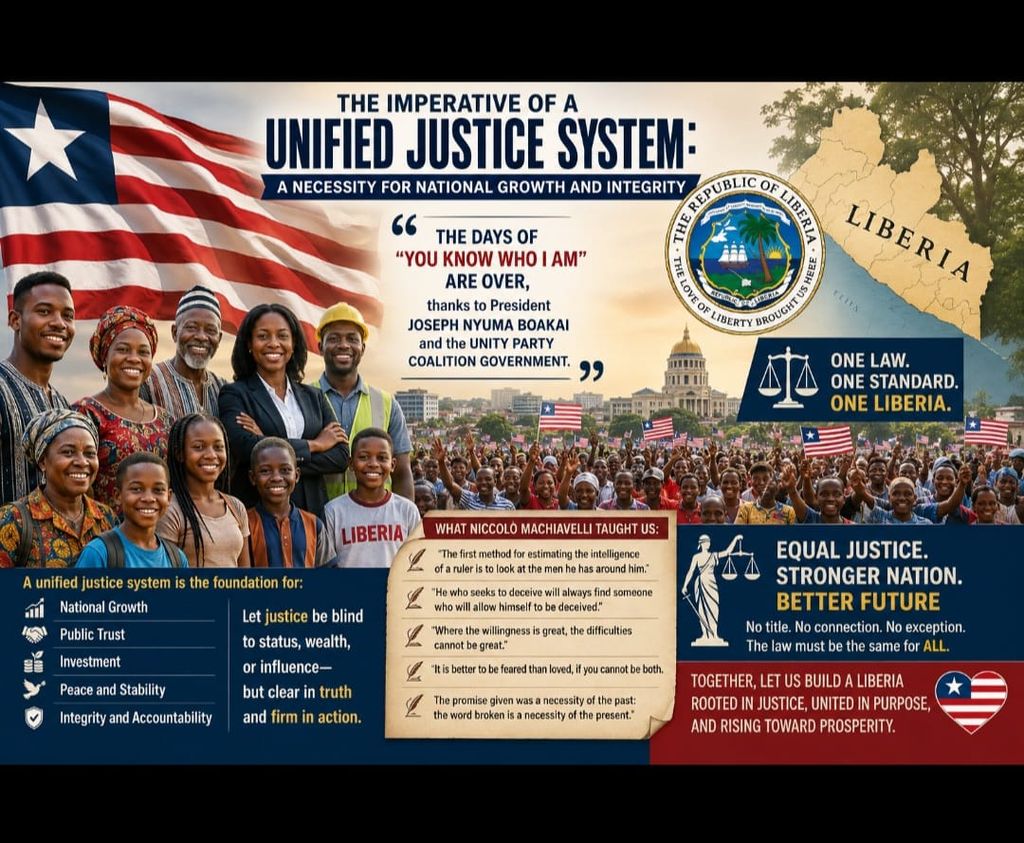
If Liberia is serious about national growth and integrity, can we truly achieve it without a unified justice system that treats every citizen equally under the law? As Niccolò Machiavelli observed, “The first method for estimating the intelligence of a ruler is to look at the men he has around him.”
Are the days of “you know who I am” finally over in Liberia, and can President Joseph Nyuma Boakai and the Unity Party Coalition/Alliance Government ensure that political influence no longer places anyone above the law? Machiavelli warned that “he who seeks to deceive will always find someone who will allow himself to be deceived.”
What does it say about a nation’s integrity when the powerful can receive different treatment from ordinary citizens within the justice system? In Machiavelli’s words, “Where the willingness is great, the difficulties can not be great.”
Can Liberia build lasting public trust, attract investment, and achieve meaningful national development without a justice system founded on fairness, consistency, and accountability? Machiavelli famously wrote, “It is better to be feared than loved, if you cannot be both,” raising an important question about whether government authority should be exercised through fear or through the credibility of just institutions.
Will the President Boakai administration make the principle of equal justice a lasting national standard so that no title, political connection, wealth, or influence can shield anyone from accountability? As Machiavelli stated, “The promise given was a necessity of the past: the word broken is a necessity of the present.”
What, then, should Liberians expect from leaders who promise justice, equality, and national renewal?
By: Austin S Fallah – A True Son of the Planet Earth Soil: [email protected]
In a world increasingly defined by disparities, the quest for equality often finds its most profound expression within the justice system.
Many nations still wrestle with the notion of dual justice systems: one that favors the wealthy and powerful, and another that serves the poor and marginalized.
This dichotomy raises pivotal questions: Should a nation enforce two separate justice systems?
What are the implications of such a division on social cohesion and national integrity?
To explore these questions, we examine Liberia.
This nation has faced the detrimental effects of divided justice systems, illuminating the long-term harm that can result when a society upholds disparate standards of justice.
The Case for Equality in Justice:
Justice is often described as “blind,” a metaphor that suggests the law should apply equally to all individuals, regardless of social status, wealth, or political power.
However, across various societies, we witness the unsettling reality that the scales of justice frequently tip in favor of the affluent and powerful.
Dual justice systems can lead to widespread public discontent, social unrest, and, ultimately, stunted national growth.
Advocating for a unified justice system that holds all citizens accountable under the same laws is essential, fostering an environment of equality, trust, and stability.
Take, for instance, Liberia, a nation that has witnessed the ripple effects of a fractured justice system.
Following its brutal civil war, Liberia struggled to rebuild its institutions, including the judiciary.
Widespread corruption, drug trafficking, drug cartelism, lack of proper resources, and political interference have led to a justice system that, in many cases, has not served ordinary Liberians.
But under the UP Coalition/Alliance government, Liberians are seeing a semblance of justice within everyone’s reach.
The perception that the rich and powerful can evade accountability while the downtrodden face harsh penalties fosters distrust and disillusionment among the populace.
Examples of Justice System Failures:
Liberia’s history offers poignant illustrations of how a perceived dual justice system can fuel national discord.
High-profile cases involving politicians and business elites highlight the disparities within the justice system, particularly in the past
Reports have surfaced of some former and current government officials engaging in corruption, drug trafficking, drug cartelism, or abuse of power, yet have faced or are facing minimal repercussions.
In contrast, ordinary citizens face severe penalties for minor infractions.
This is becoming a thing of the past, as assured by President Joseph Nyuma Boakai.
This inequity not only undermines public faith in the legal framework but also perpetuates a cycle of poverty and desperation among the marginalized.
One notable example is the pervasive issue of land disputes in Liberia, as well as drug trafficking and drug cartelism.
These are also becoming a thing of the past, and a new dawn has come to Liberia’s jurisprudence under President Joseph Nyuma Boakai and Vice President Jeremiah Kpan Koung’s administration.
Wealthy elites often use their influence to manipulate the legal process, thereby displacing vulnerable communities ot individuals.
Such actions reveal the deep-rooted challenges in the justice system where power dynamics overshadow fairness.
For the poor, facing eviction or losing ancestral lands equates to the loss of identity and a descent into deeper economic hopelessness.
This situation starkly epitomizes the adverse effects of allowing a dual justice system to flourish: loss of social stability, violence, and civil disorder.
Adverse Effects on National Growth:
The implications of an unequal justice system extend far beyond the immediate injustices individuals endure.
A society plagued by distrust in its judicial processes can experience significant barriers to development.
A nation’s investment climate is heavily influenced by perceptions of stability and fairness within the legal system.
Foreign investors, likely to seek opportunities in nations with robust and equitable legal frameworks, may be deterred from entering a market perceived as unjust.
This reluctance stunts economic growth, limiting job creation and infrastructure development crucial for national revival.
Moreover, the lack of accountability for the powerful promotes a culture of impunity that perpetuates corruption within government institutions.
In Liberia, political patronage has undermined law and order, weakened governance structures, and eroded civic trust.
Citizens’ faith in their leaders and institutions is paramount; when the justice system falters in its duty to provide equal treatment, it nurtures a climate of unrest and disillusionment, ultimately threatening social cohesion
The Call for Unity in Justice:
The urgent need for a cohesive justice system in Liberia can not be overstated.
Real reform necessitates a shift towards a judiciary that genuinely reflects the principles of equality and fairness.
Justice must remain blind to status and wealth; it must be a pillar of moral and social responsibility.
This challenge requires dedicated effort from both the government and its citizens, not individuals who think justice should favor only them; when it doesn’t, it becomes a “Witch-Hunt.”
Legal reforms must prioritize transparency, stronger institutions, and accountability mechanisms in law enforcement.
Additionally, it necessitates civic engagement and awareness campaigns to educate the populace about their rights and the importance of participating in democratic processes.
The rise of positive grassroots movements empowering ordinary citizens to demand justice will rekindle hope and ultimately pressure the government to reform.
A Lesson for Liberia: Justice Must Take Its Course:
As Liberia strides forward from its tumultuous past, it stands at a critical juncture.
The lessons gleaned from history are profound and demanding; collective action towards a cohesive justice system is paramount, not the one that a few misguided individuals, influenced by smooth political talkers, are paddling on social media like headless snakes with no direction.
Stop listening to those political nobodies with nothing to add to the discourse.
They have failed you, and they may fail you again.
Youth and young people, be wise like people who have a mission and vision for a competitive future to meet the 21st-century demands of intellectualism and a sense of purpose.
Liberia should unequivocally reject the notion of dual justice, one for the rich and another for the poor, as some are perpetuating, because their practices have come under legal scrutiny.
Instead, it should embrace a unified approach that holds all individuals accountable, irrespective of their wealth or position.
The discourse surrounding “Liberia is on time bomb(s) and gun(s)” that supposedly threaten Liberia only serves to distract from the core issues at hand.
Citizens are tired of violent threats and instability; they seek peace and justice.
A fundamentally equitable justice system serves as a precondition for a peaceful society.
When citizens perceive that they are all subject to the same laws, it fosters unity and reduces the potential for civil disorder.
Liberians should recognize that justice must not be defined by empty political rhetoric or abstract ideals of fairness.
It should be tangible, accessible, and effective.
Societies that transcend the limitations of dual economies and dual systems of justice invariably thrive.
They emerge stronger, more cohesive, and better able to face challenges in a globally interconnected world.
A Bright Future through Unity:
As Liberia endeavors to reclaim its identity and stand tall on the international stage, it must uphold the sanctity of justice for all.
The call is clear: Justice must not discriminate based on wealth or power.
For Liberia to grow and flourish, it requires a justice system that is equitable, sincere, and unyielding.
Unity in justice strengthens the fabric of society, promotes accountability, and ultimately enhances national pride.
In closing, Liberia must learn from its past, choose a path toward a single justice system, and make equality its core principle. principle
Only through such endeavors can Liberia hope to heal its wounds, rebuild trust, and affirm its position as a nation committed to justice and prosperity for all its citizens.
Let this become the new narrative: a justice system that serves the many and leads Liberia into an era of peace, progress, and undeniable integrity on the global stage.
Support Independent Journalism
Your support helps FrontPage Africa continue delivering independent, credible, and impactful journalism. Every contribution strengthens our ability to investigate, inform, and hold power accountable while keeping quality journalism accessible to our readers.
Support our journalism or subscribe to receive the latest FrontPage Africa stories and updates.