Monrovia – For the first time Liberia is going to have a “time capsule” for the purpose of reserving documents and cultural materials for future generations.
Report by J. H. Webster Clayeh, [email protected]
A time capsule is a sealed container with a collection of documents or culture materials that is opened after a specified number of years. It conveys particular memories to future generations.
The time capsule, which is to be built by the University of Liberia, will be launched on November 30, 2019. It is part of the yearlong celebration leading toward the centennial commencement slated for December 11, 2019.
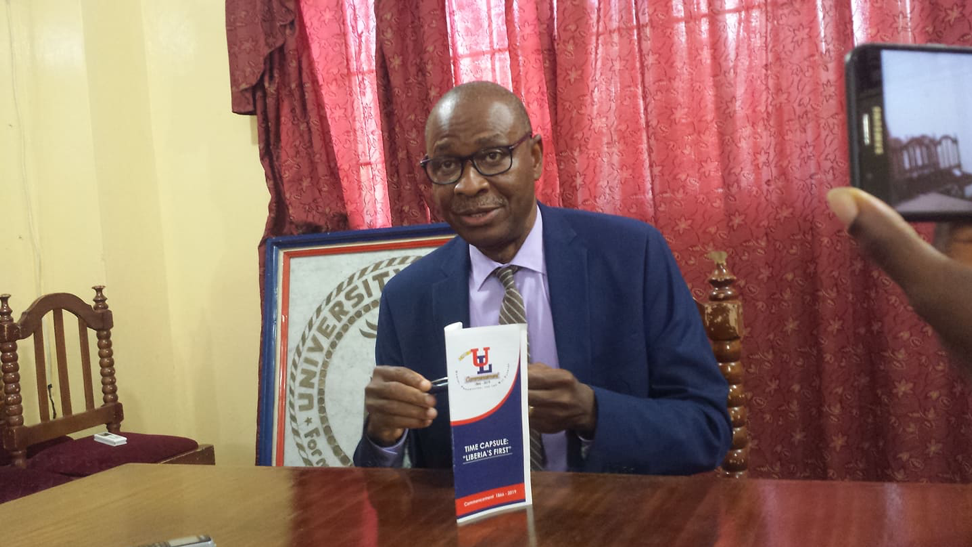
Speaking to journalists over the weekend, the University of Liberia’s Vice President for Academic Affairs, Dr. William Ezra Allen, said there is no evidence of a time capsule in Liberia – be it private, national, regional or institutional.
This, Dr. Allen explained that their team from the College of Engineering and Science College are handling technical details and will formally recommend a geographical environment where and how to store the time capsule.
“Should it be at Capitol Hill which is a harder ground? It’s not prone to flooding for perhaps in the next 100 year? Should it be at Fendall, should it be at Congo Town or Cape Mount? So, the technical team is looking at all those factors,” Dr. Allen ponders.
According to the UL Vice President for Academic Affair, the time capsule that will be buried after the centennial commencement will last for about 100 years. He added that flooded environment will be detrimental to the long lifespan of the time capsule.
“This is something new; it has not happened in Liberia before. And imagine what we are trying to do, you are burying a document and saying you are not going to open it for 100 years. The issue of how do you protect that location to ensure that nobody vandalizes it is paramount,” Dr. Allen said.
“Also, we will ask the government to make a proclamation that this time capsule was buried this day and will be open on the University of Liberia Bicentennial Commencement.”
Dr. Allen says the time capsule could be opened either in 2118, 2119 or even much later depending on whether commencements are held every year for the next 100 years.
The University of Liberia was established by an Act of Legislation in 1861 but started operation in 1862. After four years, the University put out its first and only graduate, James Henry Evans.
The time capsule can be kept sealed for a brief period, or for as long as several millennia. The container that will be used for the time capsule has to be airtight, UL Vice President for Academic Affair says.
“From what I have learned, you can suck the air out before you seal the time capsule because if you have air in, it creates problems. If it is not airtight, you will have moisture in it and that could lead to some problems of decay of the items,” Dr. Allen said.
He added that the time capsule will be opened to the public adding that anyone – be it private, national, regional or institutional can preserve documents or cultural materials for future generations.
Support Independent Journalism
Your support helps FrontPage Africa continue delivering independent, credible, and impactful journalism. Every contribution strengthens our ability to investigate, inform, and hold power accountable while keeping quality journalism accessible to our readers.
Support our journalism or subscribe to receive the latest FrontPage Africa stories and updates.