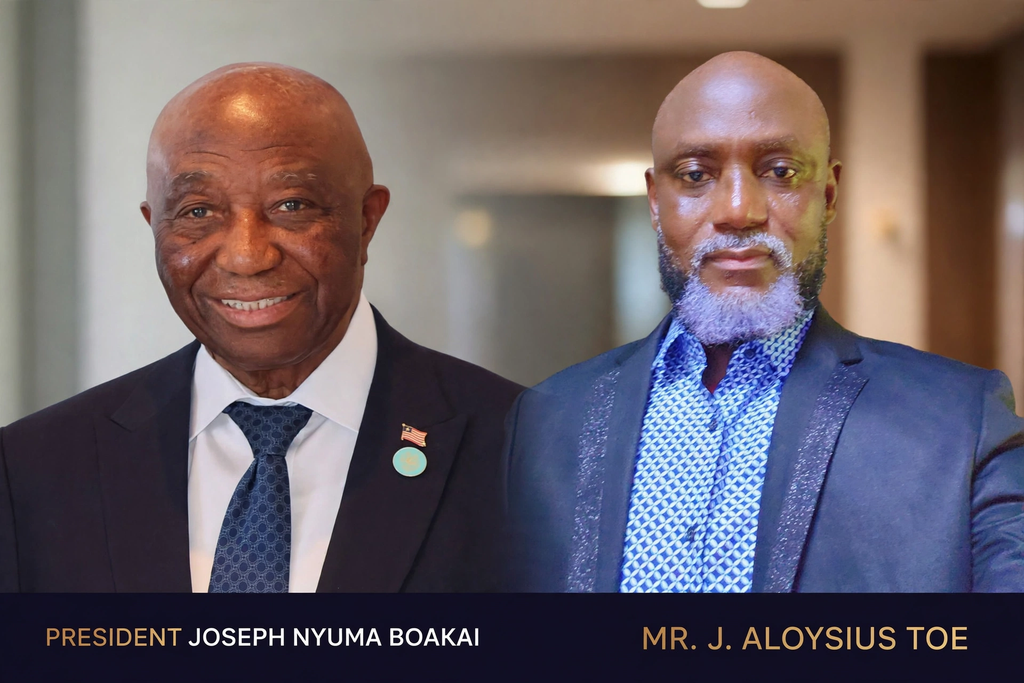
MONROVIA — President Joseph Nyuma Boakai has found an unlikely voice willing to defend his record not from within the ruling Unity Party, but from the ranks of a former opposition figure who once stood on the other side of Liberia’s political divide.
By Augustus D.R [email protected]
J. Aloysius Toe, Esq., a former Secretary General and member of the opposition Alternative National Congress (ANC) and the now-defunct Collaborating Political Parties (CPP), has put forward an extensive account of what he considers 300 achievements of the Boakai administration, making a case that the President deserves recognition for the work undertaken since assuming office in January 2024.
His publication, The 300 Blessed Sins of Joseph Nyuma Boakai Sr. (JNB 300): From Plans to Progress, is an attempt to change the conversation surrounding the President’s performance — from one largely preoccupied with political criticism to one that also acknowledges government initiatives, policy interventions and development efforts.
For Toe, the significance of the publication goes beyond documenting government activities. It is a statement that political differences should not prevent the recognition of national progress and that leadership must be assessed on the totality of its record.
The choice of title, “300 Blessed Sins,” is particularly striking. By turning the language of political criticism into a positive characterization of the President’s record, Toe challenges those who, in his view, have been quick to overlook the administration’s achievements.
His argument comes at a time when the Boakai’s administration continues to face scrutiny over the pace of its development agenda, economic conditions and delivery of public services.
But rather than allowing the challenges to define the entire presidential record, Toe has chosen to document what he believes the government has accomplished.
The compilation spans economic management, infrastructure, electricity, agriculture, education, healthcare, governance, security, diplomacy and national reconciliation — sectors that collectively define the administration’s development ambitions.
A Different Voice In Liberia’s Political Debate
Perhaps the strongest feature of Toe’s intervention is the fact that it comes from someone with a history in opposition politics.
In Liberia, where political loyalty often shapes public assessments of government performance, a former opposition figure choosing to highlight the achievements of a sitting President presents a different dimension to the national debate.
Toe’s position suggests that acknowledging a government’s accomplishments should not automatically be interpreted as abandoning political independence or surrendering the right to demand accountability.
It also challenges the tendency to dismiss positive developments simply because they are associated with a political administration one may not support.
His publication, therefore, puts forward a broader argument: Liberia’s development conversation should be based on what is being done, what has been achieved and what remains to be accomplished — rather than political affiliation alone.
Boakai’s Economic Record: Revenue And Growth
At the centre of Toe’s case is the administration’s effort to strengthen Liberia’s economy and mobilize domestic resources.
The publication highlights domestic revenue collections exceeding US$1 billion by September 14, 2026, alongside the approval of a US$1.2 billion national budget for 2026.
These developments come against the backdrop of an economy that, according to the World Bank’s November 2026 Liberia Economic Update, expanded by 5.1 percent in 2025.
The growth was supported largely by a 17 percent rebound in the mining sector and a 4.6 percent expansion in services.
For Toe, these developments form part of the record that deserves public attention as the administration pursues its economic recovery and development objectives.
While the ultimate measure of economic progress remains its impact on employment, household incomes and the cost of living, the reported growth and revenue figures provide important context for assessing the government’s economic management.
Roads, Electricity And The Drive For Infrastructure Development
One of the most visible components of the President’s development agenda is infrastructure, an area in which Toe identifies several major interventions.
The procurement of 285 pieces of road-construction equipment, the dedication of the 81-kilometer Gbarnga-Salayea Road, and the commencement of the Western Corridor Road project are among the documented achievements.
These initiatives address longstanding infrastructure concerns in a country where poor road connectivity has continued to affect commerce, agricultural transportation and access to public services.
The energy sector also provides important examples of the developments highlighted by Toe.
Restoring the Mount Coffee Hydropower Plant to its installed capacity of 88 megawatts and commissioning a 20-megawatt solar facility represent notable investments in electricity generation.
Government figures cited in the compilation indicate that electricity access increased from 33 percent in 2024 to 37 percent in 2025.
Although expanding reliable and affordable electricity remains a major challenge, the investments reflect efforts to strengthen the country’s energy capacity and create a foundation for broader economic activity.
Agriculture: The Promise of Feeding Liberia
Toe also places considerable emphasis on the administration’s agricultural agenda, particularly the Liberians Feed Yourselves initiative.
The programme is intended to strengthen local food production, support farmers and reduce Liberia’s dependence on imported food.
Among the developments documented are the receipt of 304 agricultural machines, support for more than 198,000 farmers in 2025 and the distribution of hundreds of thousands of cocoa seedlings.
For a country where agriculture remains central to rural livelihoods and food security, these interventions are important to the broader ambition of transforming the sector.
The task ahead is to sustain the investments through improved financing, storage, processing, transportation and market access so that farmers can increase production and earn better incomes.
Education And Healthcare: Investing In The People
The publication also turns attention to education and healthcare, two sectors that directly affect the quality of life and future opportunities of Liberians.
In education, Toe identifies school renovations, scholarships, teacher training, computer laboratories, STEM kits, and the US$88.7 million EXCEL Project among the administration’s notable interventions.
These initiatives reflect efforts to improve learning infrastructure, strengthen educational opportunities and prepare young people for a changing economy.
In healthcare, the compilation highlights reported improvements in essential-medicine availability, oxygen plants, maternal-health interventions and hospital reconstruction.
For communities that have historically struggled with inadequate health facilities and limited access to essential services, such investments carry particular importance.
The broader objective remains ensuring that these interventions translate into better learning outcomes, accessible healthcare and improved services across the country.
Governance, Justice And The Fight Against Corruption
Another important dimension of Toe’s assessment is the administration’s governance agenda.
The publication highlights the suspension of more than 450 public officials over asset-declaration violations and investigations undertaken by the Liberia Anti-Corruption Commission.
These actions feature prominently in the administration’s efforts to strengthen public-sector discipline and promote accountability.
Toe also documents developments surrounding the proposed establishment of a War and Economic Crimes Court and the National Reconciliation, Healing, and Unity Program.
President Boakai’s apology to victims and families affected by Liberia’s civil wars is included as part of the administration’s efforts toward national healing.
For a country still confronting the consequences of its violent past, the pursuit of justice and reconciliation remains an important part of national development.
Although the operationalization of the proposed court requires further legal, financial and institutional arrangements, the administration’s actions have kept transitional justice firmly within the national conversation.
Security And Liberia’s International Engagement
Toe’s compilation further highlights the government’s security interventions, including the reported seizure of more than 10 metric tons of illicit drugs and the arrest of over 550 suspects during 2025.
The figures point to law-enforcement activities directed at confronting the growing drug problem and strengthening national security.
The publication also recognizes the administration’s diplomatic engagements and efforts to strengthen Liberia’s international relationships.
Such engagements are important to regional cooperation, international partnerships and creating opportunities for the country to advance its development interests.
Why Toe’s Case Matters
Beyond the individual achievements, the publication raises a bigger question about the way Liberia evaluates political leadership.
Must recognition of a President’s accomplishments come only from members of his political party? And should the existence of outstanding challenges overshadow developments that deserve acknowledgment?
Toe’s intervention offers a different answer.
His former opposition credentials make his assessment particularly interesting because he is not simply repeating the position of a ruling-party loyalist. He is publicly making a case for a President whose administration he believes deserves greater recognition.
That does not mean Liberia’s development challenges have disappeared.
The October 2026 President Meter Report by Naymote Partners for Democratic Development assessed 385 interventions under the government’s ARREST Agenda. It identified 213 interventions as ongoing and independently verified 12 as completed.
The findings demonstrate that considerable work remains, but they also show that implementation activities are taking place across government institutions.
The administration must continue to accelerate projects, strengthen accountability and ensure that public investments produce tangible benefits.
However, the existence of unfinished commitments does not mean that achievements already recorded should be ignored.
This is the distinction that gives Toe’s publication its relevance: government must be held accountable for what it has promised, but it should also receive recognition for what it has undertaken and accomplished.
A Case for A More Balanced Assessment
President Boakai’s five-year mandate provides an opportunity to consolidate the initiatives documented in Toe’s publication and translate ongoing interventions into lasting improvements in the lives of Liberians.
The success of the ARREST Agenda will ultimately depend on the government’s ability to deliver on its commitments, improve public services and make economic opportunities more accessible.
But as the political debate over his presidency continues, Toe has introduced a perspective that challenges the country to look beyond partisan divisions.
Through The 300 Blessed Sins of Joseph Nyuma Boakai, he has assembled a favorable account of the administration’s record and placed it before the Liberian public for consideration.
His message is not that the government has completed its work, but that its efforts and achievements deserve a place in the national conversation.