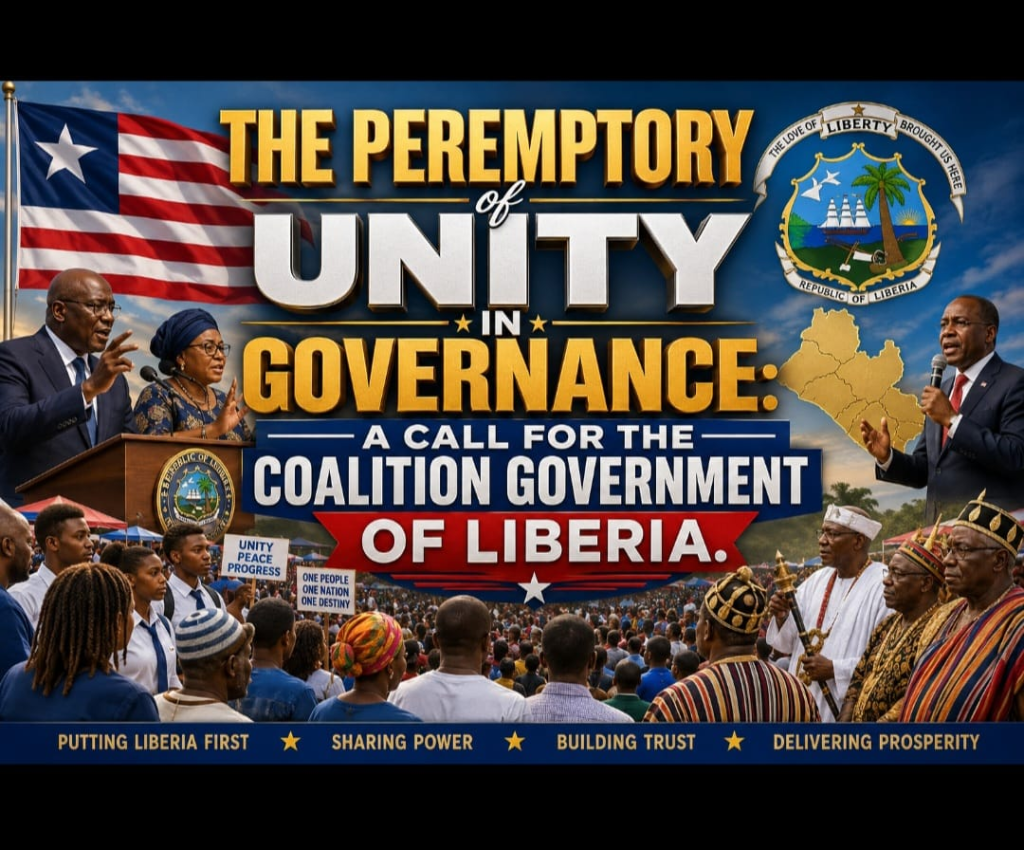
“Keeping the Flame of Unity and People’s Center Burning, which is the Unity Party’s vision bearer (Dr. Edward B. Kesselle)’s dream of “Unity and One Liberia for all Liberians,” alive.”
President Joseph Nyuma Boakai:Following his 2023 electoral victory, President Boakai called on Liberians to work together, stating, “This is a time for reconciliation and unity. Liberia belongs to all of us, and together we will rebuild our nation.”
Vice President Jeremiah Kpan Koung: Moving Past Electoral Divisions: At the opening of the 55th National Legislature on January 25, 2024, Vice President Koung explicitly called for an end to political tribalism: “Let us embrace a new mindset now that elections are over, eliminate the idea of a Green or Blue Liberia, and give every Liberian the opportunity to contribute his or her quota to nation-building.”
“Call for Bipartisan Legislative Unity” at the commencement of the 3rd Regular Legislative Session on January 12, 2026, addressed the Liberian Senate, emphasizing that political diversity should strengthen governance: “Work together in formulating policies and laws that strengthen governance, deepen democracy, and uphold the rule of law.”
He added that lawmakers should “prioritize national interests, constructive dialogue, and cooperation…” and advocate collective interests over personal agendas.
Vice President Jeremiah Kpan Koung: In his 2024 National Unification and Integration Day message, Koung urged citizens and the political class to set aside individual priorities for the country’s advancement: “I call upon all Liberians to prioritize the nation’s interests above personal agendas, recognizing that true unity requires collective sacrifice and dedication.”
Regional and Community Cohesion: Celebrating County Partnerships on December 23, 2024, Vice President Koung spoke out against historical grievances dividing Liberian counties: “If we come together as one family and embrace our love for one another, we can overcome the negative perceptions of the past.”
Speaker Richard N. Koon
The strongest documented statements after Deputy Speaker Fallah apologized: “The Liberian people expect collaboration, not conflict, and solutions, not distractions.” Smart News Liberia.
“Our nation faces significant challenges that demand our collective wisdom, energy, and unity. This is not the time for division; it is the time for service.”
“I have chosen reconciliation over resentment, institution over individual, and progress over politics.”
President Pro Tempore Nyonblee Karnga-Lawrence:
During the formation and leadership of the opposition alliance, she consistently emphasized collaboration among political actors, urging Liberians to put national interests above partisan differences. Her public addresses stressed that unity among democratic forces is essential for Liberia’s development.
President Pro Tempore Lawrence: When endorsing Joseph Boakai in 2023, she stressed that national interest should prevail over personal ambition.
President ProTempore Nyonblee Karnga-Lawrence: “Our loyalty to country is stronger and more important than our personal ambition or the personal ambition of any other individual.”
Deputy Speaker Thomas P. Fallah: While joining the Unity Party, Deputy Speaker Fallah emphasized national interest above partisan politics: “There was a country called Liberia before political parties… Liberia stands above any party.” Africa Press English.
Deputy Speaker Fallah also urged Unity Party officials to focus on serving the country:
“Work for the people. Work for the government.”
Senator Abraham Darius Dillon: “We want the government to feel so bad that it can give us in opposition the chance to govern. But what are we inheriting?” He argued that such politics ultimately hurt Liberia and called for a more constructive approach.
Senator Abraham Darius Dillon: “Unity should mean working for Liberia’s success rather than rooting for a government’s failure.”
Senator Abraham Darius Dillon: “Accountability requires enforcing the law equally, demanding transparency, and holding public officials responsible regardless of party affiliation.”
Unity Party Chairman Rev. Dr. Luther Tarpeh:
Although recent remarks focused on government performance, he reaffirmed the party’s commitment to serving Liberians: “The Unity Party-led government remains focused on delivering results for Liberians.”
Dr. Edward B. Kesselly (Unity Party’s Vision Bearer): The Unity Party itself was founded on the principle of national unity, reflected in its long-standing slogan:
“One Nation, One People, With Liberty and Justice For All.”
By: Austin S Fallah – A True Son of the Planet Earth Soil: [email protected]
In the heart of every nation lies the undeniable quest for prosperity and the eradication of poverty.
For Liberia, a nation emerging from the shadows of civil war and striving to reclaim its potential, this aspiration is more than just an abstract ideal; it is a fundamental necessity.
A government that fights itself shall not fulfill its agenda of uplifting its people from poverty.
This adage rings true, echoing the sentiments of those who understand that chaos and division can undermine even the most well-intentioned policies.
It is imperative that the Unity Party coalition government of Liberia, alongside any future government or coalition, draws lessons from history—specifically from the “11th Commandment” articulated by former President Ronald Reagan: “Thou shalt not speak ill of any fellow Republican.”
Though President Reagan popularized this principle, the idea originated with Gaylord Parkinson, the Chairman of the California Republican Party, in an effort to mitigate internal strife within the party ranks.
It serves as a poignant reminder that a government devoid of unity and cooperation is hamstrung in its ability to uplift its citizens.
The political landscape in Liberia, riddled with factionalism, risks derailing the progress needed to lift its people out of poverty.
The legacy of Dr. Edward B. Kesselle, a stalwart advocate for a unified political approach, ought to resonate deeply in the hearts of every well-meaning Liberian.
Dr. Kesselle envisioned a political party that was people-centered, prioritizing the collective good over individual agendas.
This vision must be embraced sincerely to steer Liberia toward a brighter future.
Understanding the nuances of political unity in Liberia requires reflecting deeply on the past.
The long and treacherous history of conflict in Liberia has forged societies characterized by deep-seated divisions and distrust.
A fragmented political environment not only hinders development initiatives but also perpetuates cycles of poverty.
The plight of Liberians is a testament to the failure of political leaders to put personal ambition aside for the greater good.
A government continually engaged in self-inflicted turmoil cannot focus on policies to raise its citizens’ living standards.
The implications of disunity within a government can be vast and devastating.
For instance, conflicting agendas result in policy paralysis, in which well-crafted strategies to alleviate poverty are subject to infighting rather than implementation.
This was evident during the tenuous moments of Liberia’s post-war reconstruction, when various political factions competed for power and recognition, often at the expense of the very citizens they were elected to serve.
Consequently, key issues such as unemployment, inadequate healthcare, poor educational facilities, and infrastructure deficits languished in bureaucratic limbo.
The effectiveness of governance is deeply tied to the relationships between its members and the spirit of collaboration that permeates the political atmosphere.
A coalition government, such as the Unity Party coalition in Liberia, is strategically designed to bring together diverse perspectives and policies that benefit the collective populace.
However, unity in action requires more than just a shared political platform; it necessitates a commitment to civil discourse and mutual respect.
The current political landscape presents a unique opportunity for the Unity Party coalition government to embrace Dr. Kesselle’s ethos and transform it into a practical operational framework.
The concept of a “people-centered party” must not remain an ideal but evolve into practice.
To achieve this, coalition members must unite under a shared vision that prioritizes sustainable development.
The needs of the people can only be effectively addressed when politicians champion policies that resonate with the lives of ordinary Liberians, encompassing access to education, healthcare, job creation, and infrastructure development.
Reinforcing this perspective of unity, it is essential to highlight the sustainable path toward poverty alleviation.
A government, through its policies, can profoundly alter its citizens’ socio-economic status.
Programs such as microfinance initiatives, vocational training, and community health outreach can serve as catalysts for change.
Yet these initiatives require resources, cohesion, and strategic planning, all of which are often compromised when discord reigns within a government.
By aligning their efforts around a common goal, the Unity Party’s coalition can summon a formidable force for change.
This unity in the second half of the 21st century, and as the 2029 national elections draw closer, can enable them to advocate effectively for international partnerships and investments that are crucial to Liberia’s economic revival.
With external support, targeted programs can be rolled out to address the immediate needs of the populace while simultaneously laying a robust foundation for long-term growth.
Central to this argument is the historical significance of effective leadership.
Liberia has often been hampered by leaders whose priorities have rested on personal gain rather than national welfare.
However, the call for unity must extend beyond the halls of power; it must inspire all Liberians to actively engage in the political process.
Dr. Kesselle’s vision, a political movement prioritizing collective welfare, can serve as an impetus for civic engagement.
A well-informed citizenry is essential; when citizens carry the torch of unity and integrity, the resulting pressure on leaders to adhere to a policy of decency and respect can foster a culture of accountability.
Moreover, fostering unity within the government can create a more conducive environment for conflict resolution.
When factions within a coalition approach disagreements with respect and collaboration, it reduces the likelihood of hostility.
Rather than viewing opposition as insurmountable barriers, a unified government can see dissent as an opportunity for robust discussion that leads to innovative solutions.
Embracing this mindset transforms political discourse from personal opposition into communal dialogue directed toward the common good.
In contemporary politics, Liberia can draw a lesson from the success stories of other nations that navigated similar waters of division.
Countries that emerged stronger from conflict did so by embedding the principle of unity deep into their governance fabric.
They adopted policies that emphasized reconciliation and collaboration, recognizing that the fight against poverty is relentless and requires a diverse army of advocates.
Citizens ought to see their leaders working cohesively, standing as a symbol of hope and trust, rallying together tirelessly to combat thee poverty that has stifled their potential for too long.
Complementing this spirit of unity is the need for transparency in governance.
A coalition government grounded in mutual respect and commitment to collective welfare must hold itself to the highest standards of accountability.
The more open and transparent the government is, the more trust it instills in its citizens.
A transparent government engenders civic engagement, for when citizens see their leaders transparently working towards the common good, they are far more likely to support initiatives aimed at poverty alleviation.
The challenges of poverty in Liberia are formidable but not insurmountable.
As the Unity Party coalition government and future administrations craft policies to lift the populace out of poverty, they must heed the vital principle that a government fighting itself can not succeed.
Embrace the lessons learned from Reagan’s “11th Commandment” and the vision of Dr. Edward B. Kesselle, a vision rooted in unity, respect, and collective purpose.
By doing so, Liberia’s leaders can steer the nation toward a future of hope and prosperity, where every citizen feels empowered, valued, and invested in shaping their destiny.
Only through resolve, unity, and commitment to the common good can Liberia fulfill its promise and ensure that poverty is merely a chapter in its history, not its destiny.
Support Independent Journalism
Your support helps FrontPage Africa continue delivering independent, credible, and impactful journalism. Every contribution strengthens our ability to investigate, inform, and hold power accountable while keeping quality journalism accessible to our readers.
Support our journalism or subscribe to receive the latest FrontPage Africa stories and updates.