Politicians or philanthropists should stop using children as pawns of disrespect to score political points or gain political sympathy.
By: Austin S Fallah – A True Son of the Planet Earth Soil: [email protected]
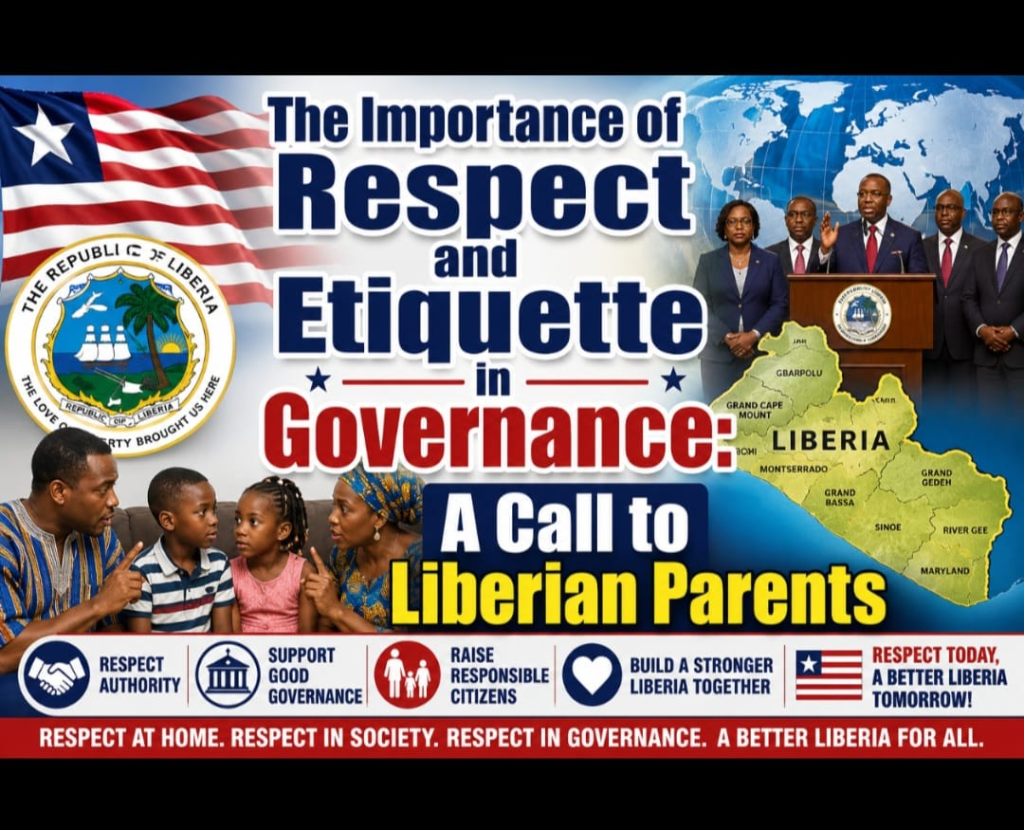
In an age where the youth are equipped with increasingly loud voices and platforms for expression, respect for authority and the rule of law must be instilled at home.
As Liberia moves forward, it becomes imperative for parents to teach their children the importance of respecting government officials.
This is not just a matter of etiquette; it is about preparing the leaders of tomorrow to navigate the complexities of governance and civic duty.
It is time for Liberian parents to recognize that the threads of respect and understanding should be woven into the fabric of their future leaders, ensuring that they hold their leaders in appropriate regard.
When engaging with government officials, it is critical to employ the proper titles reflective of the offices they hold. Members of the House of Representatives should be addressed as “Honorable,” Senators as “Senator,” judges with the title “Your Honor”, President of the nation “President,” and Cabinet Minister “Minister.”
These titles bear significance, rooted in long-standing parliamentary and legal traditions, and represent more than mere labels; they embody the weighty responsibilities and authority entrusted to these individuals.
The transition from childhood to adolescence and, eventually, to adulthood demands a prerequisite understanding of the importance of respecting authority.
In Liberia, where historical scars from tumultuous civil conflicts still linger, the concept of authority can be particularly nuanced.
Families must impart lessons that go beyond mere acknowledgment of government officials; they should also explore the wider implications of respecting institutions.
This respect is not intended to cast a blind eye to governmental shortcomings but instead to create a framework for constructive criticism and civic engagement.
Understanding that respect for institutional titles does not equate to uncritical support of every action taken by an official allows young people to engage thoughtfully in governance debates.
Moreover, the titles held by public officials reflect an overarching respect for the rule of law.
These titles designate individuals who occupy positions with significant responsibilities and authority, not based on personal merit, but through public service.
For example, the title “Honorable” is a reminder that members of the House of Representatives are meant to serve their constituents with integrity and accountability.
Similarly, addressing a Senator or a judge with their appropriate titles shows that one acknowledges the power of law and governance to uphold justice and order within society.
As Liberia continues to rebuild and shape its identity, fostering a culture of respect for governance remains a crucial commitment.
By embedding respect for government leaders into the upbringing of future leaders, we empower them to think critically about their national identity.
Young people who learn to address their leaders with respect are more likely to approach discussions about governance with civility, understanding, and a sense of propriety.
They will be better equipped to engage in community dialogues about what leadership entails and how they can contribute positively when it’s their turn to take the reins.
If younger generations understand that respect and proper titles carry weight, they will recognize their role in shaping a future aligned with civic duty and respect for democratic institutions.
Beyond merely using the correct titles, it is paramount that parents encourage children to cultivate a mindset that values deliberative discourse.
This entails engaging with differing opinions on governance whilst maintaining respect toward those who occupy positions of authority.
In a democracy, dissent is essential; however, honoring the context of opinions within a framework of reasoned discussions about policy and governance is equally crucial.
Young people must learn that differences in opinion do not preclude respect for the office and position one holds within the government.
This kind of respectful engagement instills a sense of civic responsibility and provides future leaders with tools for negotiation and collaboration.
The interplay between respect for authority and critical engagement creates a balanced perspective on leadership.
The title “Honorable” serves not as a blind accolade but as a reminder of the expectations associated with public service.
Political leaders must be held accountable, but only within a framework of respect.
Parents can ensure that future generations understand this delicate balance.
Teaching children to voice concerns respectfully, while acknowledging the roles of officials, creates an environment where change can blossom without eroding respect or the governance structures that protect public order.
Furthermore, as Liberia aims to strengthen its political institutions, instilling respect among the younger generation is a foundational pillar of a thriving democracy.
A young populace that understands the importance of these titles will better understand the roles that various officials play in their communities and nations
They will actively participate in society, aware of the nuance in criticism and praise of leadership.
Encouraging engagement with public institutions should accompany the teaching of proper titles, allowing children to learn about voting, advocacy, and civic engagement in its many forms.
Moreover, the example set by parents is pivotal.
Families can engage in discussions about local and national issues, teaching children how to express support or opposition to policies while maintaining respect for those who govern.
By participating in community meetings or local events, parents can exemplify how civic engagement is interwoven with the practice of respecting officials, shaping how future leaders view their roles in society.
While it is important to note that the titles “President, ” “Honorable,” “Senator,” “Your Honor,” and “Minister” convey respect, they do not imply unqualified allegiance or blind support.
This notion should be made clear to youths, creating a space where they can discuss and critically evaluate their leaders’ actions and policies.
Respect for positions should coexist with accountability, allowing young leaders to engage their future vocations with integrity.
This way, when young people become leaders, they cultivate environments that thrive on respect, accountability, and constructive criticism.
It is time for Liberian parents to place a premium on teaching their children to respect government officials, fostering a culture where titles are more than formalities, but symbolic of the important roles that individuals play within society.
Teaching the importance of respectful titles such as “President,” “Honorable,” “Senator,” “Your Honor,” and “Minister” goes beyond etiquette; it establishes a foundation for the democratic principles future leaders will need to uphold.
The lessons of respect, civility, and critical engagement will empower young people to become thoughtful leaders who can navigate the complexities of governance, instilling principles that keep accountability and respect tightly woven into the fabric of Liberia’s future.
Support Independent Journalism
Your support helps FrontPage Africa continue delivering independent, credible, and impactful journalism. Every contribution strengthens our ability to investigate, inform, and hold power accountable while keeping quality journalism accessible to our readers.
Support our journalism or subscribe to receive the latest FrontPage Africa stories and updates.