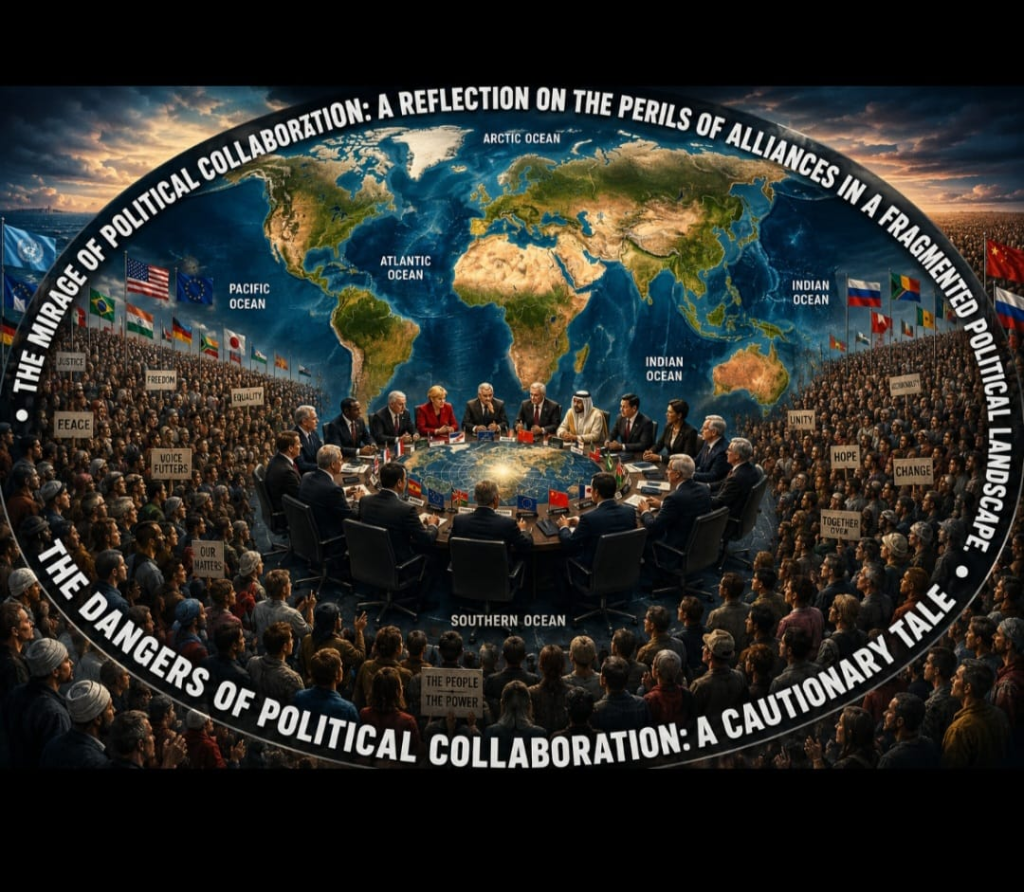
Political collaboration in a fragmented landscape often becomes a mirage, masking opportunism, instability, and inevitable betrayal.
Alliances built on convenience rather than shared principles quickly collapse into a cautionary tale of shifting loyalties and shattered trust.
President Joseph Nyuma Boakai: “My love for country is more profound and intrinsic than my desire for the presidency. “(Speech, 29 December 2017).
President Joseph Nyuma Boakai: “What good is our freedom and independence when so many of our fellow citizens are struggling?”(177th Independence Day Address, 26 July 2024)
President Joseph Nyuma Boakai: “Our future cannot take root without unity.” (178th Independence Day Address, 29 July 2025)
Former President George Weah: “I know a lot of people wonder why an ex-footballer should seek the presidency of the country, but no one asks a lawyer or a businessman why they do the same.” (The Guardian interview, 25 December 2017)
Former President Ellen Johnson Sirleaf: “History will judge us not by what we say in this moment in time, but by what we do next to lift the lives of our countrymen and women.”(Nobel Peace Prize Lecture, 10 December 2011)
Ellen Johnson Sirleaf, 2011: “If I might thus speak to girls and women everywhere, I would issue them this simple invitation: My sisters, my daughters, my friends, find your voices!”(Nobel Peace Prize Lecture, 10 December 2011)
Ellen Johnson Sirleaf, 2021: “Ethnicity should enrich us; it should make us a unique people in our diversity and not be used to divide us.”(2021 Published quotation compiled from public sources).
Machiavelli: “The man who has 100(one hundred)enemies is safer than a man with one traitor besides him. Only a fool believes the opposite.”
Machiavelli: “Enemies are not a danger, but access is. An enemy must confront you. A traitor only waits.”
Machiavelli: “History does not punish hatred, but it punishes proximity.”
Machiavelli wrote, ” men are ungrateful, fickle, false, cowards, and covetous.”
Machiavelli: “Enemies want you to be destroyed. Traitors want your place.”
Machiavelli: “Enemies move against you. Traitors move into you. Enemies create pressure. Traitors create collapse.”
Machiavelli: “Enemy attacks. A traitor smiles.”
Machiavelli: “You prepare for the enemy. You relaxed around friends, and that relaxation is the opening. That relaxation is a weakness waiting to be exploited.”
Machiavelli: “Power grows where resistance is visible. It dies where familiarity is assumed.”
Machiavelli: “Do not fear opposition. Fear familiarity.”
George Orwell: “In our age, there is no such thing as ‘keeping out of politics.’ All issues are political issues, and politics itself is a mass of lies, evasions, folly, hatred, and schizophrenia.”
William Shakespeare (from Hamlet): The master dramatist continually explored how forced alliances and hidden motives destroy the fabric of trust. As noted in literary critiques, unchecked ambition and the illusion of loyalty routinely pave the road to betrayal.”
Barbara W. Tuchman (Historian & Author): “Government remains the paramount area of folly because it is there that men seek power over others — only to lose it over themselves.”
Henry Kissinger: “We can not always assure the future of our friends; we have a better chance of assuring our future if we remember who our friends are.” Given the often fatal nature of great-power friendships, his real-world diplomatic warnings highlight the perils of trusting temporary geopolitical pacts.
Former US President George Washington: ” ‘Tis our true policy to steer clear of permanent alliances with any portion of the foreign world.”
Former French Leader Charles de Gaulle: “In politics, it is necessary either to betray one’s country or the electorate. I prefer to betray the electorate.”
Napoleon Bonaparte(Former French Emperor): “Better to have a known enemy than a forced ally.”
Walter Lippmann: “An alliance is like a chain. It is not made stronger by adding weak links to it.”
Adam Smith (from The Theory of Moral Sentiments) warned that “hostile factions” naturally fight for their own particular privileges, explaining why political coalitions so easily fragment when participants prioritize their own vanity over the broader good.
Edmund Burke: Reminded us that while government “is founded on compromise and barter”, attempting to merge deeply opposing ideologies into an alliance often leads to surrender rather than progress.”
Amy Gutmann (University of Pennsylvania Presidential Archive): “Emphasized the danger where political compromise is eschewed, warning that ‘preening, self-styled statesmen’ who elevate rigid adherence above accommodation degrade public debate and make effective governance impossible.”
Dr. Martin Luther King Jr.: Cautioned that unity and collaboration require active, shared work, famously noting, “We must learn to live together as brothers or perish together as fools.”
While political collaboration in a vacuum is occasionally a necessity for a democracy to function, in a deeply fragmented landscape, we must remind ourselves that alliances frequently dissolve into mirages—sacrificing core values for the mere illusion of progress.
By: Austin S Fallah – A True Son of the Planet Earth Soil: [email protected].
Politics has always been a realm fraught with alliances, both ephemeral and consequential.
In today’s complex political landscape, the question of collaboration has taken on new significance.
Understanding the dangers of teaming up with entities that offer little more than empty political rhetoric is vital for anyone seeking to make a genuine impact.
The danger of political collaboration with institutions that offer nothing but empty political speeches with no political future in sight, but use you to gain political relevance.
Such institutions thrive on the confidence of aspirants, often masquerading their vacuity with promises of support and progress.
However, as tempting as it might be to enter these alliances, one must ask: who truly benefits from such a partnership?
Reflecting on Historical Context:
Historically, political affiliations have shaped the course of nations.
The world’s stage has witnessed grand collaborations that played pivotal roles in changing societal paradigms.
Yet, it has equally experienced the folly of unions forged out of desperation or ambition rather than common ideals.
Such a collaboration is only intended; the winner is to ask for positions in government.
The irony lies in the fact that these entities often have a well-documented past of disparaging their collaborators, calling them slanderous names like “political booboo,” a “nonentity,” and questioning their “leadership skills.”
These labels linger like shadows, haunting the careers of those who choose to ignore the transient nature of such partnerships.
In contemplating the worth of potential collaborators, we must delve deep into self-awareness, evaluating our political heritage against our aspirations.
Do they have the political landscape to add to your results?
One can not overstate the importance of this introspection, especially when the motivations behind the collaboration stem from personal gain rather than collective progress.
Understanding Political Nuances:
Navigating the political landscape requires not only an acute understanding of one’s own beliefs but also an appreciation for the beliefs, values, and capabilities of potential partners.
Where are they below the required threshold to qualify again for winning numbers?
If collaborators are not positioned to contribute significantly to your vision, what purpose do they serve?
It becomes a delicate dance to assess whether the collaboration has the potential to amplify one’s influence or dim the spotlight instead.
Moreover, one must remain astutely aware of the inherent risks associated with such partnerships.
Do not waste your political capital on such an institution.
Such a relationship is neither guaranteed nor genuine at face value.
Political capital is not easily amassed; it is built through trustworthiness, commitment to purpose, and the ability to inspire followers.
Therefore, entering into discussions with individuals or parties who may dilute or tarnish that capital is a grave misstep, one that could have dire consequences.
Pros and Cons of Political Collaborations:
In seeking a nuanced understanding of political collaboratives, let’s examine the pros and cons inherent in these complex relationships.
Pros:
A. Shared Resources: Collaborating with established political entities may provide access to a broader range of resources, including funding, expertise, workforce, and platform visibility.
In a political environment increasingly dominated by media narratives, collaboration can amplify messages that resonate with a wider audience.
B. Diverse Perspectives: Effective collaboration encourages a wider variety of ideas and solutions.
By merging divergent viewpoints, political parties can devise comprehensive strategies that resonate with both constituents and broader societal issues.
C. Increased Impact: When multiple voices unite behind a common cause, the impact can be transformative.
The synergy created by collaboration often leads to greater mobilization of constituents, fostering civic engagement on vital issues.
D. Strategic Positioning: Successfully navigating political collaborations can position a party favorably within a complex constituency landscape.
The ability to navigate and engage with erstwhile rivals can elevate a party’s image as a progressive, inclusive force that values collaboration over exclusivity.
Cons:
A. Dilution of Core Values: Engaging with organizations or persons lacking genuine commitment to shared values can lead to a dilution of one’s essence, weakening the connection with grassroots supporters who expect authenticity and clarity of purpose.
B. Reputational Risks: As history suggests, associations with parties that struggle with credibility can have negative ramifications.
Being entangled with an entity with a legacy of failure could erode public trust, potentially jeopardizing future electoral success.
C. Manipulation and Exploitation: Unscrupulous entities may leverage political partnerships for their own advancement while leaving genuine causes neglected.
These kinds of relationships often become transactional, leaving one party disillusioned and exploited when the alliance provides little value.
D. Inherent Instability: Political landscapes are notoriously volatile.
Collaborating with weaker parties increases the risk of instability within coalitions, where differing motivations can lead to fragmentation and strategic disarray at critical moments.
A Call for Genuine Partnerships:
Ultimately, the solution lies in adhering to principles that encapsulate authentic collaboration.
Political partnerships must be: People-centered, development-oriented, peaceful, wahala-hooligism-free, and filled with innovation, critical thinking, entrepreneurship, and national unity worldwide.
Such partnerships are not just a means to an end but should be viewed as opportunities to foster change, promote development, and build sustainable political atmospheres informed by respect for constituents.
Each political party must embrace partnerships that honor this ideology.
Genuine collaboration possesses the power to build enduring relationships within the political fabric.
However, this necessitates a willingness to engage with those who share a vision of progress and mutual respect, thereby encouraging democratic participation at all levels.
Navigating the Future with Awareness:
The climate of political collaboration remains fraught with potential pitfalls.
Navigating these waters requires constant awareness of the promised and perilous territories ahead.
As aspirants and advocates, it becomes their responsibility to dissect past grievances and future aspirations, crafting political narratives that transcend fleeting alliances for genuine cooperation rooted in purpose.
As political animals embracing the future, let them heed the warnings inherent in fleeting collaborations, ensuring that their political engagements are substantive, holistic, and reflective of the community’s demands.
Only through rigorous evaluation can they discern the necessary partnerships that align with their shared motivations for true change.
They must remain vigilant against the allure of transient alliances, discarding relationships that hold no promise for advancement while championing those that resonate deeply with their intrinsic values in pursuit of collective progress.
In the end, the primary question remains: are they collaborating for genuine growth or merely navigating through the shadows of empty promises?
Embracing collaboration with purpose, responsibility, and foresight can lead to transformative impact in the political arena, but only when grounded in authenticity and dedication towards community empowerment.
They must chart a new course wisely, remembering that true success lies not solely in power but in the capability to drive meaningful change.
Support Independent Journalism
Your support helps FrontPage Africa continue delivering independent, credible, and impactful journalism. Every contribution strengthens our ability to investigate, inform, and hold power accountable while keeping quality journalism accessible to our readers.
Support our journalism or subscribe to receive the latest FrontPage Africa stories and updates.