https://www.facebook.com/share/r/1BpKpKkMJg/
https://www.facebook.com/share/r/1BSC1eEqCk/
https://www.facebook.com/share/r/1F1yUkDS9e/
https://www.facebook.com/share/r/1GzVXXWHEr/
https://www.facebook.com/share/r/1JFLH7wnQU/
https://www.facebook.com/share/r/1BQHqHvzMd/
https://www.facebook.com/share/v/1DyYRWh5eb/
https://www.facebook.com/share/r/1M1Fhdskyu/
President Joseph Nyuma Boakai: “Education is not a privilege; it is a fundamental right.”— Address to the Liberian nation, discussing education and his administration’s commitment to revitalizing Liberia’s educational system. The Embassy of the Republic of Liberia in the United States preserves the statement.
By: Austin S Fallah – A True Son of the Planet Earth Soil: [email protected]
Former President of Liberia George Manneh Weah: “Education delayed should not be education denied.”
Former President of Liberia Ellen Johnson Sirleaf: “Your government should offer you education worthy of our heritage, but it will be up to you to stay in school, to study hard, and to learn the skills required for success in this new technological world.”
“The greatest peril to our Liberian democracy lies in the illiteracy of our Liberian youths.” — T. Ebenezer Ward.
Edward Wilmot Blyden — Liberian intellectual, educator, and President of Liberia College: “Fill the valleys with your schools.”
James Madison — Former U.S. President and political thinker: “Knowledge will forever govern ignorance. And a people who mean to be their own Governors, must arm themselves with the power which knowledge gives.” — Letter to W. T. Barry, August 4, 1822.
Martin Luther King Jr. — Scholar and Civil-rights Leader: “The function of education, therefore, is to teach one to think intensively and to think critically.”— The Purpose of Education (1947).
Immanuel Kant — Philosopher
“Have courage to use your own reason!” — An Answer to the Question: What Is Enlightenment? (1784).
Hannah Arendt — Political Philosopher: “Facts inform opinions, and opinions … can differ widely and still be legitimate as long as they respect factual truth.” — Truth and Politics (1967).
John Dewey — Philosopher and educator: “Democracy is more than a form of government; it is primarily a mode of associated living, of conjoint communicated experience.” — Democracy and Education (1916).
Every society faces hardship, disagreement, poverty, corruption, and inequality.
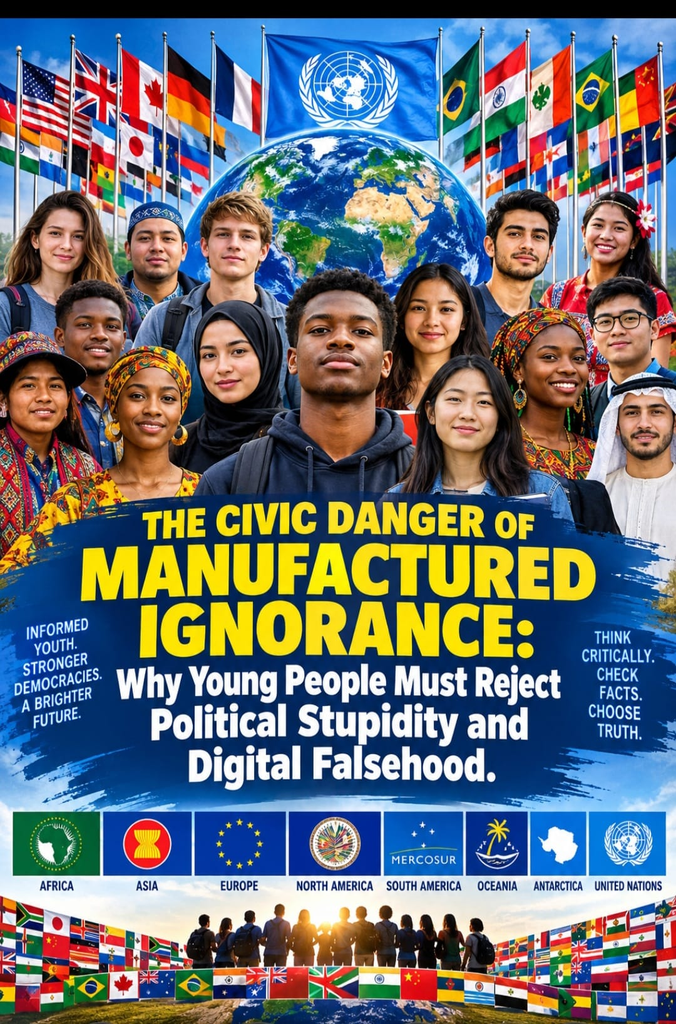
These problems are serious, but they become far more destructive when citizens are encouraged to distrust knowledge, reject evidence, glorify ignorance, and follow leaders who offer slogans instead of solutions.
The danger is not simply that some people make mistakes or lack information.
Everyone has gaps in knowledge. The greater danger is organized stupidity: deliberately spreading falsehoods, conspiracy theories, tribal hostility, and anti-intellectual propaganda for political advantage.
Terms such as “city idiots,” “bush idiotism,” and “social-media idiotism” should be understood as descriptions of harmful behavior, not as descriptions of where people live or their personal worth.
A city idiot is not merely an uninformed person in an urban area. Rather, it is a person who loudly repeats fashionable misinformation without examining it, often confusing access to technology with intelligence.
Bush idiotism is not a judgment on rural people or traditional life; it describes the cynical use of ignorance, rumor, and fear as a political weapon, often disguised as “common sense” or cultural loyalty.
Social media idiotism is the habit of sharing emotional lies, manipulated videos, fabricated quotations, and reckless accusations without checking whether they are informed, political, good-for-nothing, lie-spewing, dangerous because they create societies in which noise defeats knowledge, outrage defeats judgment. Politicians can govern people through fear rather than competence.
Young people, often the most active users of digital platforms and the most vulnerable to political manipulation, must learn to recognize these dangers before they become victims.
Stupidity Is Not a Lack of Intelligence; It Is a Refusal to Think:
The ancient Greek philosopher Socrates inquired into the foundation of a responsible life. In Plato’s Apology, Socrates declares, “The unexamined life is not worth living” (38a). He did not mean that everyone must become an academic. It was that human beings have a duty to question their assumptions, test their beliefs, and avoid pretending to know what they do not know.
The most dangerous kind of stupidity is therefore not ordinary ignorance. Ordinary ignorance can be corrected through learning.
Dangerous stupidity is the stubborn refusal to learn, especially when evidence is available. It is the behavior of the politician who knows that a claim is false but repeats it because it gains applause and public sympathy.
It is the social media influencer who spreads a fabricated story because it will attract followers. It is the citizen who says, “I do not need facts; I know what I feel.”
Plato warned about this political danger in The Republic. In his famous “ship of state” analogy, he describes a vessel whose crew members fight to control the ship even though they do not understand navigation.
The person who actually knows how to steer is dismissed as useless. Plato’s image remains relevant: a society becomes unstable when it rewards loudness and incompetence, elevates idiots over competence, and treats expertise as an enemy of the people.
Niccolò Machiavelli, though often remembered as a thinker of political ruthlessness, also understood the importance of appearances in public life. In The Prince, he observed that “men in general judge more by their eyes than by their hands,” because everyone can see appearances but few understand reality.
This insight explains why dishonest political propaganda can work so effectively.
A politician may wear humble clothing, repeat popular slogans, attack “elites,” and speak in emotional language while quietly serving corrupt interests.
Voters who judge only by performance, rather than policies and results, can be manipulated.
The lesson for young people is clear: never confuse confidence with truth, popularity with wisdom, or simplicity with honesty.
The Political Uses of Ignorance:
Good-for-nothing politicians do not always want an educated and thoughtful public.
Citizens who ask questions are difficult to deceive. Citizens who compare sources, examine budgets with open minds, interpret numbers logically, demand evidence, and hold leaders accountable are difficult to control.
By contrast, a misinformed public and a very rude bunch of idiots can be easily divided into hostile camps.
A common political strategy is to blame vulnerable groups for problems caused by poor governance.
Instead of explaining unemployment, leaders may blame immigrants, ethnic minorities, foreign countries, young people, women, intellectuals, or journalists.
Instead of fixing broken schools, hospitals, roads, and economies, they create enemies.
Instead of building national unity, they turn citizens against one another.
The Nigerian novelist Chinua Achebe stated the issue bluntly in The Trouble with Nigeria: “The trouble with Nigeria is simply and squarely a failure of leadership.” Achebe’s observation applies beyond one country.
Societies do not remain poor simply because their people lack talent. They remain poor when leaders protect corruption, weaken institutions, reward loyalty over competence, and distract the public with empty propaganda.
Political stupidity becomes especially dangerous when leaders tell young people that education, science, understanding public policy, voting for me, journalism, and critical thought are foreign or unnecessary.
This message is designed to produce dependence. A young person who can not distinguish a fact from a rumor may vote against their own interests.
A young person who believes every conspiracy theory may reject medicine, education, entrepreneurship, and civic cooperation.
A young person who is taught to hate fellow citizens may become an instrument of violence for politicians who will never suffer the consequences themselves.
President John F. Kennedy warned against the power of persistent myths in a 1962 speech at Yale University: “The great enemy of the truth is very often not the lie—deliberate, contrived and dishonest, but the myth persistent, persuasive and unrealistic.”
A myth can be more dangerous than a single lie because it becomes part of a group’s identity.
Once people become emotionally attached to a falsehood, correcting it may feel like an attack on their community.
That is why propaganda often uses national pride, religion, ethnicity, or tradition.
These are meaningful parts of human life, but dishonest leaders can misuse them.
They tell citizens that questioning a leader means betraying the nation, that verifying a claim means rejecting faith, or that criticizing corruption means supporting outsiders.
Such arguments are traps. Genuine patriotism demands better leadership, not blind obedience.
The Danger of “Bush Idiotism” and Anti-Knowledge Politics:
Bush idiotism, properly understood, is the romanticizing of ignorance as authenticity.
It is the claim that anyone who asks for evidence is arrogant, while anyone who repeats an old rumor is “close to the people.” It is politicians performing simplicity to keep citizens uninformed.
This form of manipulation may involve rumors about elections, public health, education, technology, or ethnic groups.
For example, during disease outbreaks, false claims about vaccines, herbal cures, or supposed secret plots can cause people to reject lifesaving medical treatment.
During elections, fabricated stories about ballot theft or imaginary enemies can provoke violence.
During economic crises, rumors can cause panic, discourage investment, and destroy trust in institutions.
African wisdom traditions offer a powerful answer to this narrow-mindedness.
A widely translated Akan proverb says, “Wisdom is like a baobab tree; no one individual can embrace it.”
The proverb recognizes that no single person possesses all knowledge.
Wisdom requires consultation, humility, and collective learning.
It rejects the arrogance of the propagandist who claims to have all answers while dismissing teachers, doctors, researchers, journalists and experienced citizens.
Another well-known African proverb, often associated with Ethiopia, says, “When spider webs unite, they can tie up a lion.” Its lesson is that cooperation gives ordinary people strength.
Young citizens do not have to be isolated victims of propaganda.
They can form study groups, fact-checking networks, positive community organizations, campus associations (not the ill-informed, political, good-for-nothing lie-spewing propaganda slogans one), and professional alliances.
When people share reliable information and challenge falsehood together, the influence of dishonest political actors declines.
Nelson Mandela, former president of South Africa, expressed a similar belief when he said, “Education is the most powerful weapon which you can use to change the world.” Education here means more than certificates. It means the ability to think independently, assess evidence, understand history, and act responsibly toward others.
Social-Media Idiotism and the Speed of Falsehood:
Social media has created unprecedented opportunities for communication.
A student can access lectures, libraries, scientific research, and global conversations from a phone.
Yet the same phone can become a machine for spreading ignorance.
A lie can travel through WhatsApp, TikTok, Facebook, X, Instagram, or YouTube before a careful correction reaches the public.
Social media idiotism thrives on speed, anger, and attention.
People share a shocking headline because it confirms what they already believe.
People treat a short video as proof even when it has been edited, taken out of context, or created by artificial intelligence.
A false quotation is reposted because it appears beside a photograph of a famous leader.
In many cases, users do not ask basic questions: Who created this? What is the source? When was it published? Is there independent evidence? What might the author gain by making this claim?
The historian and political thinker Hannah Arendt warned of a condition in which citizens lose the ability to distinguish fact from fiction.
In The Origins of Totalitarianism, she wrote that the ideal subject of totalitarian rule is one “for whom the distinction between fact and fiction … and the distinction between true and false … no longer exist.”
This is a frightening warning for the digital age.
A society does not need to be convinced of one official lie to become vulnerable.
It is enough for people to conclude that nothing can be known and that all sources are equally dishonest.
The astronomer and science writer Carl Sagan made a related argument in The Demon-Haunted World: “One of the saddest lessons of history is this: If we’ve been bamboozled long enough, we tend to reject any evidence of the bamboozle.”
In other words, deception can become psychologically comfortable.
People may defend falsehood because admitting they were deceived feels embarrassing.
But intellectual maturity requires the courage to say, “I was wrong. I have learned something new.”
Young people must reject the idea that sharing unverified content is harmless.
A false accusation can destroy a person’s reputation. A fake medical claim can cause illness or death. A manipulated political video can incite hatred. A conspiracy theory can turn neighbors into enemies.
Institutions, Corporations, and the Duty to Verify:
Critical thinking must apply not only to politicians and social media personalities but also to corporations, governments, religious figures, journalists, and activists.
No institution should receive automatic trust merely because it is powerful or respected.
For example, Novartis states its corporate purpose as “to reimagine medicine to improve and extend people’s lives.”
That statement reflects an important aspiration, but responsible citizens should evaluate all corporate claims through evidence, independent research, transparent regulation, and ethical scrutiny.
In 2020, Novartis agreed to pay $678 million to resolve U.S. allegations involving improper payments to patients through charitable foundations, while denying wrongdoing in the settlement.
The lesson is not that medicine should be distrusted. The lesson is that even major institutions must be accountable.
Blind faith and blind cynicism are both forms of intellectual weakness; informed scrutiny is the better path.
Former US President Franklin D. Roosevelt warned in a 1938 message to Congress that “the liberty of a democracy is not safe if the people tolerate the growth of private power to a point where it becomes stronger than their democratic state itself.”
His warning applies to corporations, political parties, media owners, and wealthy interests. When citizens stop questioning power, power becomes irresponsible.
A Better Standard for Young Citizens:
The poet W. B. Yeats captured a familiar political problem in “The Second Coming”: “The best lack all conviction, while the worst / Are full of passionate intensity.”
When reasonable, informed people withdraw from public life, the loudest extremists can dominate the conversation.
Young people must not surrender public space to propagandists, trolls, ethnic agitators, and political fraudsters.
They should practice several habits:
- Verify before sharing. Look for the original source, date, author, and supporting evidence.
- Read beyond headlines. Emotional headlines are often designed to manipulate attention.
- Compare credible sources.Do not rely on one politician, influencer, or anonymous account.
- Reject ethnic and religious scapegoating. Governance problems require policies, not hatred.
- Ask who benefits.Every piece of propaganda serves someone’s interest.
- Respect expertise without worshipping authority. Question doctors, teachers, scientists, and journalists fairly, not dismissively.
- Participate in civic life. Vote, attend community meetings, support independent journalism, and demand accountability.
The future of any society depends not merely on its natural resources or its politicians but on the quality of its citizens’ judgment.
Stupidity, when organized and politicized, keeps people divided, poor, fearful, and underdeveloped.
City idiots, bush-idiot propagandists, and social-media merchants of falsehood flourish when young people abandon critical thought.
They lose power when citizens become curious, informed, courageous, and united around truth.
The central task is not to pretend that every person will agree on every issue. Democracy permits disagreement.
The task is to insist that disagreement be grounded in facts, reason, human dignity, and a willingness to learn.
As Socrates understood, a society that refuses self-examination can not govern itself wisely.
Young people must therefore choose the harder path: to think, verify, question, learn, and refuse to become tools in someone else’s campaign of ignorance.
Support Independent Journalism
Your support helps FrontPage Africa continue delivering independent, credible, and impactful journalism. Every contribution strengthens our ability to investigate, inform, and hold power accountable while keeping quality journalism accessible to our readers.
Support our journalism or subscribe to receive the latest FrontPage Africa stories and updates.