
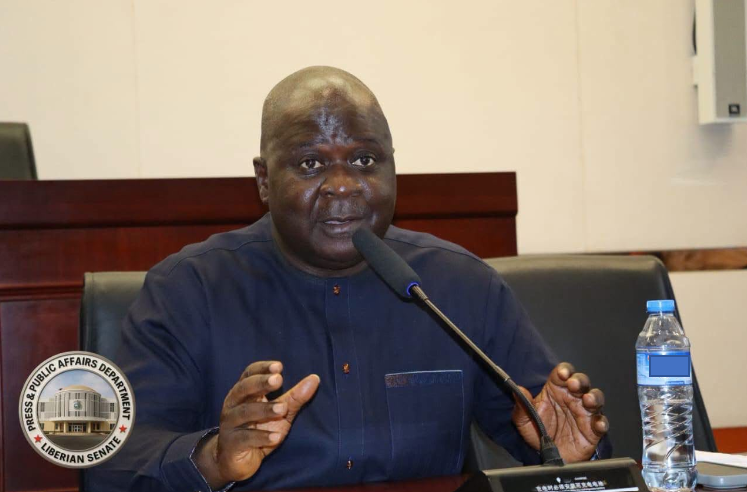
MONROVIA — Stephen M. Yekeson Jr. told senators Wednesday that he wants to be “judged by what is delivered.” His confirmation statement gives the Senate one promise it can test within 100 days, and many more it cannot.
By Rodney D Sieh
Appearing before the Senate Committee on Commerce and Industry, the acting Commerce and Industry Minister set out a vision to have Liberia “produce more of what Liberia consumes” by 2029. He pledged to protect consumers, enforce Liberian-only business sectors and cut the cost of moving goods “between the ship and the shop.”
His firmest commitment: within 100 days, the ministry will publish weekly prices for rice, fuel and cement in all 15 counties. Beyond that, the statement leans on verbs such as “work with,” “engage” and “address,” with few numbers, dates or budgets attached. Set against the problems now pressing on traders and households, the distance between promise and mechanism is where the scrutiny belongs.
A stronger dollar that isn’t reaching the market
Yekeson’s most striking admission was that prices have kept rising “in spite of a stronger Liberian Dollar.” The Liberian dollar was Africa’s best-performing currency in September, closing the month at about L$172 to US$1.
Small traders in Monrovia say the gains are not passed on. They report that some wholesalers still price stock at about L$190 to the dollar while the market rate sits near L$170, a gap of nearly 12 percent.
On October 6, Yekeson announced a five-point plan under which the ministry would work with the Central Bank to require supermarkets, wholesalers and retailers to post the bank’s daily exchange rate. That measure does not appear in his Senate statement. Instead, he cites a “reengineered” Price Analysis Department and a better-resourced Inspectorate. Whether the posting rule is still coming, and when, is a question the committee should put to him.
Fuel: a review, but no formula
Fuel is where the Senate already has its own findings. A Senate probe found that diesel rose from L$840 to L$1,235 a gallon between October 2024 and September 2026, a 47 percent increase. Gasoline climbed from L$775 to L$985 over the same period. The probe also found that Bea Mountain paid nothing on 16.4 million gallons of diesel.
The senator leading that inquiry proposed that the Liberia Petroleum Refining Company (LPRC) publish its full pricing formula every week. Yekeson’s statement moves in that direction but stops short. He promises to review pricing with the LPRC, and says regulated prices should be “transparent, rule-based and regularly reviewed,” reflecting verified import costs, duties, transport and a reasonable margin.
He does not commit to publishing that formula. His weekly price list would show what motorists pay at the pump, not how the figure was reached. He also names the LPRC, a petroleum body, as his partner in reviewing rice and cement pricing, a pairing he did not explain.
Rice: a global squeeze is coming
The next test may arrive before his 100 days are up. World rice prices are up about 67 percent on the year and hit a 26-month high in early October.
At home, the price of the staple was last fixed in March. After an emergency meeting with six major importers, the ministry announced that a 25kg bag would stay at US$14.00 wholesale and US$14.50 retail.
With import costs climbing, importers are likely to push for an increase. Yekeson’s formula of verified costs plus a reasonable margin may justify one. His weekly price list will then put any rise in public view, county by county. The Senate should ask him now whether US$14.50 can hold, and on what basis it would change.
An Inspectorate that barely registers
Yekeson promises inspectors will pursue “hoarding, collusion, false invoicing and short measures.” The ministry’s own figures suggest little enforcement capacity today.
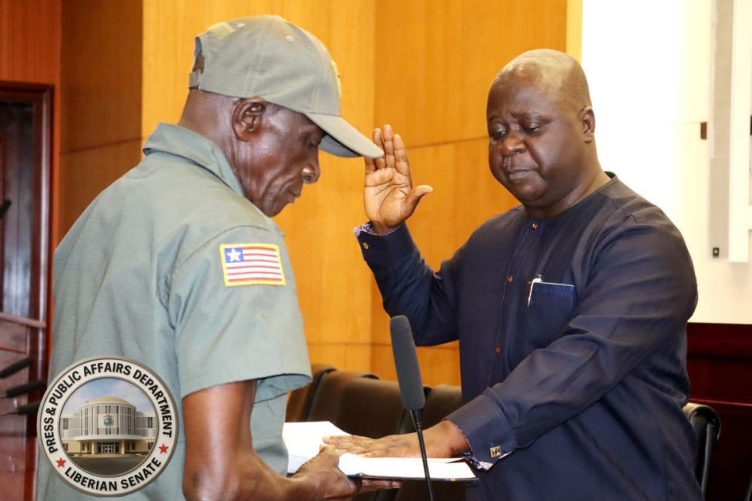
At a budget hearing last week, he reported that the ministry had collected about US$4.12 million by September 30. Of that, inspectorate fees and fines brought in roughly US$48,700, about 1 percent. He acknowledged those collections could improve.
The pledge is also not new. In 2024, his predecessor Amin Modad rolled out a rebranded Inspectorate Division to keep vendors from selling rice above the government ceiling. The committee should ask how many inspectors the ministry has, how many cases it opened this year, and what money comes with “resourcing” them.
Small business: right diagnosis, no deadlines
On Liberian enterprise, Yekeson’s diagnosis matches what traders report. He has said that women make up 75 percent of traders reporting financial constraints.
His answers are sensible but undated:
* Procurement set-aside. The law already reserves a quarter of qualifying public procurement for Liberian-owned small businesses. He promises to publish compliance “agency by agency,” but gives no date.
* Credit. A credit guarantee programme will come “only with the requisite approvals and clear fiscal safeguards,” a signal that no money is yet set aside.
* Late payment. He will “engage” concessionaires and “report progress,” with no target for how quickly government and companies must pay.
* Business registration. Service centres exist in seven counties, with nationwide expansion planned for 2027. His “every county” pledge carries no date.
* Liberians-only sectors. He will enforce the reservation of rice and cement retail, fuel stations and sand supply through ownership checks. He did not say how many such businesses are now foreign-owned.
The 2029 goal to “produce more of what Liberia consumes” has no baseline or target. He has also warned that a stronger currency can cut what farmers and processors earn, a tension his import-substitution plan does not address.
Questions of record
Yekeson told senators he will disclose all relevant interests, comply with the Code of Conduct and recuse himself where conflicts arise. He did not say whether he still holds shares or roles in South Atlantic Capital Group or Panchariya Group West Africa, where he previously served as CFO and president, respectively.
His appointment has also revived older questions. Smart News Liberia reported that his name appeared in a 2013 Liberia Anti-Corruption Commission asset verification that raised questions about deposits totaling more than US$300,000. His statement did not address it.
What the Senate should hold him to
Yekeson’s statement is the work of someone who knows the market’s pressure points. The question for senators is whether they will confirm the diagnosis or demand the mechanisms.
Five commitments would turn the speech into a record that can be checked:
1. Weekly county-level prices for rice, fuel and cement, published by the 100-day mark.
2. A date for the rule requiring traders to post the Central Bank’s daily exchange rate.
3. Publication of the full fuel pricing formula alongside pump prices.
4. An agency-by-agency report on the 25 percent procurement set-aside, with a deadline.
5. Full disclosure of his remaining business interests before confirmation.
He has offered quarterly reports to the committee. If confirmed, the first should show progress on each.
Support Independent Journalism
Your support helps FrontPage Africa continue delivering independent, credible, and impactful journalism. Every contribution strengthens our ability to investigate, inform, and hold power accountable while keeping quality journalism accessible to our readers.
Support our journalism or subscribe to receive the latest FrontPage Africa stories and updates.