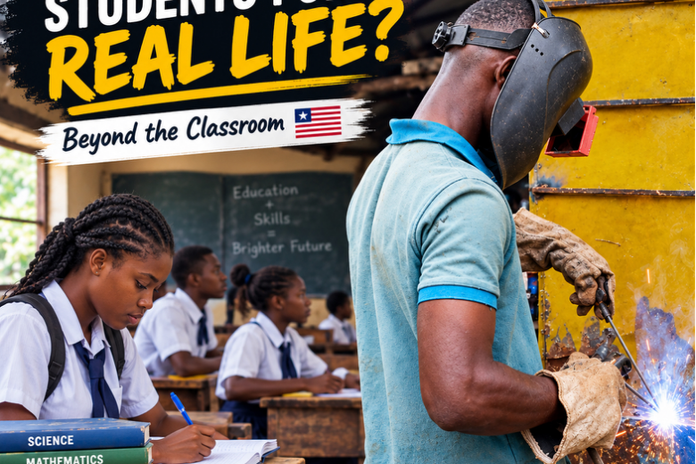
“They say, ‘having an education is one thing, being educated with skills is another, ” I would add that combining education, skills, and wisdom to deliver and achieve success is a whole different thing.”Be a useful, educated person, not a useful idiot. Jummah Mubarak! Blessed Friday!!”Facebook Post-Gbarpolu County, Liberia Senator Amara Konneh.
By: Austin S. Fallah, [email protected], contributing writer
Liberia stands at a crossroads that could define its future trajectory.
The cry for critical thinking and socioeconomic efficacy has never been more pronounced; this is particularly evident in the common refrain about “political know-it-alls.”
These individuals populate the sidewalks of Liberia, engaging in robust discussions that mask a troubling reality: they often know little about constructive governance and political engagement.
Their incessant grandstanding and empty rhetoric distract from the pressing need for meaningful discourse and action essential for Liberia’s progress.
In considering the path ahead, we must unpack this cultural phenomenon, analyze the challenges it presents, and delineate the necessity for a sweeping transformation.
At the core of Liberia’s challenges lies the lamentation of a populace weary of mediocrity, unproductive behavior, and social and political regression. Young people’s empowerment and active participation in governance are crucial at this juncture.
They are the future of Liberia, and their involvement can help to fuel a renaissance of critical thought and innovative solutions to the country’s myriad issues.
The pervasive attitude of self-destruction and the reluctance to embrace progressive ideas lead to a stagnation that erodes national potential.
It is vital to recognize that the path to advancement begins with acknowledging Liberia’s current position in the global context.
By observing other nations that have made significant progress in the 21st century, it becomes apparent that their success is rooted in education, innovation, and a collective drive for continuous improvement.
While engaging in the global economy, Liberia’s adversities, corruption, tribalism, and incompetence work against the ideals of progress and unity.
By opting for destruction over collaboration, Liberians are indeed hurtling towards a form of societal suffocation.
The use of the descriptor “mouth chor-chor” suggests that there is no shortage of voices clamoring for attention.
However, the emphasis must shift from empty talk to informed discourse that induces effective change.
There is an urgent need for a collective awakening among Liberians.
For far too long, political and social dialogues have been dominated by individuals who perpetuate ignorance rather than enlightenment.
The young people and broader society must cultivate critical thinking, fostering an environment where ideas are rigorously examined and innovative solutions are proposed.
This will require an investment in education, encouraging learners to question orthodoxies, challenge narratives, and seek alternatives.
Integrating critical thinking into educational curricula will help young people develop an analytical mindset, which is paramount to addressing Liberia’s legislative and socioeconomic challenges.
Moreover, the reconstruction of Liberia is intrinsically linked to socioeconomic emancipation.
This emancipation can catalyze a wave of creativity and productivity that transforms the nation.
Young people must embrace entrepreneurship, seeking to develop businesses that not only provide jobs for themselves but also for their communities.
Enhancing the country’s capacity for innovation will enable it to move beyond its dependency on traditional sectors and diversify its economy.
As evidence has shown, nations that invest in their young people and foster entrepreneurial spirit reap returns in the form of robust economies and lower poverty levels.
In examining the social fabric of Liberia, it becomes clear that tribalism must also be dismantled as a barrier to collective advancement.
The deeply entrenched tribalist attitudes have fragmented society, perpetuating cycles of distrust and conflict.
When people identify primarily with their ethnic groups rather than as citizens of Liberia, progress becomes stymied.
A commitment to inclusivity, mutual respect, and collaboration across tribal lines is essential.
Building a unified national identity will foster not only a sense of belonging but also collaboration in achieving common goals.
The significance of collective action can not be embellished.
Community initiatives that bring together individuals from diverse backgrounds can facilitate critical dialogue and encourage greater empathy among citizens.
When people see beyond their tribal affiliations and recognize their shared interests as Liberians, they are more likely to join forces for the overall betterment of their Mama Liberia.
These initiatives could foster a new political culture that prioritizes transparency, accountability, and competence over mediocrity and partisanship.
Indeed, the Liberian political landscape has suffered under the weight of corruption, incompetence, and ineffective leadership.
As noted earlier, “political know-it-alls” often perpetuate this cycle, prioritizing their own interests over those of the people.
To dismantle this paradigm, a new breed of leadership must emerge —one grounded in integrity, vision, and a dedication to service.
Citizens must demand accountability from their leaders, pushing for the reform of corrupt systems and practices.
Grassroots movements can play a fundamental role in this transformation, mobilizing citizens to advocate for good governance and transparency.
Furthermore, the role of technology in political and social discourse can
not be ignored.
In an increasingly digital age, the internet and social media offer unprecedented opportunities for citizens to engage, learn, and mobilize.
Young Liberians can utilize these tools to disseminate information, raise awareness, and mobilize action on pressing issues.
Digital platforms can serve as virtual town halls where discussions flourish, ideas are born, and collective action is coordinated.
By harnessing the power of technology, Liberians can redefine their narrative and propel the nation towards sustainable development.
While the path to transformation is fraught with challenges, the potential for a brighter future is palpable.
The collective will to make meaningful changes, through education, collaboration, innovation, and accountability, can steer Liberia toward realizing its full potential.
It remains essential that individuals, especially young people, take on the responsibility of realigning priorities for genuine national progress.
By choosing to reject mediocrity and unproductive rhetoric, Liberians can revive a sense of hope and pave the way for a society in which cooperation, integrity, and prosperity are paramount.
As Liberia grapples with these transformative discussions, the time for action is now.
It is crucial to foster an environment that encourages critical thinking, empathy, and a shared vision for the nation, while holding corrupt officials accountable.
The days of crying political witch hunts as a beacon of seeking public sentiments, and political tautologies are over, and people must be made to account for their inhumane, corrupt actions against the downtrodden of Liberia, who continue to linger in abject poverty.
With the emphasis on collective advancement in socioeconomic emancipation, young Liberians are tasked with the monumental duty of shaping a future that obviates the shadows of self-destruction.
The opportunity to reconstruct Liberia has arrived, and the onus is on every citizen to contribute to this significant journey towards an enlightened, united, and prosperous nation.
Ultimately, the time to bury mediocrity, incompetence, and tribalism is indeed now.
The task may be daunting, but by rallying around a common purpose, Liberians have the power to transcend the limitations of the past and create a legacy that future generations can be proud of.
Support Independent Journalism
Your support helps FrontPage Africa continue delivering independent, credible, and impactful journalism. Every contribution strengthens our ability to investigate, inform, and hold power accountable while keeping quality journalism accessible to our readers.
Support our journalism or subscribe to receive the latest FrontPage Africa stories and updates.