President Joseph Nyumah Boakai and global institutions champion infrastructure, encapsulated by the maxim that the road to development begins with the development of roads. Specific direct statements on the vital role of drivable roads in modern progress reflect official policy positions and institutional findings.
President Joseph Nyumah Boakai: Emphasized during infrastructure addresses that “the road to development begins with the development of roads,” noting that sustainable growth relies on “connecting people to opportunities, businesses to markets, children to schools, and patients to healthcare.”
I always enjoy being in the Hands-On and Barbershop, where the Phil Intellectual Engagement Center in the Midwest of the United States offers a free flow of intellectual engagement, welcoming people without language barriers (abusive tongues) that undermine discourse.
I see daily leaders and young people who carry a real vision for their nation, Liberia, ask thoughtful questions and try to make wise decisions amid the nation’s social and economic imbroglio.
They say, “This environment(Liberia)is full of both opportunity and complexity.
One of the things that stands out to me again and again when we gather is that most young people and leaders are not lacking vision.
In many cases, leaders and young people have a clear sense of where they believe God is leading Liberia.
They can see the need; they can feel the pressure the government of Liberia is going through, and they say, “The government is trying to be faithful with what the Liberian people entrusted to it in 2023: to lead them to a land free of drugs and socio-economic degradation.”
Austin S. Fallah: “Development does not listen to half-baked, so-called, self-claimed noise-making, ill-informed, know-nothing intellectuals with nothing to add to the discourse of social and economic empowerment of the downtrodden and their nations, but spew baseless empty tautologies daily. Development listens only to those who add value to their nations, not the naysayers.”
The World Bank: Stated in global transport evaluations that “roads are the arteries through which the economy pulses,” emphasizing that linking producers to markets makes road networks vital to any development agenda.
United Nations Economic and Social Commission for Asia and the Pacific (UNESCAP): Noted in sector reports that “roads are the easiest and fastest solution to rural development and poverty alleviation,” providing essential door-to-door access to medical and educational services.
By: Austin S Fallah – A True Son of the Planet Earth Soil: [email protected]
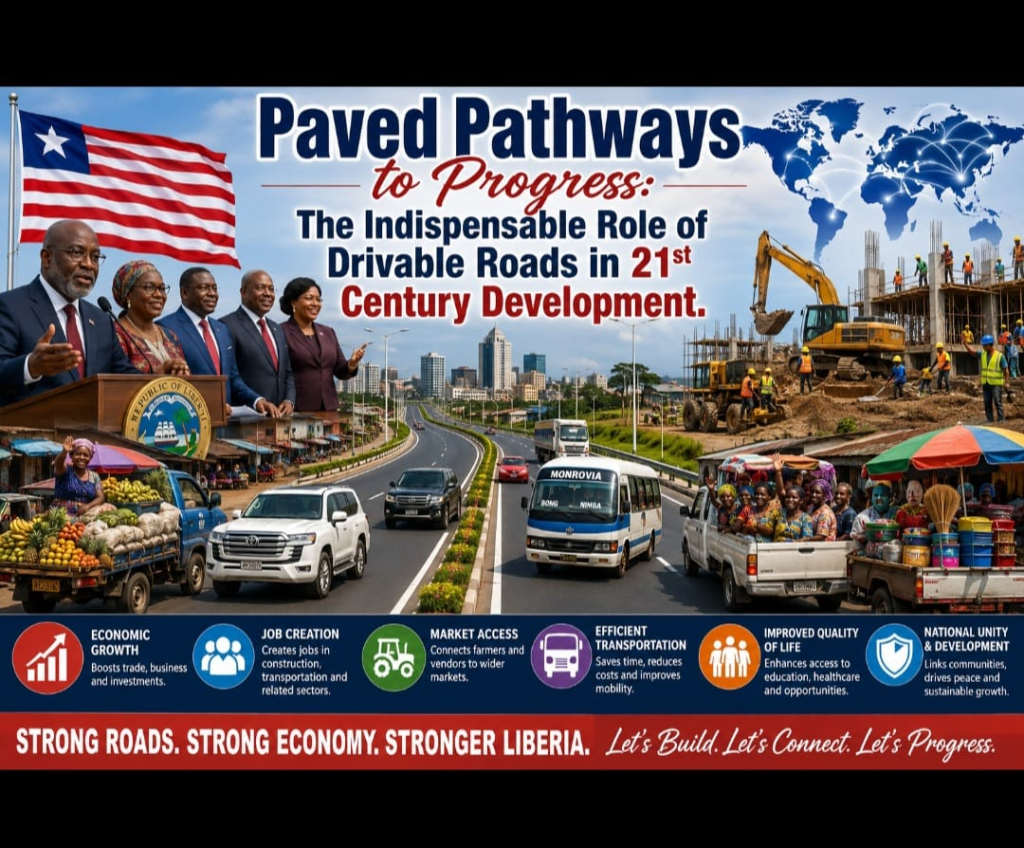
In the 21st century, where technology and innovation seem to shape the future at a breakneck speed, one essential element that remains at the core of national development is infrastructure, specifically paved and drivable roads.
These roads serve as the arteries of a nation, facilitating commerce, enhancing social connections, and fostering economic growth.
By connecting rural farmers to urban markets, they act as vital conduits for transport, trade, and social interaction.
A nation with well-constructed roads is akin to a well-functioning body; the circulatory system ensures adequate blood flow, while roads ensure the free movement of goods and people.
Consider the example of Liberia, under the stewardship of President Joseph Nyuma Boakai.
The nation, having faced decades of civil strife and economic instability, is now embarking on a new frontier that prioritizes infrastructure development, particularly in the realm of transportation.
The mantra of paving roads is not merely about laying asphalt; it signifies establishing a foundation for employment generation, enhanced market access, and social unity, the very fabric of a prospering society.
In the context of agriculture, paved roads unlock potential for productivity.
Imagine a local farmer, steadfastly tilling his land, nurturing crops that have blossomed under our Creator, Hala-Nah-God-Almighty, created sun.
Yet, despite his efforts, the produce faces a grim fate if it cannot reach the market promptly.
Without infrastructure, ripe vegetables rot in the fields, and farmers are left grappling with losses.
Paved roads alleviate this suffering. They connect agricultural hubs to bustling markets, allowing fresh produce to reach consumers promptly and efficiently.
For instance, a farmer in Margibi, Lofa, Gbapolu, Cape Mount, Sinoe, Bassa, River Cess, Maryland, Bomi, Montserrado, River Gee, Nimba, Bong, Grand Kru, Grand Gedeh counties can now transport cassava, rice, plantains, peppers, oranges, plums, good red country palm oil, and many more earth products, which had traditionally taken hours over unpaved, dilapidated routes, to Monrovia, and other district headquarters, cities and counties headquarters within a fraction of that time.
This shift not only boosts the farmers’ income but also strengthens food security, a crucial pillar in national development.
However, the impact of improved road infrastructure extends beyond agriculture.
It permeates social engagements and catalyzes community-building.
With drivable roads, citizens enjoy easier mobility, allowing them to visit family, attend social events, and participate in civic duties.
For example, in a country like Liberia where communal ties are strong, improved roads mean that individuals can partake in celebrations, funerals, or merely neighborly visits without the impediment of time-consuming travel.
This enhanced connectivity fosters a sense of unity among citizens, transforming distant communities into interconnected ones.
Economically, the case for roads is equally compelling.
A well-maintained road network lowers transportation costs for businesses, enabling them to move products swiftly and efficiently.
This, in turn, stimulates local economies and attracts foreign investment.
When businesses save on logistics, those savings can be reinvested into growth, leading to job creation.
For instance, with the newly paved roads in Liberia, small enterprises can thrive, be it a budding restaurant with fresh ingredients from local suppliers or a small-scale manufacturer who can now reach wider markets without prohibitive transportation costs.
The cycle continues: increased employment leads to higher incomes, which can spur further economic activity.
Furthermore, roads serve as a platform for educational opportunities.
Students who previously faced daunting travel times to access schools can now arrive punctually and in good health, a seemingly simple luxury that plays a critical role in educational success.
With more accessible educational institutions, the literacy rate can be improved, ushering in an era of informed citizens who can contribute meaningfully to national discussions and decisions, rather than mere spectators.
This is particularly relevant in Liberia, where educational disparity is a stark issue.
Investing in roads means investing in the future generation and creating an informed populace that can drive social and economic change.
Despite the evident benefits of paved roads, there are naysayers, the intellectuals who dismiss infrastructure projects as mere wastelands of governmental expenditure, arguing they deteriorate without the accompanying measures of social empowerment.
However, development does not heed the voices of those who merely squawk warnings.
Development listens to those who add value, who understand that infrastructure is a foundational element for any substantial progress.
Roads convert stagnant economies into dynamic markets; they facilitate progress at the grassroots level, where the seeds of development lie.
Historical cases abound where infrastructure has driven national transformation.
The United States, for instance, expanded its territory and consolidated its economy in the 19th century through the establishment of the transcontinental railroad.
The project not only connected the nation’s coasts but revolutionized trade, encouraged westward expansion, and amplified the mobility of people and goods.
Similarly, the Great North Road in Australia was a lifeline that opened the interior of the continent to new settlements and economic opportunities, turning isolation into integration.
In the context of African nations, roads have been a significant aspect of post-colonial development.
Botswana, which has consistently experienced high economic growth, has utilized its road infrastructure to facilitate tourism, mining, and agriculture, forming a robust economic base.
The country capitalized on paved routes to connect its capital, Gaborone, to southern regions and beyond, illustrating how infrastructure can catalyze growth.
Returning to Liberia, the unique opportunity under President Boakai’s leadership is a chance at a new narrative.
This narrative recognizes infrastructure as a critical stepping stone towards social and economic emancipation.
The open roads symbolize hope, progress, and a commitment to moving forward rather than hovering in perpetual discord.
They remind every citizen that their government is invested in their well-being, their mobility, and their potential to contribute to a thriving nation.
Let me conclude this korero by saying that the importance of paved and drivable roads in the development of any nation in the 21st century cannot be overstated.
They bridge gaps, connect lives, and forge paths to opportunity.
For nations to thrive, they must invest in infrastructure, ultimately acknowledging that improved transportation is more than a series of roads; it is a lifeline of economic growth, social connection, and national unity.
The story of Liberia and its journey toward revitalization is a testament to the transformative power of paved roadways, an investment in the present that paves the way towards a prosperous future for all.
In the relentless pursuit of progress, let every patriotic Liberian heed the call of infrastructure as an enabler, not merely a backdrop to socio-economic discourse, but the very framework upon which the edifice of development stands.
Support Independent Journalism
Your support helps FrontPage Africa continue delivering independent, credible, and impactful journalism. Every contribution strengthens our ability to investigate, inform, and hold power accountable while keeping quality journalism accessible to our readers.
Support our journalism or subscribe to receive the latest FrontPage Africa stories and updates.