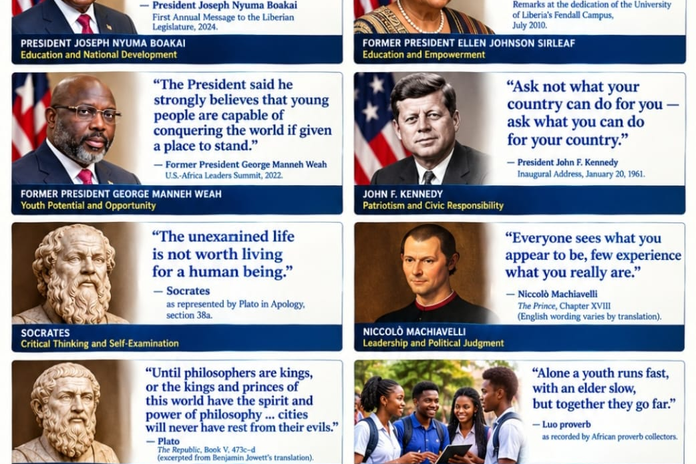
“You can not draw a line between poverty because almost every one of us has endured it. I have firsthand experience of poverty during Liberia’s civil war.” – Austin S Fallah.
Overcoming poverty is not a gesture of charity. It is an act of justice. It is the protection of a fundamental human right, the right to dignity, and a decent life.” — Nelson Mandela.
“Poverty is the parent of revolution and crime.” — Aristotle.
Hon. Edward Wesee: I have endured poverty and know what it looks like, and from there I became grateful.
“God does not make poverty. It is created by you and me when we don’t share what we have.” — Mother Teresa.
“Working for the eradication of poverty is not a matter of charity; it is a matter of justice.” — Kofi Annan.
Alhaji V Kromah: I have drunk from the fountain of poverty, and from there I developed a dream.
“Extreme poverty anywhere is a threat to human security everywhere.” — James Wolfensohn.
“Where men are forbidden to honor the dignity of the human person, they are also forbidden to honor the dignity of labor.” — Pope John Paul II.
“The test of our progress is not whether we add more to the abundance of those who have much; it is whether we provide enough for those who have too little.” — Franklin D. Roosevelt.
“To be poor is to be invisible. To be extremely poor is to be erased.” — Unknown.
“Poverty is a very complicated issue, but feeding a child isn’t.” — Jeff Bridges.
“Education is the most powerful weapon which you can use to change the world.” — Nelson Mandela.
“Poverty is the lack of all as much as it is the lack of one.” — St. Augustine.
“The hungry world can not be fed until and unless the small farmer is helped.” — Jimmy Carter.
“Give a man a fish, and you feed him for a day; teach a man to fish, and you feed him for a lifetime.” — Proverb.
“Poverty is like living in a cage with no door.” — Unknown.
“It is a hidden wound. It eats away at a person’s soul and their potential.” — Evelyn Lambart.
“The tragedy of the poor is that they have no choice but to be brave.” — Aravind Adiga.
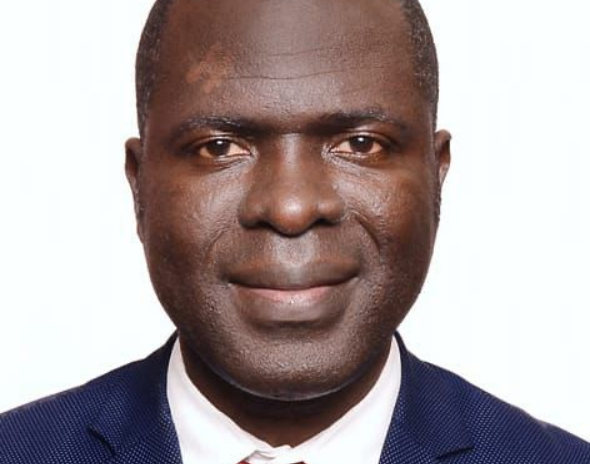
By: Austin S Fallah – A True Son of the Planet Earth Soil: [email protected].
Poverty remains one of the most pressing global issues of our time, acting as a shackle that binds millions to a life devoid of dignity and potential.
Nelson Mandela stated, “Overcoming poverty is not a gesture of charity. It is the protection of a fundamental human right, the right to dignity, and a decent life.”
This powerful assertion resonates across generations, underscoring that the battle against poverty is more than a social issue; it is a fight for the fundamental rights of individuals.
The narratives of impoverished communities reveal that this struggle is far from abstract; it demands action, empathy, and a paradigm shift in how poverty is understood.
Understanding the essence of poverty requires a multifaceted approach, one that goes beyond mere financial insufficiency.
This conceptualization aligns with the views of renowned economist Amartya Sen, who articulated that “Poverty is not just a lack of money; it is not having the capability to realize one’s full potential as a human being.”
This quote underscores the need to view poverty through a broader lens, encompassing not just economic deprivation but also social, educational, and health-related issues.
It is within this framework that we can begin to address the systemic factors that perpetuate poverty, especially in countries like Liberia, where the aftermath of civil conflict has left a legacy of economic instability and social fragmentation.
In Liberia, the struggle against poverty is intricately tied to the control and distribution of resources.
Muhammad Yunus, a Nobel laureate known for his pioneering work in microfinance, asserted, “If we go out into the real world, you cannot miss seeing that the poor are poor not because they are untrained or illiterate but because they cannot retain the returns of their labor.”
This observation resonates deeply within the Liberian context.
Many individuals in Liberia are hard-working and resourceful. Yet they find themselves trapped in a cycle of poverty due to limited access to capital, infrastructure, and opportunities to expand their businesses or improve their livelihoods.
The issues surrounding capital control are emblematic of the larger economic structure that favors those who already possess wealth.
Franklin D. Roosevelt once stated, “The test of our progress is not whether we add more to the abundance of those who have much; it is whether we provide enough for those who have too little.”
This perspective is particularly relevant in Liberia, where a small percentage of the population holds disproportionate wealth, while a significant number struggle to meet basic needs such as food, shelter, and education.
The stark income inequality underscores the urgent need for policies aimed at wealth redistribution and inclusive economic development.
However, the remedy for poverty must also take into account the profound lack of aspirations that can accompany such economic despair.
As Adam Smith poignantly noted, “The real tragedy of the poor is the poverty of their aspirations. (As a student of economics, one of my favorite quotes is).
In Liberia, the impacts of years of conflict and instability have instilled a sense of hopelessness and disillusionment among many.
This cultural malaise can stifle ambition and dampen the will to dream beyond immediate survival.
It is crucial, therefore, to implement programs that not only provide economic support but also empower individuals and communities to envision and work towards a better future.
Liberia’s path towards overcoming poverty is complex, yet not insurmountable.
Central to this progression is the focus on education, health, and infrastructure development.
Investing in education, particularly for women, girls, and the downtrodden, is fundamental to breaking the cycle of poverty.
Educated individuals tend to participate more in the economy, make informed health choices, and contribute positively to their communities and nation.
Engaging creative and positive local organizations and community leaders (not hooligans or money-eating human hyenas-vampires) in educational initiatives will ensure that the needs and aspirations of the population are considered, fostering a sense of ownership and agency among those most affected.
Moreover, healthcare access must be prioritized to prevent the further burdening of the impoverished population by preventable communicable diseases.
In Liberia, where health systems were severely weakened by conflict, ensuring access to quality healthcare can be transformative.
International bodies, NGOs, and the Unity Part y Liberian government must work collaboratively to rebuild these systems while emphasizing preventive care and nutrition.
The intersection of health and poverty can not be overemphasized; poor health often leads to diminished income and productivity, perpetuating the cycle of poverty.
Infrastructure also plays a pivotal role in an economy straining under the weight of poverty.
Developing essential infrastructure, such as roads(like the Unity Party under the leadership of Ambassador President Joseph Nyumah Boakai and Vice President Jeremiah Kpan Koung, not the Unity Party of Madam Dawoh), electricity supply(hope it continues to improve), and internet access(hopefully consistent,if feasible), will provide significant opportunities for economic advancement.
For example, improved transportation networks(NTA(formerly MTA) Public Transportation)can facilitate market access for farmers, allowing them to sell their goods at competitive prices.
Additionally, enhancing access to technology through internet connectivity can open doors to education, information, and commerce.
In today’s global economy, access to digital resources can be a game-changer for aspiring entrepreneurs and innovators in Liberia.
Furthermore, it is vital to create an enabling environment for small and medium enterprises to thrive.
Small and Medium Enterprises are often the backbone of economies, particularly in developing countries.
(Buy and read: Labor Patterns of Economi c Growth:Navigating the Way to Economic Freedom for Developing and Third-World Countries-By: Austin. S.Fallah).
By fostering a supportive policy environment and providing access to microloans and training, Liberia can empower local entrepreneurs to generate employment and stimulate economic growth.
Such initiatives not only help lift individuals out of poverty but also strengthen community bonds as they engage in collective economic pursuits.
Ultimately, overcoming poverty in Liberia, as Mandela articulated, entails recognizing and protecting the rights of the disadvantaged.
Beyond just charity, it is a call to uphold human dignity and promote justice.
Governments worldwide(particularly developed nations), NGOs, and international partners must take a holistic approach to poverty eradication, addressing its root causes and empowering individuals to reclaim their lives from the grips of despair.
The commitment to breaking the cycle of poverty transcends mere economic revitalization; it is about nurturing a society where all individuals, regardless of their background, can aspire to fulfill their potential.
In this quest, it is essential to elevate the aspirations of the impoverished, fostering hope, creativity, and resilience.
The journey towards equality and opportunity is fraught with challenges, yet it is indispensable to embrace this journey as a collective responsibility.
The fight against poverty in Liberia is not merely a humanitarian effort; it is a vital component of establishing a society where human rights are respected and dignity is upheld.
By ensuring equitable access to resources, investing in education and healthcare, and developing infrastructure, Liberians can galvanize the efforts needed to create sustainable change.
As nations reflect on the wisdom of constructive and critical thinking by activists and scholars, the collective goal should be to envision and create a world where poverty is not an inevitable condition but a challenge overcome, paving the way for a prosperous, dignified future for all.
Through empowerment, opportunities, and a relentless fight against inequality, the world can indeed foster a society where every individual can realize their full potential, because, in the end, the true measure of progress lies in how well we support those who have too little.
Support Independent Journalism
Your support helps FrontPage Africa continue delivering independent, credible, and impactful journalism. Every contribution strengthens our ability to investigate, inform, and hold power accountable while keeping quality journalism accessible to our readers.
Support our journalism or subscribe to receive the latest FrontPage Africa stories and updates.