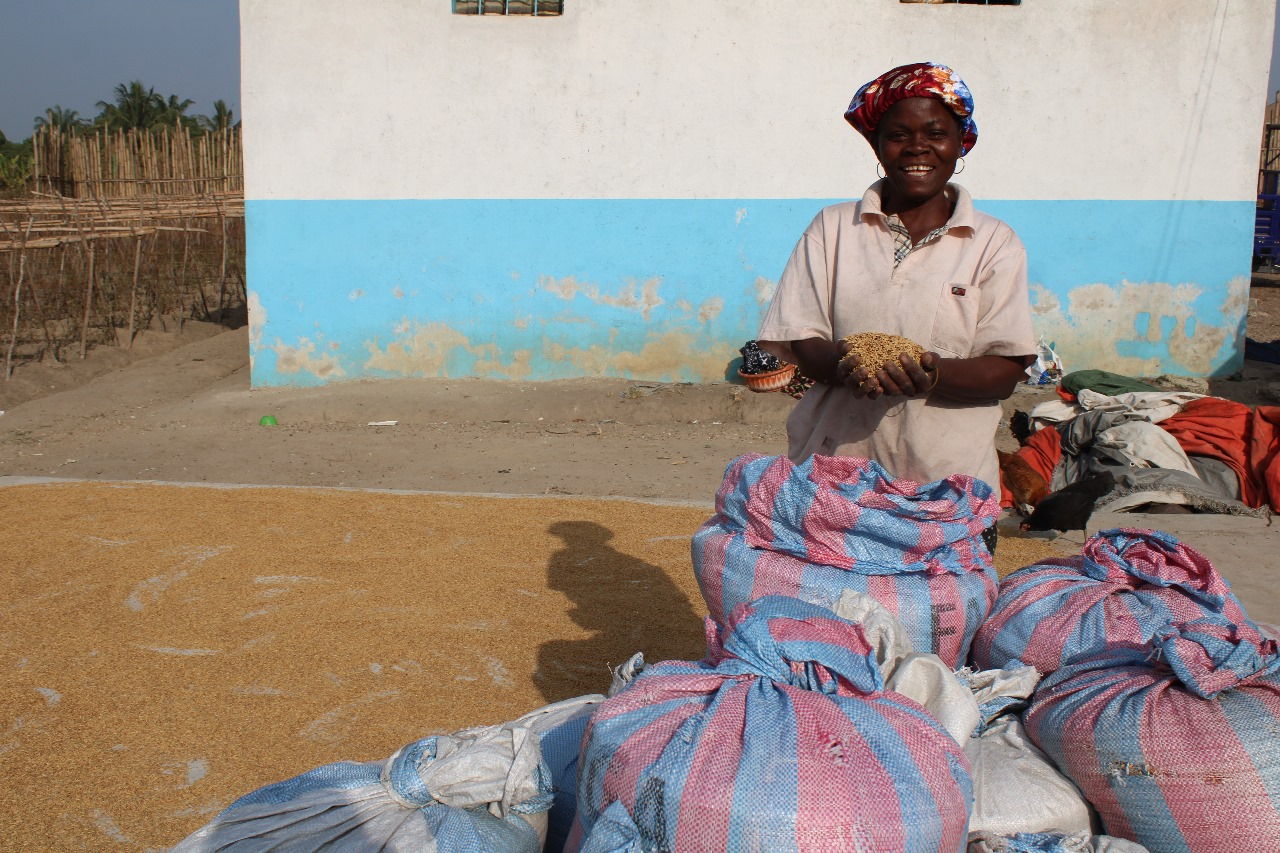
When scrolling through the UN Women and Orange Foundation-supported ”Buy from Women digital platform, the faces of four Liberian women farmers appear. Fifty-six-year-old Gertrude Kpoleh, an oil palm and cassava farmer from Bong County, is one of them.
By Tina S. Mehnpaine, contributing writer
Through her Cooperative, Meni-Nina Farmers, located in Bellemu Town, Bong County, Kpoleh’s crops are harvested from her farm, sold to the cooperative, and uploaded to the platform where customers from Liberia and other parts can browse to buy with prices attached. Customers are responsible for the delivery fees.
Before joining the Cooperative in 2021, Kpoleh struggled with access to the market to sell her crops. The deplorable road in her native hometown in Bong County prevented her from getting to the market in time, and finding customers to buy at an actual price was a challenge, causing her to lose profit and income when her perishable vegetables spoiled because she couldn’t find a buyer.
“I am so happy that I joined this cooperative,” said the mother of one and grandmother of four, who has been relieved from the burden of struggling to access the market and customers, now generating income from her goods sold to the cooperative.
Women farmers like Kpoleh are the backbone of Liberia’s economy, making up 80 percent of the agricultural labor force. From planting, harvesting, and distributing the products, they are responsible for 93 percent of food crop production seen on various market grounds.
Despite their important role in the sector, women farmers — and their male counterparts — lack access to markets, finance, and information on weather and climate change. Compounding these constraints are high poverty and literacy rates.
Launched in 2022, the US$250,000 project titled “Digital Inclusion for Women’s Economic Empowerment (D4WEE)” aims to limit challenges women encounter using digital tools. Spearheaded by UN Women and supported by the Orange Foundation Liberia and the Ministry of Gender, Children, and Social Protection, the project aims to empower local women farmers like Kpoleh to leverage digital platforms that provide them with sustainable livelihoods.
Through the project, a partnership with the Central Bank of Liberia provided financial literacy and skills for farmers to be able to manage and raise income through the Village Saving Loans Association (VSLA).
The project also provided training and renewable energy-powered equipment, such as solar mills and solar dryers, to women-led cooperatives, enhancing their productivity, value addition, and income diversification.
To date, the buy from women platform has 4,454 registered sellers; 81% (3,619) are women, according to an email from the UN Women country team in Liberia, with 230 active registered buyers that regularly browse the website to buy their products. These women are recruited across 17 cooperatives.
According to UN Women, the platform has successfully facilitated 591 sales transactions, generating a total income of LDR 65,736,319 (approximately USD 349,300). “What makes our platform truly unique is its focus on empowering women not only in agriculture but other areas, including arts and crafts, clothing, and fisheries. “
“Each transaction on the platform represents more than just a sale—it’s a step toward financial independence and sustainable livelihoods for women farmers and entrepreneurs who previously faced significant barriers to market access, information, and finance. The platform continues to grow as more buyers recognize the quality and value offered by our community of sellers.”
“Farm, sell, and manage your own money.”
Mamie Saye had never been to school. As a member of the Sua-Yelle Multipurpose Cooperative in Gbartala, Yellequelleh District, Bong County, she was fortunate to be among the women who enrolled in the Cooperative’s adult literacy Program supported by the D4WEE project. Through the program, Saye and her peers are taught numeracy and business skills, where they can keep simple records of their activities, write their names, and calculate profits by themselves.
“I’m happy I can now spell my own name, and I know my orange mobile money number, where nobody will do any business on my behalf,” says Mamie. Like Kpoleh from Meni-Nina Farmers in Bellemu Town, Bong County, Mamie also sells to her group, the Sua-Yelle Multipurpose Cooperative. Her palm oil, bitter balls, and cassava are uploaded on the platform for customers to buy.
“I used to plant bitter bolls and cassava, with nowhere to sell,” Mamie recalled. “It used to spoil in my hands when I carried it in the market to sell because there was no buyer. But since I joined this cooperative, I can sell to them, and then they carry it on the buy from women platform that is helping me today. I can send my children to school and buy the food we eat.”
Founded in 2017, the Sua-Yelle Multipurpose Cooperative supports women farmers to eradicate poverty through agribusiness value chain development mechanisms focusing on production and value addition in the rice, cassava, vegetables, cocoa, oil palm, fish, and livestock subsectors. The Cooperative operates a Village Saving and Loan Association (VSLA) Program to enable members to have access to finance at the community level to enhance their farming activities. The current membership is 1,560 (1,056 females, 504 males, including 696 youths) farmers in 53 communities in Yellequelleh, Suakoko, Sanoyea, and Jorquelleh Districts, Bong County.
According to Musu Nana, head of the Cooperative, UN Women, the Orange Foundation, and the Central Bank of Liberia have been tremendously supportive. Before now, she says, the group struggled with access to funding, but now they have received training and financial support that empowered them to work with schools to supply rice, oil, and other products.
“For now, we have 97 schools in Bong and Lofa that we supply with beans, rice, gari, and red oil. We get it from farmers. Before the issue of the market was one of our problems, like most of our problems, so when we came across UN Women, they introduced the Buy from women platform so it’s almost like the buy from women is something that has been promoting us to the extent that sometimes people put in for material they want; sometimes we can’t readily get all to supply them,” Nana said.
Nana says every month, the Cooperative supplies more than 500 metric tons of rice to schools. Cooperative members are also given beans and other products to plant and harvest, and produce based on the percentage.
“Challenges still persist.”
The essence of the VLSA is to enable women to have access to finance to support their farming work and boost their livelihood. According to Nana, while some women have received initial financial support to enroll in the VSLA program, the fund is insufficient to keep up with keep supporting their work. She said more women from Gbartala and other parts of the county continue to express interest and fill out membership forms to join the cooperative, but adequate funding has been a challenge.
“We are appealing to Orange Foundation to provide agent SIM cards to facilitate mobile money transactions for the women so they won’t have to come here [Gbartala, the Cooperative’s office].
According to her, with the agent sim, the women can do their own transactions anywhere and don’t have to come to Cooperative head office.
Michael Pewu, the founder of the Meni-Nana farmer , echoed Nana’s plea. Pewu said they lacked enough equipment to produce more rice and other products and finances. The additional equipment and funds will increase production and workforce for the Cooperatives to meet it goals, according to Nana and Pewu.
Back in Bellemu and Gbartala in Bong County, Kpoleh’s Kpoleh, and Mamie are happy that the their goods are sold upon harvest, preventing their perisable goods from spoilage, while being paid.
Support Independent Journalism
Your support helps FrontPage Africa continue delivering independent, credible, and impactful journalism. Every contribution strengthens our ability to investigate, inform, and hold power accountable while keeping quality journalism accessible to our readers.
Support our journalism or subscribe to receive the latest FrontPage Africa stories and updates.