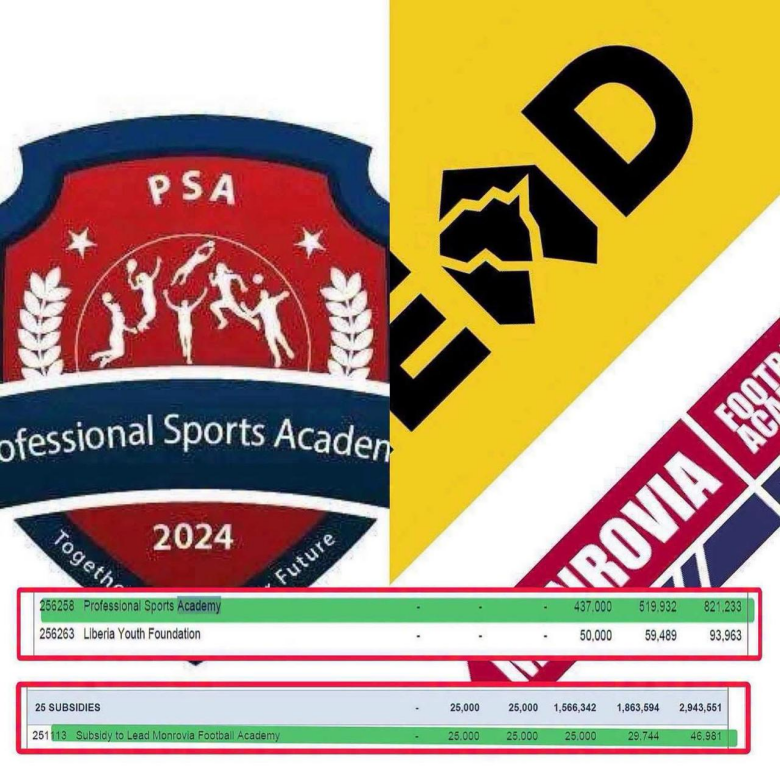
Monrovia — A proposed US$462,000 allocation to two football academies in Liberia’s FY2027 Draft National Budget has triggered mounting backlash from football administrators, grassroots academy owners, and sports stakeholders, who are demanding transparency and a more inclusive distribution of state funds.
By Christopher C. Walker, [email protected]
The draft budget earmarks US437, 000 for Professional Sports Academy and US25,000 for LEAD Monrovia Football Academy.
The disparity and selection process have drawn sharp scrutiny across the local football community, where dozens of community-based academies operate without state subsidies.
Youth and Sports Minister Cornelia Wonkerleh Kruah has distanced her ministry from the budgetary line items, clarifying that the Ministry of Youth and Sports did not determine the proposed grants.
According to Kruah, grant allocations are handled by the Ministry of Finance and Development Planning (MFDP) and the Legislature, and she urged concerned stakeholders to direct their inquiries to those institutions.
However, the minister’s explanation has failed to quell criticism, as stakeholders continue to question why two specific institutions were prioritized while longstanding grassroots programs remain unfunded.
CPAL Calls for US$1 Million National League Investment
Sylvanus Kelvin Morris, chairman of the Clubs Presidents Association of Liberia (CPAL) and president of Borough FC,has urged the government to scrap the current proposal and instead allocate US$1 million directly to the national football league.
Morris questioned the fairness of concentrating public funds on two privately operated entities while dozens of clubs struggle to finance basic operations and youth development programs.
He warned that favoring two institutions creates an uneven competitive playing field within Liberian football.
“Clubs across Liberia have consistently sacrificed their limited resources to keep football alive, providing opportunities for young boys and girls to develop their talents despite inadequate institutional and financial support,” Morris noted,adding that redirecting funds to the national league would ease operational burdens, raise playing standards, and benefit the broader football ecosystem.
He called on Minister Kruah to engage stakeholders to establish an equitable funding model.
Grassroots Administrators Express Frustration
Melton Yoko, chairman of the Montserrado County Sub-Association, criticized the government’s apparent neglect of community-based clubs and academies that have spent more than 15 years scouting and developing young talent without meaningful state assistance.
Yoko questioned why established grassroots programs continue to struggle while an institution reportedly linked to an individual appointed as Ambassador of Youth and Sports stands to receive a substantial budgetary windfall.

He also warned against the precedent of such allocations expanding in future budget cycles at the expense of proven community developers.
Academy Owners and Observers Question Selection Criteria
Prominent figures across the sector have echoed similar concerns:
Emmett Stages Glassco, president of the Senior Female Professional League questioned why other veteran grassroots academies were overlooked for state support.
Liberian Sports journalist and vice president of the Sports Writers Association of Liberia Edwin Dolo condemned the decision to allocate more than US$400,000 to a single academy,adding to growing calls for accountability in sports financing.
Scrutiny Shifts to MFDP and Legislature
The controversy underscores a wider debate over Liberia’s football development priorities.
While CPAL pushes for a US$1 million league-wide injection, grassroots academy owners are pressing for clarity on the vetting process and whether equitable grant opportunities will be opened to other qualifying institutions.
With Minister Kruah shifting responsibility to the MFDP and the Legislature, scrutiny now turns to lawmakers and finance officials as the FY2027 Draft National Budget undergoes review.
Stakeholders maintain that public funds must be governed by clear, transparent criteria that recognize the broader network of academies and clubs building Liberia’s next generation of footballers.