A coalition of civil society groups says signing long-term contracts under Liberia’s 2000 mining law would lock in the weak oversight, lost revenue and pollution that have marked the sector for decades.
MONROVIA, Liberia — A coalition of civil society organizations in Liberia has called on the government to stop signing and ratifying new long-term mining contracts until the West African nation replaces its 26-year-old mining law.
The CSO Consortium on Minerals, Mining, and Inclusive Sustainable Development made the appeal on Monday, October 26, at a press conference in the capital. It urged President Joseph Nyuma Boakai and the national legislature to impose a moratorium on new Mineral Development Agreements (MDAs) — the contracts, typically lasting 25 years or more, that set the terms under which large mining companies operate and that carry the force of law once lawmakers ratify them.
“We strongly believe that entering into new or additional long-term mineral development agreements under an outdated legal framework risk perpetuating existing governance weaknesses,” the coalition said.
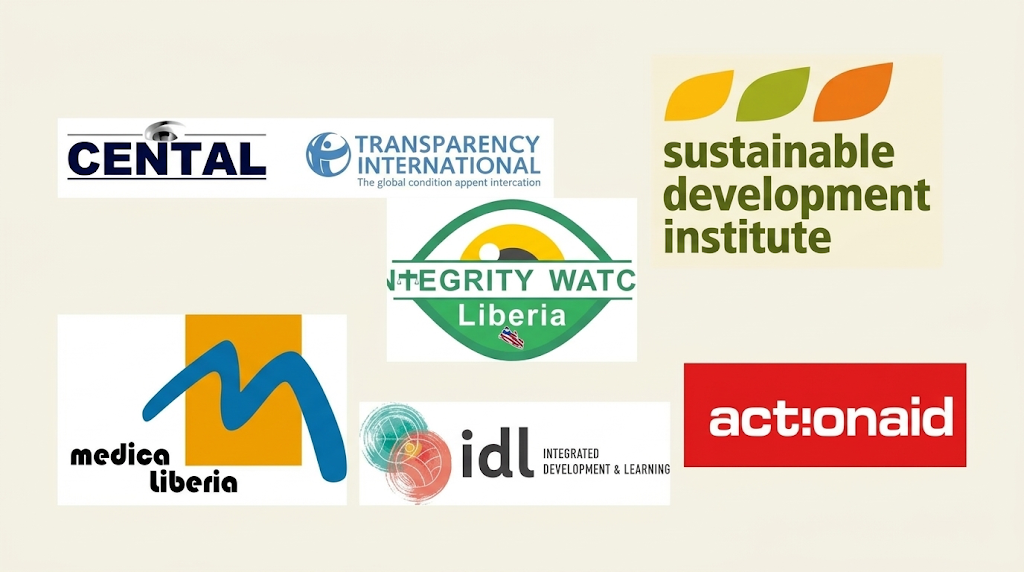
Its members include the Center for Transparency and Accountability in Liberia, Integrity Watch Liberia, the Sustainable Development Institute, Medica Liberia and ActionAid Liberia, among others.
Wealth that has not reached communities
Mining is central to Liberia’s economy. It accounts for about a fifth of gross domestic product and dominates exports, according to a March 2026 assessment by the Washington-based research group Forest Trends. Iron ore and gold are the main products.
Yet the coalition said decades of extraction have not delivered matching jobs, public services or development for the communities that host mines. It blamed weak enforcement, corruption, the export of unprocessed ore, poor transparency, environmental damage and the exclusion of local people from decisions.
The Forest Trends report reached similar conclusions. It found the government may be losing millions of dollars a year in uncollected mining revenue. Mining companies paid just over $844 million to the state between 2007 and 2023, according to figures from the Liberia Extractive Industries Transparency Initiative (LEITI), the national arm of a global revenue-disclosure standard. Mining licenses now overlap more than two million hectares of forest in a country that holds about half of what remains of the Upper Guinean rainforest biodiversity hotspot.
A year of illegal mining and license violations
The call follows a year in which government inspectors repeatedly found companies mining outside the limits of their permits, or with no permit at all.
Liberia issues several tiers of mining license. Class C permits are reserved for Liberian citizens and allow only hand tools. Class B permits cover small commercial operations. Large industrial projects operate under MDAs.
In March, a committee of the House of Representatives suspended Hurine Mining Company in central Bong County after investigators found it had exceeded the limits of its Class B license.
In April, the Ministry of Mines and Energy closed JinXin Mining Company in Rivercess County for mining without a valid license on ground licensed to another firm. The ministry said JinXin had ignored an order in January to stop. Days later it shut Alex Gee Group of Companies in Grand Gedeh County, whose license had lapsed. Officers also dismantled an unlicensed site whose alleged Chinese operators fled before they arrived.
In June, officials in Gbarpolu County seized excavators working a Class C claim, where heavy machinery is banned. They also found Chinese nationals mining under another company’s license, outside its approved boundaries.
Mines and Energy Minister R. Matenokay Tingban has acknowledged that many small commercial license holders fail to account for the minerals they extract.
The problems are not new. In 2024, the then-minister sought legal advice on revoking licenses issued since 2018, citing letters from the presidency directing that license applications be routed through the Office of the President. In 2025, a ministry investigation found that two companies, Hamak Mining and its successor 79 Resources, had misrepresented their license status and owed the government more than $400,000 in fees.
Big miners under scrutiny
Concerns extend to the largest operators. An investigation by The Associated Press and The Gecko Project published this year found that Bea Mountain Mining Corporation, Liberia’s biggest gold producer, repeatedly leaked cyanide, arsenic and copper at levels the country’s Environmental Protection Agency said exceeded legal limits.
The investigation found the company failed to report a 2022 spill on time and had earlier blocked government inspectors from its laboratory. Bea Mountain exported more than $576 million worth of gold between July 2021 and December 2022.
Why the coalition wants a pause now
Liberia’s Minerals and Mining Law was enacted in 2000, before the country’s 14-year civil war had fully ended. Lawmakers opened public hearings on amendments in July. At those hearings, the Liberia Chamber of Mines, an industry body, warned that changes limited to small commercial licenses would not fix the sector’s deeper problems. It called for a full overhaul covering taxation, licensing, environmental protection and strategic minerals such as lithium, cobalt and rare earths.
In January, the legislature ratified an amendment to the contract of steelmaker ArcelorMittal, Liberia’s largest iron ore producer, extending it to 2050 with an option to renew for 25 more years. Some senators praised the deal as a model for renegotiating other contracts. Another senator abstained, citing the company’s record of unmet commitments to host communities.
For the coalition, that timeline is the core of the argument. Contracts signed under a law that government, industry and activists all describe as outdated will outlast any reform that follows.
What the activists want in a new law
The coalition drew up its proposals at a meeting with mining-affected communities on October 1 and refined them at an October 21 roundtable with government agencies, donors and companies. Its 10 recommendations include:
* Binding transparency rules for licensing, contracts and revenue, including public disclosure of who ultimately owns mining companies;
* Clear penalties for violations by companies and by officials, and legal remedies for affected communities;
* Enforceable benefit-sharing for communities, building on a 2018 land rights law;
* Requirements to process more ore locally and to prioritize Liberian workers and suppliers;
* Binding obligations for mine closure and land restoration;
* Measures to protect women, young people and people with disabilities, including against sexual exploitation and abuse in mining areas; and
* Tighter regulation of small-scale mining, including sand and quarry operations.
The coalition praised the Boakai government’s stated commitment to reform but said the new law “must go beyond updating existing provisions.”
The Ministry of Mines and Energy did not immediately respond to a request for comment.
Support Independent Journalism
Your support helps FrontPage Africa continue delivering independent, credible, and impactful journalism. Every contribution strengthens our ability to investigate, inform, and hold power accountable while keeping quality journalism accessible to our readers.
Support our journalism or subscribe to receive the latest FrontPage Africa stories and updates.