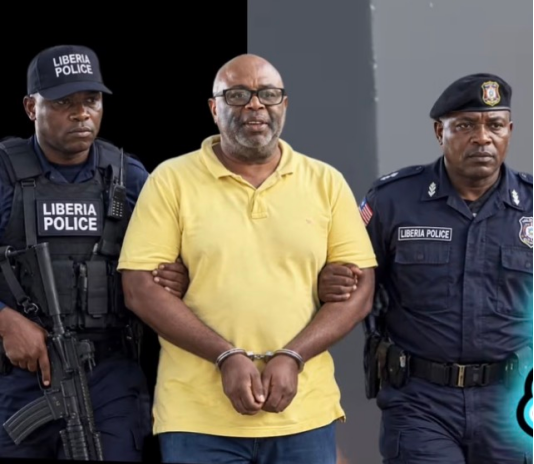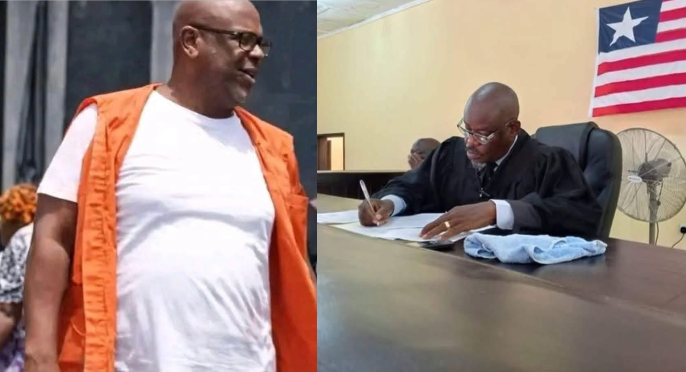
A Liberian judge convicted a former national security aide of statutory rape and kidnapping but cleared him of gang rape. Four days later, his lawyers filed a motion arguing that the two halves of the ruling cannot both stand.
By Rodney D. Sieh
MONROVIA — When Judge Wesseh Alphonsus Wesseh Sr. delivered his verdict on Friday, October 23, he framed the case around three questions: whether the evidence supported a conviction for gang rape, for statutory rape, and for kidnapping. He answered no to the first and yes to the other two.
That split is now the battleground. On Tuesday, October 27, at 11:12 a.m., lawyers for Peter Bon Jallah, 63, a former special assistant to the director of Liberia’s National Security Agency (NSA), filed a motion for a new trial at Criminal Court “E” in Monrovia. The filing, received by Acting Clerk of Court Abraham Richards, asks the judge to set aside his own verdict.
The motion is the first formal test of a ruling that, by the court’s own record, states its conclusions on each charge without detailing how it weighed every witness and exhibit. That gap is what the defense is trying to exploit.
What the court decided
Jallah was arrested on January 7, 2026, after the mother of a 16-year-old boy complained to the police Women and Children Protection Section. The boy did paid chores at Jallah’s home.
A grand jury indicted Jallah and two unidentified men in February on charges of gang rape, statutory rape and kidnapping. The indictment alleged abuse at Jallah’s home on November 29 and December 24, 2025. It also alleged that on January 1, 2026, Jallah lured the boy with an offer of football boots, drove him to a building off Camp Johnson Road in central Monrovia, and held him there for three days while he and two other men abused him.
The two other men were never brought before the court. Jallah, who has denied all the allegations, chose to be tried by a judge rather than a jury.
The court acquitted him of gang rape, finding the prosecution’s evidence insufficient. It convicted him of statutory rape and kidnapping. Jallah was remanded to Monrovia Central Prison pending a pre-sentence report from the Ministry of Justice’s Bureau of Probation Services. No sentence has been imposed.
The prosecution’s case
According to the written verdict, the prosecution called 13 regular witnesses and six rebuttal witnesses. The defense called eight witnesses, including Jallah, plus three subpoenaed witnesses from the Ministry of Gender, Children and Social Protection, the mobile operator Orange Liberia and the John F. Kennedy Medical Center.
The state’s strongest scientific evidence came from Pascal Bavugirije of the Rwanda Forensic Institute, which analyzed exhibits after Liberia sent them abroad. He testified that DNA profiles from four clothing exhibits matched Jallah’s reference sample. Material collected from the alleged scene produced a mixed profile from unknown people that matched neither Jallah nor the boy.
The boy testified in August that he was assaulted three times, and the court admitted his police statement over defense objections. Investigators also told the court that phone records placed Jallah near one of the alleged scenes, contradicting his account that he had no contact with the boy.
The defense’s four arguments
The motion, signed by Counsellor G. Wiefueh Alfred Sayeh of the Law Offices of Sayeh & Sayeh, makes four main claims.
1. The kidnapping conviction contradicts the gang rape acquittal. The defense argues that the kidnapping charge rests on the alleged three-day confinement off Camp Johnson Road, the same episode at the heart of the gang rape charge. If the court found too little evidence that the gang rape happened there, the motion says, it cannot find that the boy was held there. It describes the conviction as “contrary to weight of the evidence.”
2. The court lacked jurisdiction over kidnapping. Criminal Court “E” is Liberia’s specialized court for sexual offenses. The motion argues it has no jurisdiction over kidnapping as a separate crime. This is a purely legal question, and if the judge or a higher court agrees, it could void that conviction regardless of the evidence.
3. Penetration was never proven. Under Liberia’s rape statute, penetration is an essential element. The defense points to three pieces of testimony:
* A JFK Medical Center doctor, called by the defense, testified that an examination under anesthesia shortly after the boy’s January rescue found no evidence of trauma. The hospital’s operative record lists the post-procedure diagnosis as “normal findings.” The motion says the prosecution offered no rebuttal.
* The Rwandan forensic examiner testified that DNA analysis cannot establish guilt or innocence and that his report did not show whether penetration occurred.
* A nurse examiner from the hospital’s One Stop Center for survivors of sexual violence, a prosecution witness, testified that she could not say the boy was not raped, adding that she was there only to report what she saw. The defense argues that statement does not prove rape and creates doubt that must favor the accused.
The motion goes further, accusing the judge of attributing the words “penetration” and “blunt object” to the nurse’s testimony when, it says, no witness used them.
1. The defendant did not get a fair trial. The motion alleges the judge remarked in open court that the prosecution was “asking weak questions.” It also says that after reviewing the defense’s Orange phone records, the judge on his own initiative subpoenaed Jallah’s records from a second carrier, Lonestar Cell MTN, over a defense objection that the court could not introduce evidence on the state’s behalf.
How strong are the arguments?
Each claim faces hurdles, and none has yet been tested by the prosecution’s response.
The medical findings do not settle the question on their own. Forensic medicine broadly recognizes that the absence of physical injury does not rule out sexual assault, particularly when an examination comes days after an alleged act. The prosecution can also point to the DNA findings and the boy’s testimony. A judge sitting without a jury is entitled to weigh credible testimony against an inconclusive medical record.
The kidnapping argument may be harder to dismiss. The acquittal on gang rape could reflect doubt about the two unidentified men rather than about the alleged confinement itself. Whether that distinction holds depends on reasoning the published verdict does not spell out.
The fair-trial complaint about the phone subpoena raises a recognized principle: a judge in an adversarial system is not supposed to build the prosecution’s case. How much weight the court gave those records is not clear from the verdict.
What happens next
Judge Wesseh must rule on the motion. If he denies it, the case moves to sentencing once the probation report arrives. The defense has already said it will appeal to the Supreme Court of Liberia, and the arguments in this motion offer a preview of that appeal.
The case has been closely watched in Liberia because of Jallah’s position close to the head of the country’s main intelligence agency, and because it tests how the courts handle sexual violence against children. It has already passed through two courtrooms, a failed prosecution bid to move the trial out of Monrovia, and a change of judge.
The Ministry of Justice, which prosecuted the case, had not filed a response to the motion as of Tuesday.
Support Independent Journalism
Your support helps FrontPage Africa continue delivering independent, credible, and impactful journalism. Every contribution strengthens our ability to investigate, inform, and hold power accountable while keeping quality journalism accessible to our readers.
Support our journalism or subscribe to receive the latest FrontPage Africa stories and updates.