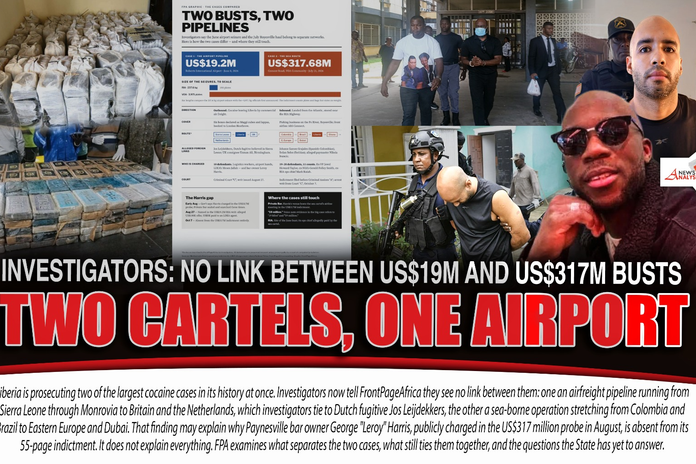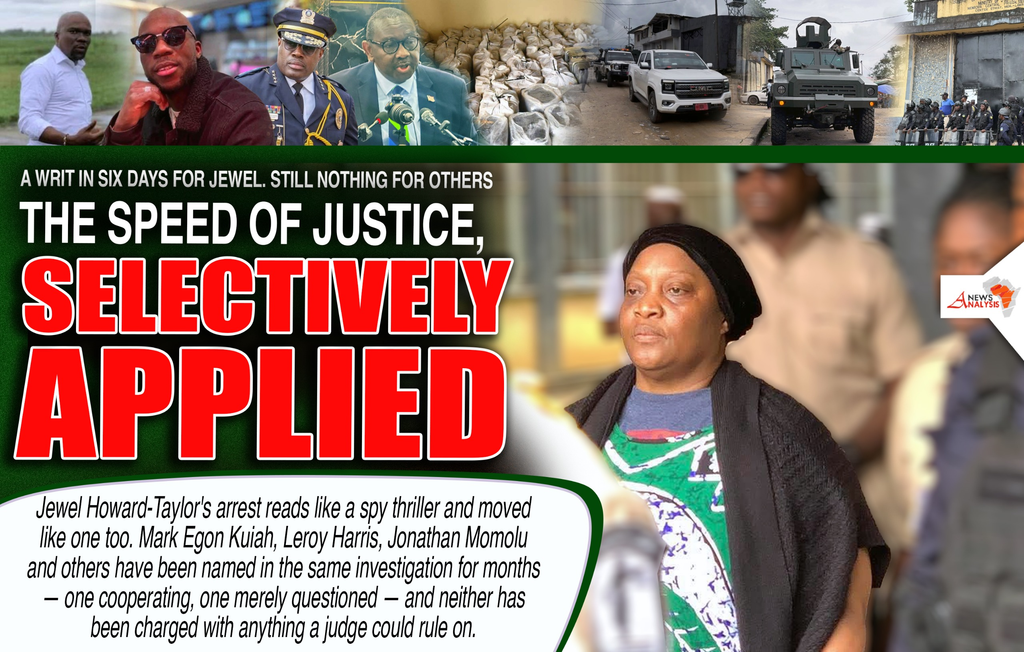
Jewel Howard-Taylor’s arrest reads like a spy thriller and moved like one too. Mark Egon Kuiah, Leroy Harris, Jonathan Momolu and others have been named in the same investigation for months — one cooperating, one merely questioned — and neither has been charged with anything a judge could rule on.
By Rodney D. Sieh | [email protected]
MONROVIA — For the second time in a decade, Liberia has hauled a household political name into a cocaine investigation. This time it’s Jewel Howard-Taylor — Vice President from 2018 to 2024, and before that, the wife of a president who ended up at The Hague. Her writ of arrest, dated August 25, reads more like a spy thriller synopsis than a court filing: hotel meetings in Dubai, forty-five thousand dollars in cash handed over for “shopping,” a foundation named Jewel Star Fish quietly receiving cartel money while she kept her office. She was picked up six days earlier, on August 19, stopped at Roberts International Airport on her way out of the country.
It’s a remarkable document. It’s also, so far, a lonely one.
The Charges Against Howard-Taylor
The writ and the Ministry of Justice’s own charging documents lay out a formal case that spans three separate Liberian statutes. Under the Controlled Drugs and Substances Act of 2023, she faces unlicensed importation of a controlled drug or substance; unlicensed sale, trading, administration, dispensation, delivery, distribution, dispatch in transit and transportation of a controlled drug or substance; and illicit trafficking of a controlled drug or substance. Under Chapter 10 of the Penal Law, she faces criminal solicitation, criminal facilitation and criminal conspiracy. And under the Anti-Money Laundering and Terrorist Financing Law, she faces a money laundering charge tied specifically to the Jewel Star Fish foundation — the vehicle prosecutors say received cartel funds while she held public office. Taken together, it is one of the most detailed charge sheets brought against any Liberian official in this scandal, naming specific cash amounts, specific meeting locations and a specific financial instrument rather than the vaguer language of “linked to” or “connected with” that has characterized most of this year’s other cases. That specificity is precisely why the six-day turnaround between her arrest and the formal writ stands out — and why the comparative silence around Kuiah and Momolu reads as more than a scheduling quirk.
The Men Named Months Ago
Because sitting a few paragraphs down in the same broader investigation are men whose names have been circulating for weeks — sometimes months — without a single charge attached, and without the country ever really stopping to notice how long that silence has run. Mark Egon Kuiah ran operations at RIA, the same airport that has become this case’s center of gravity, the place every road in this scandal seems to lead back to eventually. His name turned up on a writ of arrest back in June — not a rumor, not a leak, an actual writ, with his name on it, in black and white. He signed off on a letter vouching for a “distressed” ship that Liberian troops are now chasing down off Rivercess, suspected of ferrying more product. He was fired from his job in late July. And then, nothing. He has not been arrested. By most accounts, he is currently helping investigators — a cooperation that only started, notably, after his name was already public, after the firing, after the writ, once staying quiet had stopped being an option.
Jonathan Momolu tells a similar story from a different angle, and his is, if anything, the more uncomfortable of the two. A security officer at the airport, he is tied not just to this year’s case but to an older one that should have been a warning sign years ago — a 2023 shipment labeled as tea leaves that turned out to be methamphetamine, waved through an unauthorized gate while he was the senior inspector on duty that day. In between, he spent months moonlighting as a driver for the head of the Drug Enforcement Agency, a detail that sits uneasily in a country trying hard to convince itself, and everyone else, that its own drug agency isn’t compromised from the inside. Momolu was questioned briefly. He went home the same day. He is free.
So the uncomfortable question writes itself, the way these questions always do once you lay the timeline out side by side: why did it take six days from arrest to a formal, detailed writ for the former Vice President, while men named in writs since June are still walking around, still going home at night, still, as far as anyone can tell, living exactly the lives they were living before their names became part of Liberia’s biggest drug story in years?
The Optics Problem
Government officials would say the comparison isn’t fair, and they would say it with real conviction — that a case against a former Vice President requires a different evidentiary bar, more coordination, more care, precisely because it will be picked apart by defense lawyers and international observers alike, in a way a mid-level airport officer’s case never will be. There’s something to that. Overcharging a former head of the executive branch and watching it collapse in court would be its own kind of disaster for a government trying hard to prove it isn’t simply performing accountability for an audience.
But Liberians have heard this argument before, and it hasn’t aged well in their memory. The country’s last nine-figure cocaine case, back in 2022, ended with everyone accused walking free — no convictions, no accountability, just a case that quietly evaporated once the cameras moved on. That memory is doing a lot of work right now, sitting underneath every headline this summer like a low hum nobody can quite tune out. It’s why the sheer volume of activity this season — dismissals across five agencies, cocaine burned in a public ceremony with officials standing solemnly around the flames, a president promising “we will find you” — hasn’t actually translated into public confidence. Motion is not the same as justice, and Liberians, this time, seem to know the difference. Of the people swept into this scandal since June, only a couple have actually been charged and sent toward trial: an LDEA officer and a Paynesville bar owner. Everyone else, including Kuiah, is still suspended in a kind of legal limbo — fired, named, talked about, but not formally accused of anything a judge could actually rule on.
That gap between “named” and “charged” is where public trust usually goes to die, quietly, without anyone ever announcing it happened. Opposition voices have already tried to use it, with the CDC framing the Taylor charges as a distraction from other people — unnamed in their statement, but the implication isn’t subtle — whose conduct deserves equal scrutiny. That’s a self-serving argument coming from a party defending one of its own, and it shouldn’t be taken at face value simply because it was said loudly. But the underlying observation underneath it, that a mid-level airport official can sit named-but-uncharged for two months while a former Vice President goes from questioning to a formal writ in under a week, is not something the government has really answered. Not denied, not explained. Just left sitting there.
What Would Actually Settle It
The honest answer is probably not conspiracy. It’s leverage, and evidence quality, and the unglamorous mechanics of how real prosecutions get built. Kuiah, unlike Taylor, appears to be cooperating, and prosecutors sometimes let cooperating witnesses stay uncharged longer while they build a bigger case around them — using the very silence that looks so suspicious from the outside as a tool to reach higher up the chain. That’s a normal, defensible prosecutorial strategy, the kind taught in any competent law school. It is also, and this is the uncomfortable part, indistinguishable from the outside from protecting someone with the right connections — which is exactly why the president’s own son found himself having to publicly clarify that his friendship with Kuiah wasn’t a shield. When a president’s family has to say that out loud, the appearance problem has already done its damage, whatever the underlying facts turn out to be.
What would change this story isn’t another dismissal, and it isn’t another press conference with cameras and confident language. It is a charge sheet with Kuiah’s or Momolu’s name on it, in the same black-and-white detail that now sits beside Jewel Howard-Taylor’s — the Dubai meetings, the cash, the foundation, spelled out for a judge to weigh. Or, absent that, it is a plain public explanation for why there isn’t one yet. Liberia has shown this year that it can move fast when the target is politically convenient, when a name is already a headline. The real test of this investigation, the one that will decide whether Liberians believe any of it meant anything, is whether it can move at that same speed for the people nobody is watching quite as closely.
Support Independent Journalism
Your support helps FrontPage Africa continue delivering independent, credible, and impactful journalism. Every contribution strengthens our ability to investigate, inform, and hold power accountable while keeping quality journalism accessible to our readers.
Support our journalism or subscribe to receive the latest FrontPage Africa stories and updates.