- Hundreds of war victims, survivors and justice advocates protested at the war crimes court office and the Capitol Building, demanding approval of legislation to establish the long-awaited court.
- A disagreement erupted at the Capitol after a lawmaker said a legislative committee had decided to exclude economic crimes from the proposed court. Protesters objected, prompting another lawmaker to assure them that both categories of crimes would be covered.
- The House Committee Chairman pledged to bring the matter before plenary Tuesday, as the government’s timetable for establishing the courts faces uncertainty.
By Anthony Stephens, senior justice correspondent with New Narratives
Hundreds of victims and survivors of Liberia’s civil wars, joined by justice advocates, protested Thursday outside the government office overseeing the establishment of a war crimes court, temporarily disrupting operations, before moving to the Capitol Building, where a senior lawmaker pledged to place the long-delayed legislation before the House plenary on Tuesday.
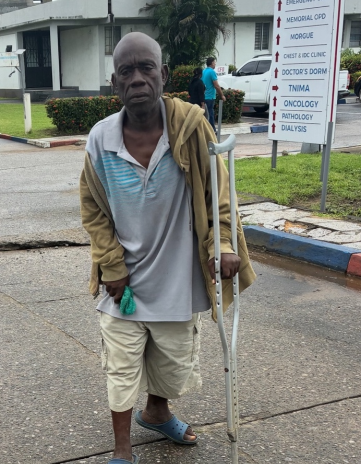
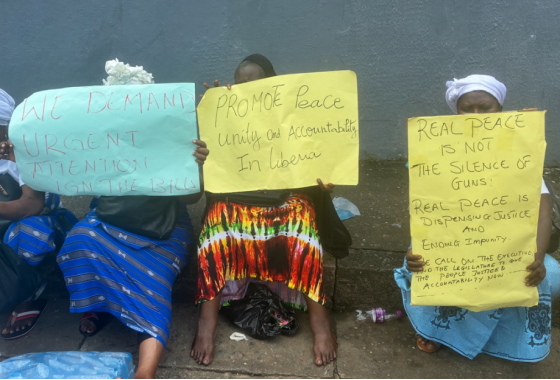
The peaceful demonstrations drew people with disabilities, rural women, elderly victims and survivors, young people, and traditional and religious leaders. For hours, protesters gathered outside the Office for the Establishment of the War and Economic Crimes Court, holding placards demanding justice. One read: “REAL PEACE IS NOT THE SILENCE OF GUNS. REAL PEACE IS DISPENSING JUSTICE AND ENDING IMPUNITY. WE CALL ON THE EXECUTIVE AND LEGISLATURE TO GIVE THE PEOPLE JUSTICE & ACCOUNTABILITY NOW…”
“What’s going on wrong? We are suffering,” said Korpo Dennis, president of the Women in Peacebuilding Network, her voice cracking as she broke down in tears, burying her face in her lappa, a traditional cloth wrapped around her waist. Addressing Jallah Barbu, the office’s executive director, Dennis questioned why President Joseph Boakai had not raised the issue at the United Nations General Assembly, as she said he had promised. “He na come, we can hear nothing. We want answer today or else, we will sleep on this street.”
The protests underscored mounting frustration over Liberia’s failure to establish a court to prosecute atrocities committed during its civil wars, more than two decades after the fighting ended. Despite repeated government commitments and consultations, competing bills remain before lawmakers, leaving uncertain when those accused of wartime crimes will face prosecution.
Dennis’s organization was among the women’s peace groups widely credited with helping pressure Liberia’s warring factions to end the conflicts.
Barbu told protesters he remained confident that Boakai had not abandoned his commitment to establishing the court. Prevented from entering his office, along with other staff, he unsuccessfully attempted to reach House Speaker Richard Koon by telephone.
He then contacted James Verdier, the speaker’s chief of staff, who assured protesters that the legislation would be approved. Unsatisfied, the protesters moved to Capitol Hill to press lawmakers directly.
Kula Fofana, Boakai’s press secretary, did not respond to a request for comment on the protesters’ concerns.
“It has taken us too long,” said Jeremiah D. Cooper, a member of the Group of 77, an organization representing people with disabilities. “The same Liberian people who voted for you are the same Liberian people demanding that you pass certain documents in the interest of the country,” he added. “You people say you will not do it. Why?”
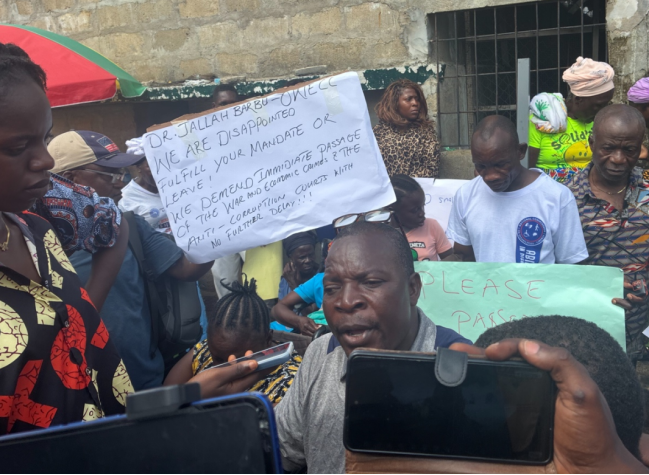
But the gathering soon exposed a disagreement over whether the proposed court would prosecute both war crimes and economic crimes.
Prescilla A. Cooper, a Montserrado County representative and member of the House Committee on Claims and Petitions, told protesters that a joint legislative committee tasked with harmonizing the competing bills had agreed to proceed with legislation establishing a war crimes court, leaving economic crimes to be handled separately by the Liberia Anti-Corruption Commission.
The protesters rejected her account, insisting that economic crimes allegedly committed during Liberia’s civil wars must also fall within the proposed court’s jurisdiction.
Justice advocates have long argued that including economic crimes would allow the court to order convicted warlords and other perpetrators, including institutions found responsible, to pay restitution to victims and communities harmed by their actions.
Prince Toles, chairman of the House Committee on Claims and Petitions, sought to reassure the protesters, saying he shared their position that the legislation should establish a War and Economic Crimes Court.
“We signed it in 2024 (the joint resolution). We signed it 5G. But this one, we will give it 20G,” Toles said, referring to the Legislature’s earlier support for establishing the court. “If people did not rob the system, all of us would have lived better. I want to tell you that we are with you.”
“We will bring this matter before plenary,” Toles said. “But if they ask us to bring a paper signed by the different stakeholders, I will just propose that you draft something for us temporarily. Bring it here tomorrow (Friday), then I will put it on the floor on Tuesday.”
Plenary, the full membership of either legislative chamber, is its highest decision-making body. Toles’s pledge does not guarantee a vote or passage Tuesday.
House leaders subsequently invited protest organizers to a meeting.
“We feel a little bit relieved that it will work,” Peterson Sonyah, executive director of the Liberia Massacre Survivors Association, said by phone afterward. “We are impressed with the discussion. We are planning to be there on Tuesday.”
The protests came as Liberia approaches a deadline in its plans to establish the courts.
Under a 36-page roadmap submitted to Boakai in July 2025, the court office projected that the National Anti-Corruption Court would be operational by November 2026, followed by the War and Economic Crimes Court in November 2027.
With neither court’s establishing legislation approved, the timetable faces uncertainty. The roadmap also envisaged completing trials by 2031, after which the war crimes court would transition to a residual mechanism.
Liberia is also preparing to assume the rotating presidency of the United Nations Security Council in December, a moment justice advocates say will draw international attention to the country’s unfinished accountability efforts.
A FrontPage Africa/New Narratives survey of 1,150 people across 11 counties found that 91 percent supported establishing the court, while 89 percent said they would not vote for lawmakers opposing it.
The survey was not scientifically sampled. Only 4 percent of respondents reported awareness of lawmakers’ consultations on the proposed court.
The legislative process has been complicated by six competing proposals.
They include a War Crimes Court bill from the Liberian National Bar Association; a separate proposal from civil society organizations working with the Independent National Commission on Human Rights; and two bills introduced by Senate President Pro Tempore Nyonblee Karnga-Lawrence and Senator Joseph Jallah, one proposing a War Crimes Court and another a Special Economic and Corruption Crimes Court.
The remaining two bills were prepared by the court office, proposing a War and Economic Crimes Court and a separate National Anti-Corruption Court. Boakai subsequently forwarded both proposals to the Legislature.
The senators’ proposals drew criticism from justice advocates, who warned that provisions concerning jurisdiction and appeals could weaken wartime accountability.
In June, more than 40 House members attended a two-day technical deliberation in Buchanan, Grand Bassa County, organized by the court office and its partners to examine the legislation.
Separately, the Senate Committee on Judiciary, Human Rights, Claims and Petitions began consultations on the competing bills, seeking to resolve differences over senior appointments, prosecutorial independence and appeals.
The committee also outlined plans to harmonize the proposals, with further consultations and hearings expected before the legislative session ended.
Neither chamber approved the legislation before lawmakers departed for their constituency break.
The Legislature was scheduled to return October 9, but a dispute over lawmakers’ benefits delayed the House’s reopening. Regular business resumed October 13.
For Sonyah and the other organizers, Tuesday will test the assurances they received. They intend to return to the Capitol to see whether the matter reaches plenary — and whether the proposed legislation retains both war crimes and economic crimes.
This story was a collaboration with New Narratives as part of the Investigating Liberia project. Funding was provided by the U.N. Office of the High Commissioner for Human Rights and the European Union. The funders had no say in the story’s content.
Support Independent Journalism
Your support helps FrontPage Africa continue delivering independent, credible, and impactful journalism. Every contribution strengthens our ability to investigate, inform, and hold power accountable while keeping quality journalism accessible to our readers.
Support our journalism or subscribe to receive the latest FrontPage Africa stories and updates.