Summary:
- In a new FrontPage Africa/New Narratives survey nine in every 10 of 1,150 respondents across 11 counties said they want the government to establish a War and Economic Crimes Court.
- In a warning to lawmakers, nine in every 10 said they won’t vote for lawmakers who don’t support a bill to establish the court.
- With many lawmakers saying they needed time to consult constituents before voting on the bill, just one county reported any meaningful consultation with lawmakers. In most counties survey respondents said there had been none.
By Eric Opa Doue, chief county correspondent with New Narratives
BOLA, Bomi County– Kumba Thomas returns home from a long day at her farm. Around her, life in the community continues at its ordinary pace, but ghosts follow Thomas, weighing down every step of her day.
Thomas says she was a new mother when fighting reached Bola. She can’t remember which faction. She hid in the bush with her family, but rebels captured her.
“They put a gun to my head and threatened to kill me, but I had my baby in my arms,” she says. They finally let her go. Thomas walked all the way to Monrovia. “I fled through the bush with no shoes and no food, only praying my daughter and I would survive.”
Later, she learned that both her parents had been killed. More than two decades later, no one has been held responsible for what happened to her family. But Thomas has not stopped hoping that justice will come.
“The war took away my childhood and left wounds that I still carry in my heart,” Thomas said. “I saw families separated, homes destroyed, and people running for their lives. Some of us still wake up remembering the sounds of gunfire and the faces of people we never saw again. That is why I want to see a war crimes court.”
Thomas was one of 1,150 people surveyed by eight FrontPage Africa/New Narratives reporters across 11 of Liberia’s 15 counties in August — the first publicly released data by any organization gauging public opinion on the proposed court. The survey was not conducted under scientific standards and is intended simply to contribute to a national conversation that has yet to see any concrete evidence of where public opinion lies. (Data can be viewed at this link.)
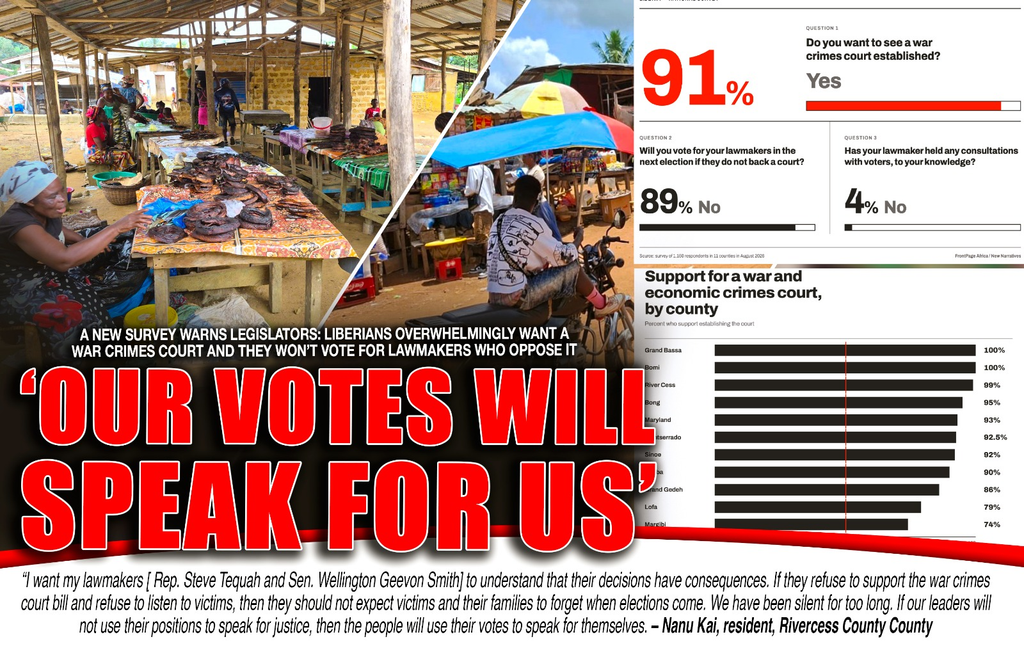
But the results strongly suggest the public is demanding lawmakers enact a court. Of the 1,150 people surveyed, 91 percent said they wanted to see a court. And, in a stark warning for legislators who are still debating whether to have an internationally recognized court to try those accused of war and economic crimes, nearly as many — 89 percent — said they would not vote again for lawmakers who fail to support the bill.
Accountability a long time coming
Lawmakers have only one choice according to Nanu Kai, 47, of River Cess County. She was a child when the war came to Monrovia where she was living. She and her family walked through the bush to River Cess witnessing horrors that haunt her to this day.
“I want my lawmakers [ Rep. Steve Tequah and Sen. Wellington Geevon Smith] to understand that their decisions have consequences,” Kai said. “If they refuse to support the war crimes court bill and refuse to listen to victims, then they should not expect victims and their families to forget when elections come. We have been silent for too long. If our leaders will not use their positions to speak for justice, then the people will use their votes to speak for themselves.”
The demand for accountability traces back to Liberia’s two civil wars, fought between 1989 and 2003. The first began in December 1989, when Charles Taylor’s National Patriotic Front of Liberia rose up against President Samuel Doe, and then splintered the country among rival factions. A 1996 peace deal collapsed within three years, and fighting resumed as rebel groups — including Liberians United for Reconciliation and Democracy and the Movement for Democracy in Liberia — turned on the government of Charles Taylor who had been elected president in 1997.
The wars ended with the Accra Comprehensive Peace Agreement in 2003 and Taylor’s exile. But by then conflict had left the country on its knees. By the United Nations’ estimate, more than 250,000 people were killed and hundreds of thousands more displaced or driven from the country, in a conflict marked by massacres, sexual violence, torture and the forced recruitment of children.Liberia’s Truth and Reconciliation Commission, formed after the war to investigate abuses committed between 1979 and 2003, delivered its final report in 2009. It called for criminal accountability, reparations for victims, institutional reform and community reconciliation, and a special court to try those held most responsible for war crimes and crimes against humanity. Most of those recommendations were never acted on.
The movement was revived in 2024 when incoming President Joseph Boakai pledged to establish a court. That, and the convictions of six Liberians accused of atrocities by courts in Europe and the United States, has helped boost support among a public that had originally feared a court might reignite conflict.
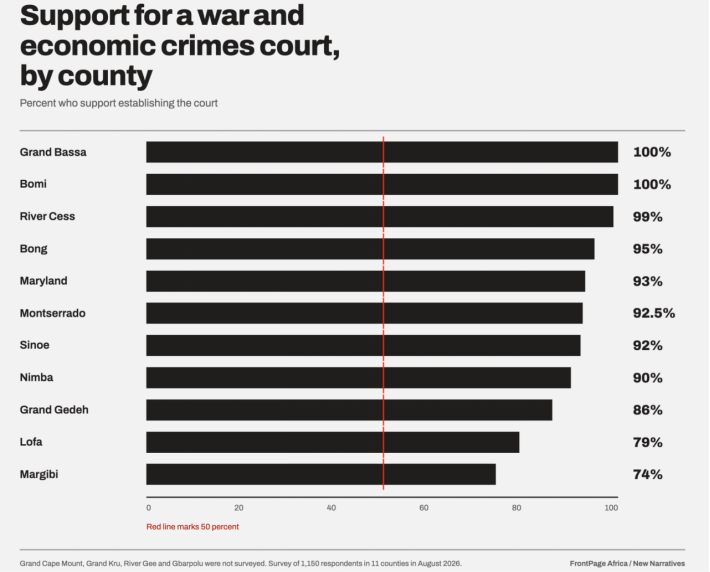
Support for the court was effectively unanimous in Grand Bassa and Bomi counties. River Cess follow closely at 99 percent and Bong at 95 percent. Support was lowest — though still decisive — in Grand Gedeh, at 86 percent, Lofa, at 79 percent, and Margibi, at 74 percent.
The results came as no surprise to Peterson Sonyah, of the Liberia Massacre Survivors Association, the umbrella body for survivor’s groups in the country.
“The survey is very clear evidence that Liberians need a war and economic crimes court,” said Sonyah, in an interview. “It is also a wakeup call for our legislators to listen and act fast, because our people, we all want justice.”
“Accountability has remained an undebated subject for more than two decades,” said Adama Dempster, long time war crimes court advocate and secretary general of the National Civil Society Platform of Liberia. “The fact that people, even in rural communities, are still saying that the issue of war crimes and some sort of justice should be considered tells you that, no matter the time or duration, justice will serve as a deterrent.”
Survey issues a clear warning to legislators
Survey respondents were also clear who they will hold to account if a court is not held. Nine in every ten correspondents told survey takers that they would not vote for their lawmaker in the next elections if he or she did not vote for the court.
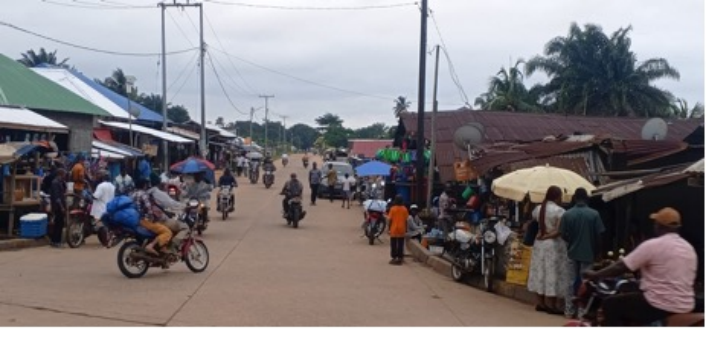
Marcus Flomo, a welder and father of three who lives in District 1, Margibi County, said he wants justice for a rebel attack on his town at 4 a.m in the early part of the war. His uncle was killed in front of him. Now, he said, he does not trust lawmakers to follow through on promises of accountability.
“I voting, they stealing the money,” said Mr. Flomo in Liberian English. “We are in the sun, in the rain for them, they doing their own thing. Then why I voting for [Rep.] Opee Cooper and [Senator] Nathaniel McGill for? Let them agree, let the people bring the war crimes court. When they do not bring it, me I will not vote for anybody this coming 2029.”
“Our leader keep promising the court will come, election after election, but nothing can change,” said Eliza Gueh, in Grand Bassa, in her 60s. “Some of the same people who committed all those crimes are the ones sitting in government today. This is why they are joking.”
Gueh said she would not support her legislators — Rep. Matthew Joe and Sen. Nyunblee Kangar Lawrence — in the 2029 elections.
Sentiment tracked support for the court, with the strongest numbers in River Cess, where 98 percent said they would withhold their vote, followed by Bong at 97 percent, Grand Gedeh at 95 percent and Nimba at 93 percent. Even in counties with softer numbers, opposition to the bill carried a political cost: 70 percent of respondents in Lofa and 73 percent in Margibi said they would not vote for a lawmaker who blocked it.
Consultations are not happening
The final question of the three in the survey also carried a warning for legislators. They did not pass the bill to establish the court before their legislative break claiming they needed to consult constituents. But just a handful of the 1150 respondents – 4 percent – said they were unaware of any consultations.
Only in Maryland, Grand Gedeh and Margibi were there any people saying that they had been consulted.
“As far as we know, as far as stakeholders know, as far as our partners know, there has not been one consultation anywhere by any member of the Legislature that we know of,” said Jallah Barbu, executive director of the Office of the War and Economic Crimes Court. “Maybe they may have had it on a one-to-one basis, but formally we are not informed.”
Representative Steve Tequah, who represents River Cess County District No. 2, said he supports the court and lawmakers owe their constituents a voice in the process.
“We serve our people; they elected us to represent them,” he said. “We have been having this conversation and educating our people on the importance of the War and Economic Crimes Court, and the support is overwhelming.”
But Tequah acknowledged he had not held formal meetings.
“I have not really organized a town hall meeting where chiefs and communities gather to discuss this issue,” he said. “If I call a town hall meeting, I have to pay people’s way, feed them and provide drinks. Imagine calling three or four town hall meetings at different locations. Trust me, my brother, I don’t have that funding.”
“Since we don’t have the funding for those consultations, as I go out in the communities, making donations and doing projects, I use those opportunities to provide information to our people and talk about the importance of the War and Economic Crimes Court. So, this is how they get information.”
The one outlier was Lofa County where respondents said Senator Joseph Jallah has been heavily engaging the people about the court on radio and in meetings across the country. One third of respondents there said they had been consulted.
Senator Jallah has a special interest in the process. He joined Grand Bassa County Senator Nyonblee Karnga introduced bills for the courts to be considered by the legislature. They have been widely condemned by court advocates because of their insistence on excluding international actors from the court.
“Jallah knows better. He knows what he’s doing. He’s a lawyer. He comes from a progressive school of thought. He knows what he’s doing, and he’s doing it deliberately,” said John Stewart, court advocate and former TRC commissioner. “He should be ashamed because a lot of atrocities were committed there. He’s abandoning the concerns of his people to entrust it to a corrupt body.”
Lawmakers face mounting pressure to pass bill establishing the court by December
The survey will be one more factor weighing on the country’s lawmakers as they debate six competing bills submitted to them. Committees in the House and Senate are tasked with merging them into a single bill for passage. The Legislature is expected to hold public hearings once that process is complete.
The international community has been clear that Liberia’s best chance for securing international support is to have the bill passed before President Joseph Boakai takes his seat as the president of the UN Security Council’s December meeting. Better yet would have been for it to be passed before the UN General Assembly begins this month. War Crimes Court Office chief Barbu has urged the president to call legislators back early for a special session for this purpose.
No lawmakers have spoken publicly on the debates but stakeholders who have spoken with them say there is stiff opposition – especially from those who may be facing indictments for war crimes or economic crimes or in the national anti-corruption court that is to be set up first – or are closely allied with those who might.
There is a strong faction, including Jallah, insisting that the courts be set up under Liberia’s constitution which prohibits foreign lawyers from practicing and says the Supreme Court is the final court of appeal. They may be hoping that a call to exclude non-Liberians from the court will find a sympathetic ear among the public.
But court proponents say that is just a fig leaf to disguise an effort to sabotage the court. Opponents know they have lost the battle to convince Liberians to “let bygones be bygones” and so are now resorting to pitching a model that they know the international community will not support.
Every other country from Rwanda, to Gambia, to Sierra Leone, have established a “special court” in a legal bubble outside the country’s constitution that would allow the experts and laws required to prosecute crimes of this magnitude in a way that would be trusted.
“The appeals chamber should be within the court itself,” Hassan Bility, director of the Global Justice and Research Project, said the court’s authority would rest on international law that predates the conflict. “In this way, there will be credibility lent to the court and to its work. We do not want a situation where politics will influence the outcome of both investigations and prosecutions.”
International involvement, he said, is essential if Liberia hopes to build a court capable of investigating war crimes to internationally accepted standards. International diplomats and United Nations officials have been very clear that the international community will not back a court that is not separate from Liberia’s judicial system.
Dempster said the survey should underscore the need for speed. “The speedy establishment of the court is what is needed right now,” he said. “The unnecessary delays that have caused us to reach this far should not have happened. What we need to do now is accelerate the efforts that will lead to establishing a court.”
“What we can do now is continue the engagement and advocacy, talk to our citizens and district leaders, and make sure we have this court,” said Sonyah. “It cannot be one person; through collaborative effort, we can see this court established.”
Augusta Lafaly, Nukanah Kollie, Jerome Saye, King Brown, Gloria Wleh, Joseph Titus Yekreyan, Anthony Stephens and Moses Geply contributed reporting. This story was a collaboration with New Narratives. Funding was provided by the Swedish International Development Cooperation Agency. The funder had no say in the story’s content.
Support Independent Journalism
Your support helps FrontPage Africa continue delivering independent, credible, and impactful journalism. Every contribution strengthens our ability to investigate, inform, and hold power accountable while keeping quality journalism accessible to our readers.
Support our journalism or subscribe to receive the latest FrontPage Africa stories and updates.