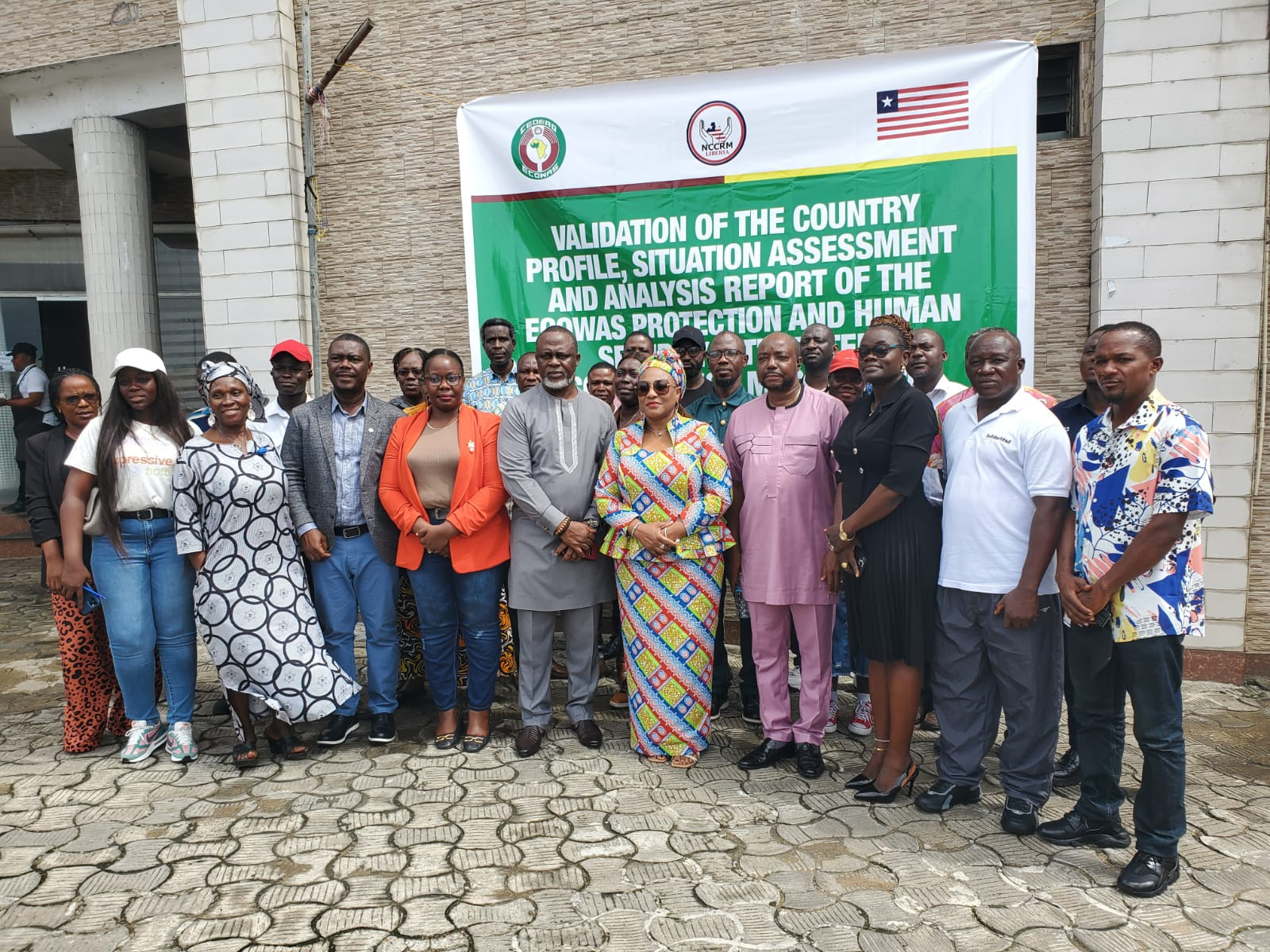
Monrovia, Liberia — Stakeholders from government, civil society, security institutions, and international partners gathered in Monrovia on Friday to validate Liberia’s National Protection and Human Security Profile under the ECOWAS Protection and Human Security Integrated Coordination Mechanism (ECO-PHSICM).
By Jaheim T. Tumu – [email protected]
The meeting marked a key milestone in Liberia’s effort to assess and strengthen its national protection and human security architecture.
The validation workshop, convened by the National Center for the Coordination of Response Mechanism (NCCRM) with support from ECOWAS, aimed to finalize a comprehensive country report outlining Liberia’s vulnerabilities, institutional capacities, and gaps in protecting at-risk populations including women, children, refugees, and survivors of gender-based violence.
ECOWAS Ambassador to Liberia, Josephine Nkrumah, opened the session with a call for seriousness and shared responsibility, warning participants not to treat the workshop as a routine formality.
“This is about national survival and resilience,” Ambassador Nkrumah said. “Whether it is us or those connected to us, human protection is a collective duty. Let this not be another talk shop—this must lead to real change.”
Ambassador Nkrumah underscored that effective human protection must be decentralized, urging greater involvement of local governance actors such as the Ministry of Internal Affairs. She reiterated ECOWAS’s commitment to people-centered integration, invoking the regional body’s 50th anniversary theme: “Stronger Together for a Better Future.”
“ECOWAS is not an ECOWAS of states—it is an ECOWAS of the people,” she said. “This report must serve as a basis for building a resilient and inclusive Liberia.”
The draft assessment, compiled by a national consultant, highlights major challenges Liberia faces in delivering effective protection services, including limited coordination among institutions, underfunded frameworks, and weak implementation of national policies.
Arthur Bestman, Acting Executive Director of the NCCRM, told participants that the workshop concludes a process that began in 2022 and continued through multiple technical consultations in 2024. He emphasized that the validation must produce actionable results.
“This document must not sit on shelves,” Bestman said. “It must become a go-to resource for policymakers, development partners, and implementers working to address human insecurity in Liberia.”
Bestman reminded attendees that the ECO-PHSICM is a regional initiative rooted in ECOWAS legal instruments such as the Conflict Prevention Framework and the Supplementary Protocol on Democracy and Good Governance.
Philip M. Kollie, National Network Coordinator of WANEP-Liberia, representing civil society, said the report must go beyond validation and become a driver for actual reform.
“We see the consequences of inaction every day,” Kollie stated. “This must be a living document—one that reflects the reality of those experiencing human rights violations and insecurity across Liberia. We, in civil society, are ready to support its implementation.”
Amos N. Tubor, representing the ECOWAS National Office at the Ministry of Finance and Development Planning, confirmed that conclusions from the validation process would be escalated to ECOWAS’ highest technical body—the Administration and Finance Committee (AFC).
“This is not a dead-end document,” Tubor said. “The outcome of today’s discussions will shape regional decisions. Let us use this opportunity to ensure that the voiceless and vulnerable are truly represented.”
During the technical review session, participants were urged to “critically interrogate” the content of the draft, paying close attention to overlapping institutional mandates, data inconsistencies, and policy blind spots. Calls were made for the report to include a clear implementation roadmap, timelines, and accountability mechanisms to ensure that recommendations are acted upon.
Participants reiterated that national protection and human security must be elevated beyond theory to tangible action, particularly as Liberia faces mounting socio-economic pressures and regional security concerns.
Support Independent Journalism
Your support helps FrontPage Africa continue delivering independent, credible, and impactful journalism. Every contribution strengthens our ability to investigate, inform, and hold power accountable while keeping quality journalism accessible to our readers.
Support our journalism or subscribe to receive the latest FrontPage Africa stories and updates.