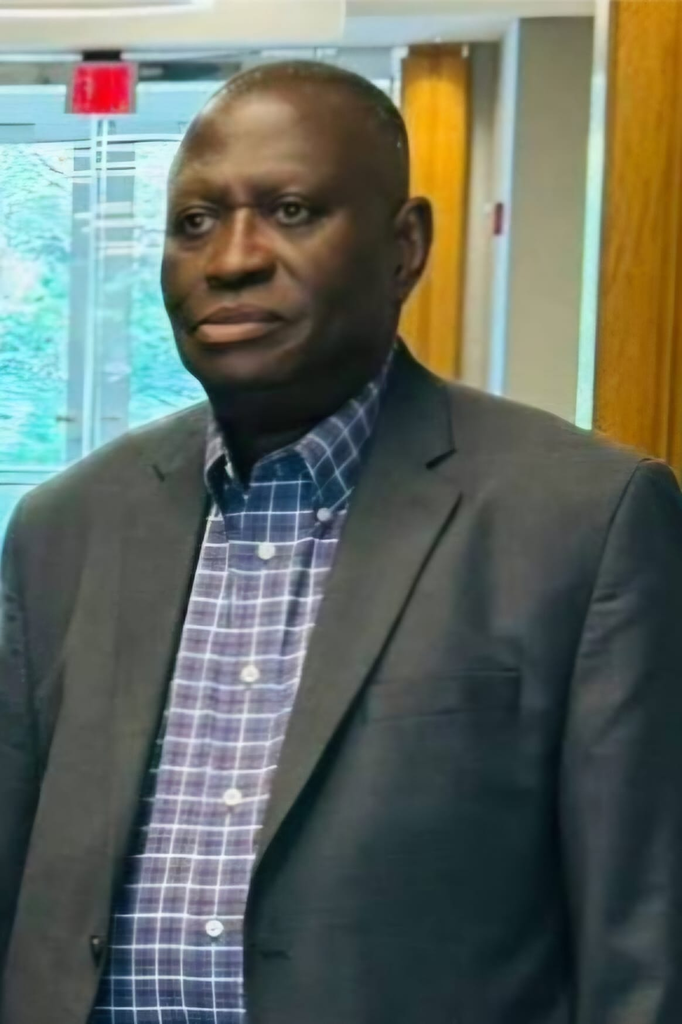
The Altruism of Mr. Emmanuel Nuku Reeves, Sr.Chief Executive Officer, Reeves Investment Group, LLC & Atlantic Finance, LLC.
By Julius Konton, contributing writer
There are many ways to measure a successful life. Some count accumulated wealth, professional titles, institutional influence or public recognition.
Others measure success by the number of people whose lives have been made better because one person chose to act.
For years not too long to forget, I have come to know a nobleman called Emmanuel Nuku Reeves, sr. as a Liberia statesman, self-made businessman and consummate professional embodied with vast wisdom, unbending principles, distinguished public servant and leader, self-discipline, sturdy courage, unimaginable humility and the determined will to impact humility for the better.
The life of Mr. Emmanuel Nuku Reeves, Sr. belongs firmly in the latter category; one in which success has become a vehicle for service, and generosity a philosophy rather than a transaction.
For more than five decades, Nuku Reeves has built a life spanning public service, finance, entrepreneurship, maritime administration, philanthropy and community development.
Yet the most compelling dimension of his journey is not what he has acquired, but what he has consistently chosen to give away: knowledge, opportunity, financial resources, mentorship, institutional support and, perhaps most importantly, the confidence that someone else’s future is worth investing in.
His story is therefore not simply the biography of a successful Liberian businessman, but a study in the disciplined use of success.
A Liberian of Bassa heritage, Reeves began his public-service journey in the 1970s as a cadet at the Ministry of Finance in Liberia during the tenure of Stephen A. Tolbert as Minister.
Armed with a Bachelor’s degree in Accounting from the University of Liberia, he entered a professional world that would eventually take him beyond Liberia’s borders.
A scholarship enabled him to pursue graduate studies in Finance in the United States, followed by another Master’s degree in fulfilment of his dream to catapult himself in corporate America.
That trajectory, from cadet to finance professional, entrepreneur and corporate leader, could have produced a life primarily concerned with personal advancement.
Instead, he gradually turned his accomplishments into instruments for lifting others; a distinction quite central to understanding his true character.
The Philosophy of Giving Without a Ledger:The Greek philosopher Aristotle argued that character is not established by what a person occasionally does, but by the habits that person develops over time.
Virtue, in the Aristotelian sense, becomes visible through repeated action. Generosity is therefore not merely the act of giving; it is the disposition to recognize another person’s need and respond to it as a matter of character.
Mr. Reeves’ philanthropy fits this deeper conception of generosity.His record suggests a man who does not regard giving as a transaction requiring an immediate return.
His interventions have not been framed principally around votes, political office, electoral support or personal recognition.
Instead, they reflect a conviction that those who have overcome hardship and been given opportunities have a responsibility to make opportunities available to others.
This philosophy also resonates strongly with the African idea of Ubuntu, the understanding that human flourishing is interconnected, and that the advancement of one person acquires greater meaning when it contributes to the advancement of others.
In this sense, Mr. Reeves’ success is not treated as a private possession. It becomes social capital.
His life demonstrates an important proposition, that wealth can build a legacy when it is converted into human capacity, institutions and opportunity.
That is perhaps why his philanthropy has extended across education, health, community infrastructure, entrepreneurship, diaspora engagement and individual assistance.
He has not limited his giving to moments of public visibility.
Instead, his support has often taken the quieter form of creating possibilities for people who may never be able to repay him.
And that is what makes giving without expectation particularly powerful. It changes the meaning of generosity from exchange to responsibility.
From Enterprise to Social Purpose:As Chief Executive Officer of Reeves Investment Group, LLC. and Atlantic Finance, LLC.
In the United States, Mr. Reeves has combined private enterprise with a broader humanitarian outlook.
His professional experience in finance and the maritime domain have given him an understanding of capital, institutions and economic organization.
But his contribution extends beyond the conventional responsibilities of business leadership.
He has sought to use enterprise as a platform through which resources, knowledge and opportunity can reach people and communities that might otherwise remain excluded.
This is particularly significant in the context of Liberia, where private capital and diaspora resources can play an important complementary role in national development.
At a gathering of the Grand Kru County Development Association in the Americas, for example, though he contributed toward the association’s development initiatives, Mr. Reeves quickly entreated diaspora organizations to move beyond isolated charitable gestures toward sustainable and results-oriented development interventions.
Given Nuku, ambitious philanthropic and humanitarian agenda and drive for increased empathy for the less privilege, he recently, during the 179 independence day celebration, donated more than 500 bags of rice and dozens of mattresses to the old folks and disable community in Grand Bassa County, as his way of identifying with the less fortunate.
The distinction is important:There is a difference between giving someone temporary relief and helping to create the conditions under which people can become economically and socially self-sufficient.
Mr. Reeves’ approach increasingly reflects the latter, an understanding that philanthropy is most transformative when it strengthens systems, institutions and people.
His philosophy is therefore not simply to give, but to do so in ways that multiply the value of giving.Education:
The Investment That Outlives the Donor:Perhaps nowhere is this philosophy more visible than in education.
Through scholarship initiatives in Liberia and the diaspora, Nuku Reeves has helped thousands of people pursue academic and professional advancement.
But the significance of such support extends well beyond tuition.
A scholarship is an investment in human potential.
The student who remains in school may become a teacher.
The student who earns a professional qualification may become an entrepreneur, public servant, researcher or community leader.
One educational opportunity can therefore generate benefits far beyond the individual recipient.
This is why education occupies such an important place in Mr. Reeves’ philanthropic outlook.
It addresses an immediate need while simultaneously strengthening the human capital upon which communities and nations depend.
His support for schools, clinics and other community facilities follows the same logic.
Development is not experienced only through national statistics or major infrastructure projects.
It is experienced in the classroom where a child learns; in the clinic where a patient receives care; and in the community facility where citizens gather with dignity and purpose.
The physical structure matters. But the human possibility it creates matters more.A Liberian Identity That Extends Beyond Geography:
Although Liberia remains central to Mr. Reeves’ philanthropic commitment, his humanitarian outlook has never been confined exclusively to geography or ethnicity.
His assistance has extended to people of different backgrounds in the United States and elsewhere.
This broader outlook reflects an understanding of service as a universal human obligation.
At the same time, his role as a founding member of the United Bassa Organizations in the Americas (UNIBOA) demonstrates his commitment to diaspora organization and cultural continuity.
He is widely regarded as the organization’s highest individual contributor, supporting its efforts in education, community development, cultural preservation and service to Liberia.
The decision by UNIBOA to break ground for an event center in Grand Bassa county in his honor is significant because it reflects a relationship developed over years of contribution.
It recognizes not merely financial generosity but sustained investment in collective identity and community progress.
Similarly, the naming of the Emmanuel Nuku Reeves, Sr. Park in Grand Bassa provides a physical reminder of a legacy associated with community development rather than political office.
Such recognition does not define a person’s contribution.
It merely provides visible markers of something that is otherwise much harder to measure, and that is the cumulative effect of generosity on human lives.
A National Honor for a Lifetime of Citizenship:In July 2026, President Joseph Nyuma Boakai, Sr. admitted Hon. Reeves into the Most Venerable Order of the Star of Africa with the rank of Grand Commander.
The distinction carries particular weight because it recognizes a journey that began not in the corridors of power, but as a young cadet in government service.
Over more than five decades, Nuku Reeves developed a career in finance, maritime administration and private enterprise while continuing to direct resources toward education, community development, humanitarian assistance and institutional strengthening.
The honor consequently represents more than recognition of professional accomplishment. It affirms a broader conception of national service.
Citizenship is not exhausted by occupying public office.
A citizen can serve through business, scholarships, mentorship, community investment, institution-building, helping a young person remain in school, supporting a community project, using private success to create public value.
That is the more expansive meaning of Mr. Reeves’ story. The significance of the national honor was further deepened when President Boakai dedicated the Geneva Reeves Johnson Event Center in St. John, Grand Bassa County, in honor of Emmanuel Nuku Reeves’ late mother, just a day after honoring her son.
The gesture connected public recognition with family legacy.
It acknowledged not only what Hon. Reeves had achieved, but the familial values and influences that helped shape the man behind those achievements.
Development as Civic Partnership:Mr. Reeves’ philosophy of service also intersects naturally with Liberia’s development ambitions.
Human-capital development, economic inclusion, investment, stronger communities and broader opportunity cannot be produced by government alone.
Government has the primary responsibility for public policy and service delivery, but sustainable development requires a wider social compact involving citizens, businesses, diaspora organizations, communities and institutions.
Within that framework, Hon. Reeves’ support for Liberia’s development agenda can be understood less as political alignment and more as civic partnership.
His contribution is practical. Scholarships build human capital. Schools expand opportunity.
Clinics improve access to essential services. Community facilities strengthen local participation.
Business and financial initiatives create pathways for economic activity.
The underlying principle is straightforward: national development becomes more meaningful when private success is converted into public benefit.
For Liberia and other African countries, the idea of Africans contributing to Africa’s transformation is particularly consequential.
The diaspora represents not only a source of remittances, but also a reservoir of knowledge, capital, professional experience and institutional networks.
Hon. Reeves’ life illustrates what can happen when those resources are deliberately redirected toward the homeland.
He built a successful life abroad, but he did not sever the connection between success and origin.
Instead, he has continued to invest experience, resources and influence in Liberia.
The Measure of a Legacy:Ultimately, the most revealing measure of Emmanuel Nuku Reeves’ life will not be the number of buildings, parks or institutions that bear his name, nor will it be the titles, awards or professional distinctions attached to it.
The more meaningful measure is human: it is the student who remained in school, the young professional who received an opportunity, the family that received assistance during a difficult period, the community that gained a school, clinic or gathering place, the organization whose development initiative received support, the young person who gained confidence because someone with greater experience chose to believe in his or her potential.
These outcomes rarely make headlines individually. Yet, together, they constitute a legacy.
Nuku Reeves’ story is ultimately about what happens when achievement is accompanied by responsibility.
He has accumulated professional expertise, built businesses and achieved financial success.
But the greater achievement may be the decision to regard those accomplishments not as the final destination, but as resources that can be placed at the service of others.
That is where his character becomes most visible. Aristotle’s philosophy reminds us that character is formed through repeated acts.
Ubuntu reminds us that our humanity is enlarged through our relationship with the wellbeing of others.
Hon. Reeves’ life brings these two ideas into a distinctly Liberian story, that success acquires its deepest meaning when it becomes useful to someone beyond oneself.
In an age when philanthropy can sometimes be interpreted through the lens of influence, branding or political ambition, Hon. Reeves represents a different model; one in which giving does not require a ledger, service does not demand applause, and generosity does not have to be converted into political capital.
His most compelling philosophy appears to be remarkably simple: help where you can, invest in people, strengthen communities, and do not make the expectation of reciprocity the condition for giving.
That is a difficult philosophy to practice consistently, but it is a powerful way to build a legacy.
And perhaps that is the most fitting way to understand Mr. Emmanuel Nuku Reeves, Sr., not simply as a successful Liberian, businessman, philanthropist or recipient of one of the nation’s highest honors, but as a citizen who has spent much of his life demonstrating that the true value of success lies not in how much one can possess, but in how many lives one can help to rise. Simply put, he’s living simple, so that others can simply live!
Support Independent Journalism
Your support helps FrontPage Africa continue delivering independent, credible, and impactful journalism. Every contribution strengthens our ability to investigate, inform, and hold power accountable while keeping quality journalism accessible to our readers.
Support our journalism or subscribe to receive the latest FrontPage Africa stories and updates.