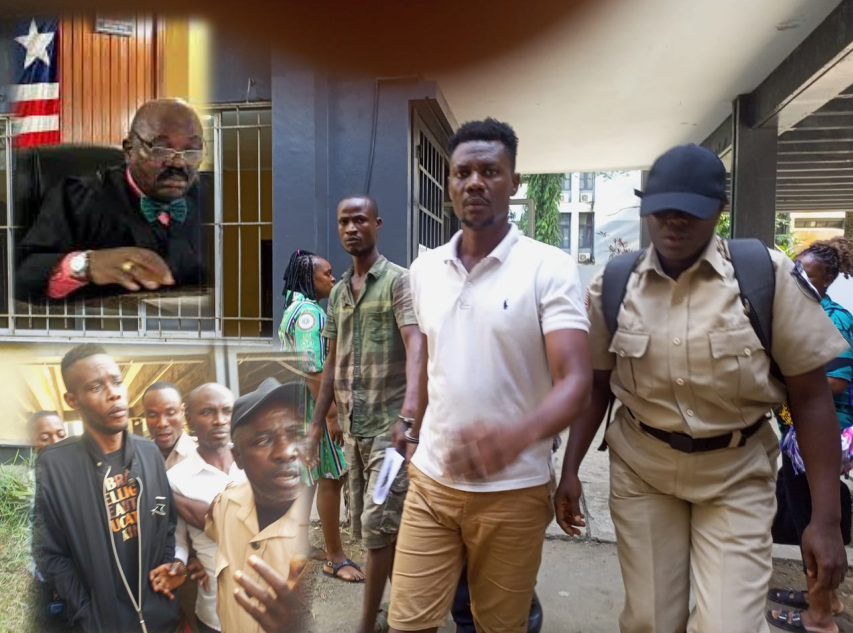
Monrovia – The Supreme Court of Liberia has directed Criminal Court “A” Judge Roosevelt Z. Willie to resume full jurisdiction over the trial of five defendants accused in the December 2024 “arson attack” on the Capitol Building.
By Willie N. Tokpah
The high court’s decision came on Friday, August 29, following a petition for a writ of certiorari filed by defense, seeking to overturn or delay Judge Willie’s handling of the matter.
In a directive issued by Associate Justice Jamesetta Howard Wolokolie, presiding in Chambers, the Court declined to grant the writ, effectively denying the prosecution’s request and ordering the trial to proceed without further interference.
“By directive of Her Honor Jamesetta H. Wolokolie, Associate Justice presiding in Chambers, you are hereby mandated to resume jurisdiction, and proceed in keeping with law, as the Justice has declined to issue the writ prayed for,” stated a court communication signed by Supreme Court Clerk, Sam Mamulu.
The ruling has been welcomed by legal observers and advocates as a critical win for due process and a reaffirmation of judicial independence in the face of mounting political and public pressure.
The five accused men, Christian Kofa, John Nyanti, Eric Susay, Thomas Isaac Etheridge, and Stephen Broh, have consistently denied any involvement in the attack, which left the Joint Chambers and dome of the Capitol Building in flames.
All five are charged with arson, criminal conspiracy, reckless endangerment, attempted murder, and other felonies following the December 18, 2024, incident that shook the nation’s political core.
While the Ministry of Justice maintains that it possesses incriminating audio evidence and other intelligence suggesting a coordinated conspiracy, defense lawyers have repeatedly argued that the case has been marred by prejudice, procedural missteps, and what they describe as “politically motivated overreach.”
Judge Roosevelt Z. Willie had earlier come under pressure from both the defense and the public following his decisions on bail for the accused.
In July 2025, an initial property bond filed by the defense was withdrawn after the state challenged its validity.
In August, Judge Willie approved a US$500,000 joint bail bond, backed by two sureties, Randolph and Rufina Cole, which allowed for the temporary release of the defendants.
However, family members and legal supporters argued that Judge Willie imposed excessively burdensome bail conditions, including the requirement of four human sureties per defendant and refusal to accept expired government-issued IDs, a move they said violated Article 21 of the Liberian Constitution, which prohibits excessive bail.
These controversies fueled defense motions for Judge Willie’s recusal, alleging bias, and prompted the prosecution to seek the intervention of the Supreme Court, a move now blocked by Friday’s ruling.

Legal experts say the Supreme Court’s refusal to intervene at this stage of the trial reinforces the principle that trial courts must be allowed to exercise discretion without premature interference, particularly in sensitive criminal proceedings.
“This decision upholds the integrity of the legal process and restores confidence that this case will be determined on the strength of the evidence, not the weight of public opinion or political influence,” said one senior legal analyst who asked not to be named.
With the Supreme Court clearing the procedural bottleneck, Judge Willie is expected to immediately resume control of pre-trial proceedings, including setting a new date for formal arraignment of the defendants; hearing pending motions from both sides; reviewing the conditions of bail and pretrial release and determining whether to allow a bench or jury trial.
Sources inside the judiciary suggest that arraignment could now proceed as early as Tuesday, September 2, barring any new legal challenges.
While the state remains confident in its evidence, supporters of the accused insist that the charges are exaggerated, and the defendants have been used as scapegoats for deeper political tensions.
As the trial resumes, attention will shift to the courtroom where the rule of law, not political statements, must determine the fate of five men at the center of one of Liberia’s most explosive legal dramas in recent history.
Support Independent Journalism
Your support helps FrontPage Africa continue delivering independent, credible, and impactful journalism. Every contribution strengthens our ability to investigate, inform, and hold power accountable while keeping quality journalism accessible to our readers.
Support our journalism or subscribe to receive the latest FrontPage Africa stories and updates.