Monrovia – It was the kind of moment politicians plan for and pretend they didn’t.
By Rodney D. Sieh
In a hall full of Liberians who had driven in from Maryland, New Jersey, Minnesota and beyond, someone asked President Joseph Nyuma Boakai the question that has hovered over the Executive Mansion since the day he took the oath: Will you run again?
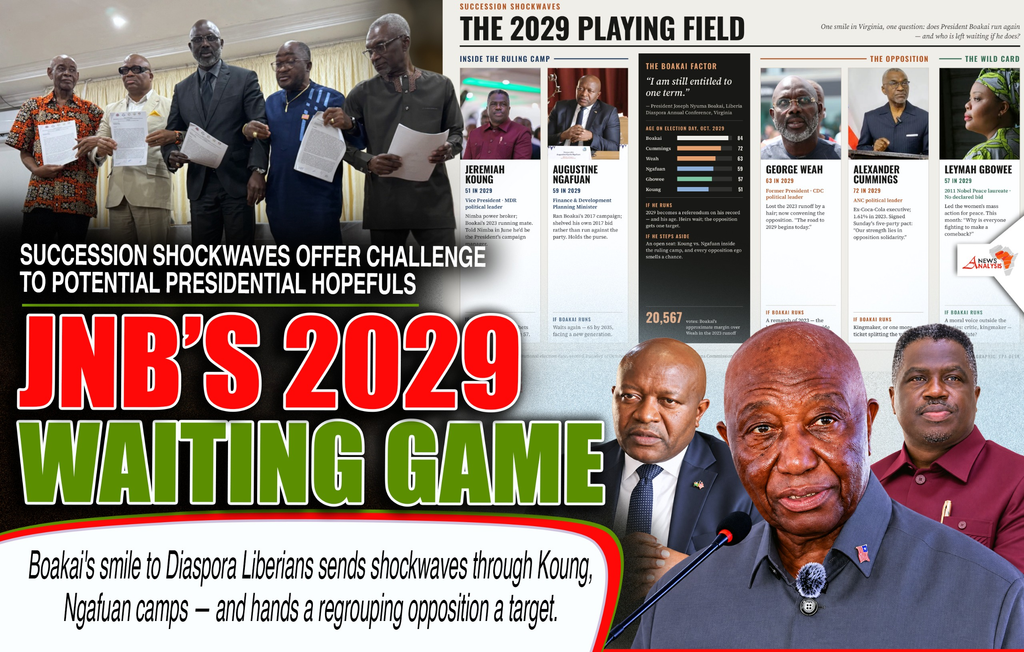
The 81-year-old did not answer. He turned it around. Did they want him to seek another term? The room said yes. The President smiled, the easy smile of a man who has spent more than four decades in Liberian politics, and replied: “I am still entitled to one term.”
Seven words. No declaration, no denial. But in a country where the 2029 race has been quietly underway for months, it was enough to set phones buzzing from Alexandria to Zwedru.
A question with an age attached
The setting was the Liberia Diaspora Annual Conference. Boakai addressed the gathering in Alexandria, Virginia, pressing Liberians abroad to move past talk and turn their patriotism, skills and money into measurable projects at home. The theme, fittingly, was about moving from dialogue to delivery.
But the arithmetic behind his answer is hard to ignore. Boakai was born on November 30, 1944, in Worsonga, Lofa County. He would be 84 on election day in 2029 and 91 by the end of a second six-year term. The Constitution allows him to run; the question Liberians will debate at kitchen tables and in attaya shops is whether he should.
His remark was also not quite a bolt from the blue. In June, Vice President Jeremiah Koung told a crowd in Nimba County’s Yarwin Mehnsonoh District that Boakai intended to seek a second term and that he, Koung, would serve as campaign manager. Weeks ago, presidential adviser MacDella Cooper posted a message cheering “6 more years” for the President. What changed over the weekend is that, for the first time publicly, the signal came from Boakai himself.
Koung: heir, or man in the waiting room?
No one has more riding on that smile than Jeremiah Kpan Koung.
Born in Yekepa in 1978, Koung rose from the House of Representatives to the Senate before becoming Vice President in January 2024. At 48, he is young enough to wait, and ambitious enough that waiting is painful. A Liberian Observer commentary last year described him as visibly eager to occupy the presidential chair in 2029.
A Boakai second term pushes that dream to 2035. Yet Koung has chosen to embrace it rather than fight it. “I’m currently paving the roads for the president of Liberia to come back,” he told residents in Nimba. It is a calculated bet: carry the old man’s bags to victory, and inherit the party’s machinery and goodwill when he finally steps aside.
The risk is that six more years is a long time to hold a coalition together. Koung is not just Vice President. He also leads the Movement for Democracy and Reconstruction (MDR), the party founded by the late Senator Prince Y. Johnson, which was a key pillar of the coalition that carried the Boakai-Koung ticket in 2023. The Nimba alliance that once rallied behind Johnson has already shown signs of splintering under ambition and mistrust, and reports, not independently verified, that Koung is backing a challenger to Unity Party Senator Prince Moye in Bong have raised questions about whether coalition politics and party loyalty can coexist. The longer the succession question stays open, the more those tensions fester.
Ngafuan: been here before
If Koung is the heir in waiting, Finance Minister Augustine Kpehe Ngafuan is the loyalist with a long memory.
Ngafuan knows what it means to put ambition on hold. He was national campaign manager for Boakai’s 2017 presidential run. Before that, he left the Unity Party in 2016 to pursue the presidency, only to announce in May 2017 that he would no longer run, unwilling to stand against the party. He came home, and today he holds the most powerful purse in government.
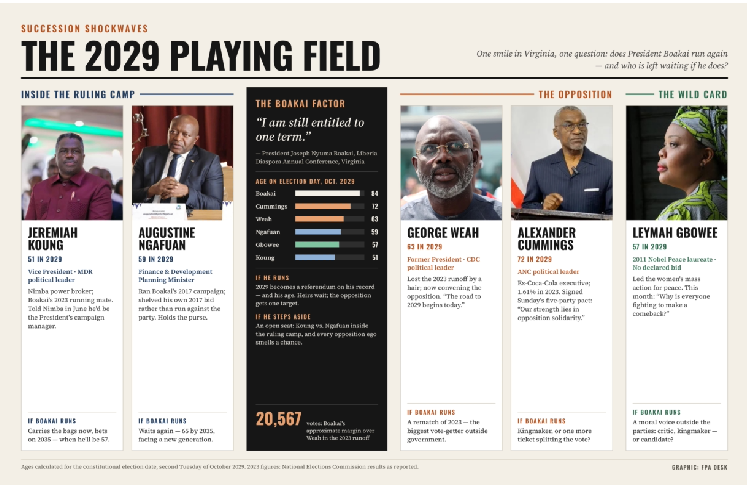
Now 56, Ngafuan has spent recent days at the UN General Assembly, where he laid out a goal of reaching 75 percent electricity access by 2029-2030. That target is a campaign promise waiting to be written. The question is whose campaign.
A Boakai second term would ask Ngafuan to do what he did in 2017: step back and wait. By 2035 he would be 65 and competing not only with Koung but with a new generation of politicians who will have spent a decade building their own bases. For a man whose power flows from the President’s trust, openly challenging the boss is unthinkable. Quietly building a network while delivering the numbers may be the only path.
Other figures in the President’s circle face the same calculation: loyalty now, or positioning for a future that keeps moving further away.
The opposition’s unexpected gift
As Boakai smiled in Virginia, the opposition was busy in Monrovia. On the same Sunday, five opposition parties signed a joint communiqué committing to closer cooperation ahead of 2029, at a roundtable hosted by MPC leader Simeon Freeman at Sinkor Palace. Former President George Weah of the CDC was joined by Alexander Cummings of the ANC, Maxwell Kemayah of MOVEE, Freeman, and Mason of the ULDP.
The document accuses the government of losing territory to Guinea, fighting corruption and drugs selectively, defying the Supreme Court, and using a new cybercrime law against critics. But on the big question of who leads, the leaders held back. “We are not discussing who becomes president, who becomes vice president,” Freeman told reporters.
That is precisely where a Boakai candidacy could change the equation. An open seat in 2029 would have invited every opposition heavyweight to believe his moment had come, the same clash of egos that undermined the Collaborating Political Parties. An incumbent on the ballot concentrates minds. The election becomes a referendum on one man’s record, one government’s promises, and one very visible question about age and vigor.
The margins invite them to try. Boakai beat Weah in 2023 by roughly 20,567 votes. Weah has already declared that the road to 2029 begins now.
But incumbency cuts both ways. A sitting president controls the budget, the appointments and the calendar of ribbon-cuttings. And the opposition has made this promise before.
The people who decide
For all the drama at the top, the verdict on a second Boakai term will not be delivered in a Virginia ballroom. It will be delivered by the market woman in Red-Light counting the cost of rice, the motorcyclist in Ganta dodging potholes on a road he was promised would be paved, the teacher in Voinjama waiting on salary arrears.
They did not get to answer the President’s question on Sunday. In October 2029, they will.
Support Independent Journalism
Your support helps FrontPage Africa continue delivering independent, credible, and impactful journalism. Every contribution strengthens our ability to investigate, inform, and hold power accountable while keeping quality journalism accessible to our readers.
Support our journalism or subscribe to receive the latest FrontPage Africa stories and updates.