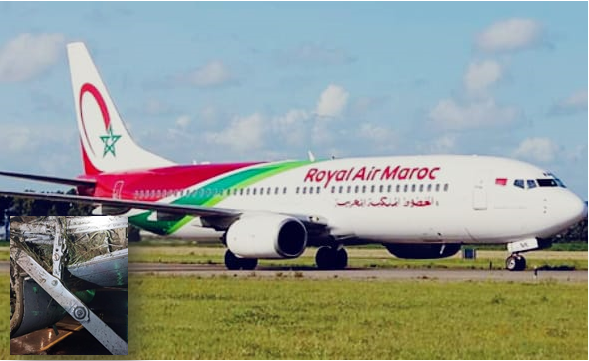
Monrovia –A Royal Air Maroc flight narrowly avoided a serious accident at Roberts International Airport (RIA) on Saturday morning. Sources familiar with the incident reported that the plane initially landed on both rear wheels, but shortly after, the left wheel veered into a muddy grass patch adjacent to the runway, damaging several runway lights, which are already sparse at RIA.
By Jaheim Tumu, [email protected]
The pilot did not report the incident to the control tower or airport authorities, as the aircraft was parked at the passenger boarding bridge without any visible signs of alarm among the passengers, who disembarked normally. The situation only came to light when departing passengers experienced a two-hour delay in their boarding time. It was then that Royal Air Maroc staff informed them of the issue.
As a precaution, the departing passengers were transported to the Farmington Hotel near the airport and Tíme Royal Ambassador Hotel in Unification Town, where they remain while the incident is being investigated by the relevant authorities.
The Liberia Airport Authority (LAA) later confirmed the incident in a statement. According to the LAA, the aircraft, a Boeing 737-800 Series with flight number AT-567, had landed safely but veered off the runway. The incident resulted in no injuries to passengers, no structural damage to the aircraft, and no fatalities. “It is important to note that passengers on board the aircraft were unaware of the incident,” the LAA emphasized.
During a routine inspection of the aircraft before its scheduled departure, significant debris was found on the runway, leading to further inspections. The airport’s Safety Compliance team inspected the runway and discovered damage to portions of the runway pavement shoulders, with debris scattered along the runway.
Upon learning of the situation, the LAA contacted the airline crew through the aircraft engineer, instructing that the aircraft remain grounded until further notice. The Liberia Civil Aviation Authority (LCAA) and the Aircraft Accident Investigation Bureau (AAIB) were promptly informed, and inspection teams from both agencies, along with the Minister of Transport, were dispatched to the airport to assess the incident further.
Pilot Error Suspected
FrontPageAfrica has reliably learned that the pilot of the Royal Air Maroc flight may have been at fault for the near-accident. A source, speaking on condition of anonymity, indicated that while the details surrounding the pilot’s actions are still under investigation, the incident has raised concerns about flight safety and operational protocols at the airport.
During routine inspection of the aircraft prior to departure, in keeping with standards and recommended practices, it was observed that the aircraft had picked up significant debris that precipitated further inspections. As a result, the airport Safety Compliance team inspected the runway and observed that portion of the runway pavement shoulders had been damaged with huge debris along the runway. Upon receipt of this information, the Liberia Airport Authority (LAA) management immediately contacted the airline crew, through the aircraft engineer, about the situation and that the aircraft remain grounded until further instructions…
The source explained that the plane landed on both rear wheels, but shortly after, the left wheel veered into a muddy grass patch, damaging several runway lights. “The fault did not come from the airport. The fault came from the aircraft. The pilot slipped off the runway and broke the lights. The incident occurred between 3-4 am,” the informant told FrontPageAfrica.
The source detailed the communication protocols before an aircraft lands, stating that the Control Tower and the powerhouse operator coordinate to ensure the appropriate lighting is provided. “At times during the day, the lights are set to level five because it needs to be really bright for larger aircraft. The pilot cannot see the ground clearly without the approach light, the PAPI (Precision Approach Path Indicator), and the runway edge light,” the source explained.
The source further emphasized that there was no electricity fault at RIA, stressing that the airport has 24-hour electricity, boasting the longest uninterrupted power supply in West Africa.
When asked whether the plane was landing at the time of the incident, the source confirmed that the pilot was indeed landing and had brought passengers to the airport. They added that every time a plane arrives at any airport, it is given sufficient time to rest and undergo proper checks before its next departure.
Support Independent Journalism
Your support helps FrontPage Africa continue delivering independent, credible, and impactful journalism. Every contribution strengthens our ability to investigate, inform, and hold power accountable while keeping quality journalism accessible to our readers.
Support our journalism or subscribe to receive the latest FrontPage Africa stories and updates.