MONROVIA — Liberia is on course to collect more than one billion United States dollars in domestic revenue in a single year for the first time in its history, with the milestone expected to be crossed in September.
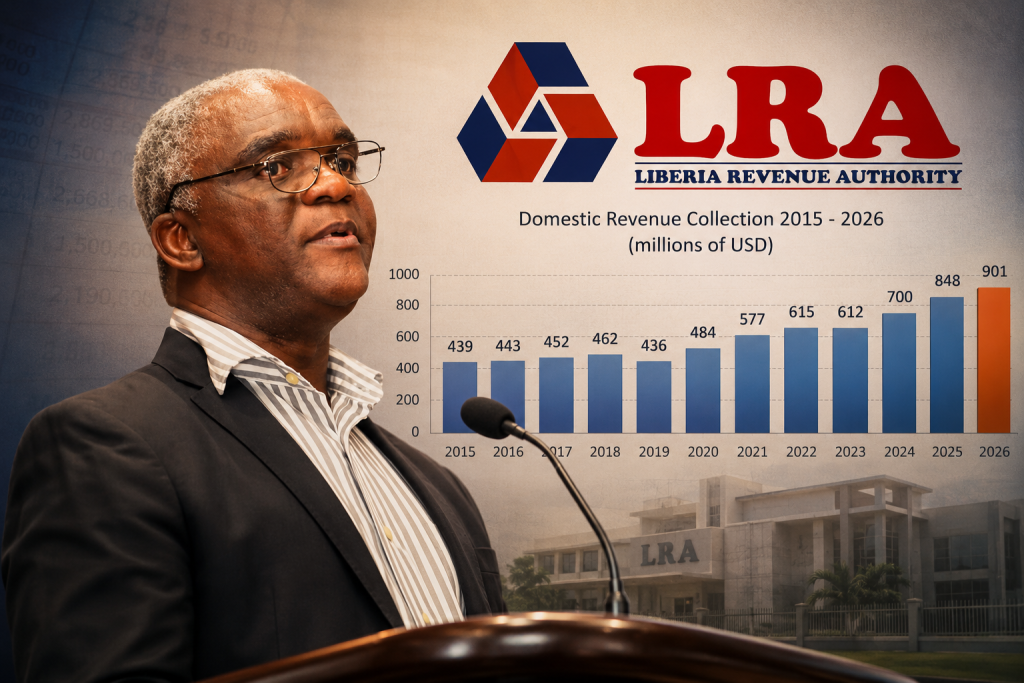
Figures from the Liberia Revenue Authority show that collections stood at US$901 million as at August 14, leaving US$99 million to be raised before the country passes a threshold that has been a stated national ambition across successive administrations. On the Authority’s current run rate, that gap closes within weeks.
“One billion dollars will not be the achievement,” said James Dorbor Jallah, Commissioner General of the Liberia Revenue Authority. “What it pays for is — the clinics, the classrooms and the roads we no longer have to ask anyone else to fund. And a record only means something if it becomes the new floor rather than the high point. Nothing about next year is guaranteed by what we do this year.”
The pace tells the story. March brought two one-off signature bonuses totaling US$211 million, of which US$200 million came from ArcelorMittal. Setting that windfall aside, the Authority collected an average of US$88 million a month between January and July. August has run ahead of that pace, with US$75 million banked in the first fourteen days alone.
Even on conservative assumptions — August closing at no better than the underlying monthly average, and September doing the same — the billion-dollar mark is reached before the end of next month. On the more likely trajectory suggested by August’s opening fortnight, it arrives sooner.
Not a one-off
The March windfall raises an obvious question: whether the record rests on a single large payment rather than on the underlying strength of collections
The arithmetic answers it. Excluding those payments altogether, underlying collections are tracking toward roughly US$1.05 billion for the full year. On that basis alone — treating the US$211 million as though it had never been received — Liberia would still cross one billion dollars, though later in the year, around the beginning of December.
The exceptional payments bring the milestone forward by some weeks. They do not create it.
Three years, one decade’s worth of growth
The billion-dollar figure is the headline, but it is the trajectory behind it that officials are pointing to.
Domestic revenue stood at US$612 million in 2023. In 2024, the first full year under the current government and the current management of the Revenue Authority, collections rose to US$699 million — an increase of US$87 million, and US$9 million above the target set for the year. In 2025, collections reached US$848 million, a further increase of US$149 million and US$44 million above target.
Each of those years set a record as the highest domestic revenue ever collected in the country’s history. Together, the two years added US$236 million to annual collections — more, according to the Authority, than the thirteen preceding years added combined.
Should collections close 2026 at approximately US$1.22 billion, as the current pace suggests, annual domestic revenue will have doubled from the 2023 base of US$612 million in the space of three years. Reaching that figure requires around US$72 million a month between now and December 31 — below the US$88 million monthly average the Authority has sustained through the year to date.
That would put the increase in annual domestic revenue across the three years at US$612 million — as much again as the entire sum collected in 2023. The comparison that matters, though, is with what came before. Annual collections rose by roughly US$490 million between the 2006/07 fiscal year, the first full budget year after the war, and 2023 — a span of seventeen years. On the Authority’s projection, three years will have added more than the seventeen that preceded them.
The Finance Minister has already pointed to the trend. Addressing the National Steering Committee on the ARREST Agenda for Inclusive Development in Monrovia on August 11, Augustine Kpehe Ngafuan set out the year’s collection figures and said the trajectory left the country “firmly on course to meet the approved 2026 revenue target of US$1.3 billion.”
That figure covers the full resource envelope for the year. Of the US$1.301 billion, US$1.182 billion is domestic revenue and US$120 million comes from external partners. And because US$5 million of the domestic figure is carried forward from last year’s surplus, the sum the Authority must actually collect this year is US$1.176 billion. On the trajectory described above it will pass that too, by roughly US$48 million — a third consecutive year above target, and the widest margin of the three.
What is driving it
The Authority attributes the sustained over-performance to a set of administrative changes rather than to new taxes or higher rates.
Chief among them are reforms to tax administration, the digitization of filing and payment systems, modernization at customs, and a concerted effort to close leakages in the collection chain. Together these are intended to widen the base of compliant taxpayers, shorten the distance between an assessment and a payment, and reduce the discretion at which revenue has historically been lost.
At customs, the reform agenda now carries a measurement. The Authority’s second National Time Release Study, published in July with the World Customs Organization, found that imported cargo takes an average of 12 days, 19 hours and 42 minutes to move from vessel arrival to final exit at the Freeport of Monrovia.
“Twelve days and nineteen hours is what it currently costs to bring a container through the Freeport,” said Saa Saamoi, Commissioner of Customs. “We have committed to three. Every day taken out of that is revenue arriving sooner and one less reason for a trader to treat Liberia as the expensive route.”
He has called on shipping lines, terminal operators and customs brokers to work toward that target.
The ratio that matters
For economists, the more telling measure is not the absolute figure but what share of the economy it represents.
On IMF figures, domestic revenue was equivalent to 13.4 percent of GDP in 2023. It rose to 14.5 percent in 2024 and to 15.9 percent in 2025 — a gain of two and a half percentage points in two years. The Fund projects 16.3 percent for 2026.
That climb is the strongest available evidence that something has changed structurally rather than cyclically. The economy was growing throughout: real output expanded by 4.6 percent in 2023, 4.0 percent in 2024 and 5.1 percent in 2025. A ratio that rises while the denominator is also rising means collections outpaced the economy that produced them — the difference between a state taxing a larger economy and a state that has become better at taxing.
The Fund’s own projection carries a caution, though. The increase it expects for 2026 is four-tenths of a percentage point, against 1.1 points in 2024 and 1.4 in 2025. On that forecast, the steepest part of the climb is already behind. The IMF continues to describe more ambitious domestic revenue mobilization as a priority for Liberia, and identifies low domestic revenue as a constraint on the country’s capacity to finance infrastructure and climate-resilient investment.
Not everyone was convinced
The projections were not universally believed. When the 2026 budget went before the House in November, the Joint Committee on Ways, Means, Finance and Public Accounts opened its review by questioning the revenue assumptions, several of which lawmakers judged inflated and uncertain. The committee chair, Representative P. Mike Jurry, said the Legislature would not be swayed by the symbolism of a billion-dollar budget and pressed the Executive for verifiable figures. He singled out the projected US$200 million ArcelorMittal bonus, warning that it had to survive technical and legal verification, and recalled that earlier administrations had built budgets on optimistic estimates before returning mid-year to borrow against the shortfall. Lawmakers also questioned whether domestic revenue would stretch to cover Liberia’s rising debt-servicing obligations without squeezing allocations to health and education.
Much of that has since been answered. The bonus was received. Collections have tracked the forecast. The debt warning has not been tested: servicing is budgeted at US$230 million this year, and the squeeze the committee described would not show up in a collection figure.
What comes next
The immediate significance of crossing one billion dollars is fiscal room. Every dollar raised domestically is a dollar the government does not have to borrow or seek from external partners, and domestic revenue is the portion of the budget over which the state has the most direct control.
The harder test is durability. Revenue records set on the back of administrative tightening tend to deliver their largest gains early, as the most visible leakages are closed and the most easily reached taxpayers are brought into the net. The Fund’s own forecast of a much smaller rise in 2026 points the same way. Whether the ratio climbs beyond 16 percent in 2027 and after will depend on whether the reforms have changed the system’s underlying capacity or simply collected more efficiently from within its existing limits.
For now, the number stands at US$901 million and rising. Barring an abrupt reversal in the weeks ahead, Liberia will end September having done something it has never done before.
Support Independent Journalism
Your support helps FrontPage Africa continue delivering independent, credible, and impactful journalism. Every contribution strengthens our ability to investigate, inform, and hold power accountable while keeping quality journalism accessible to our readers.
Support our journalism or subscribe to receive the latest FrontPage Africa stories and updates.