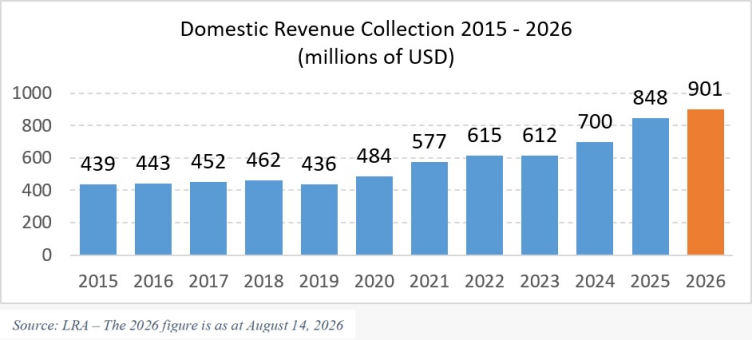
LIBERIA IS ABOUT to do something it has never done in its history: collect more than one billion United States dollars in domestic revenue in a single year. On the figures reported this week, the country will very likely cross that line in September. It is worth pausing on what that means, and, more importantly, on what it does not yet mean.
THE TRAJECTORY is not in dispute. Domestic revenue has climbed from US$612 million in 2023 to US$848 million last year, and is on course for something above US$1.2 billion by December — a doubling of the base in three years, achieved not through new taxes but through the unglamorous work of tax administration, digitized filing, and tighter customs enforcement. Three years have added more to annual collections than the seventeen years that followed the war. Whatever else is said about this government’s record, that is a genuine institutional achievement, and it deserves to be recognized as one.
BUT COMMISSIONER General James Dorbor Jallah put his finger on the more important point when he said, in effect, that the number is not the achievement. He is right. A billion dollars collected and a billion dollars well spent are two different accomplishments, and Liberians have learned, over successive administrations, not to assume that the first guarantees the second.
THIS IS WHERE government now has the harder job. Collection has been the story of the last three years. Delivery has to be the story of the next three.
CONSIDER WHAT a billion dollars in domestic revenue actually represents for an ordinary Liberian household. It is not simply a fiscal milestone to be announced in Monrovia. It is the difference between a clinic in Bong County that has antimalarials in stock and one that does not. It is the difference between a school term that runs on schedule and teacher salaries that arrive on time, and one where both are subject to the usual uncertainty. It is fewer roads that turn to mud in the rains, and fewer communities where the nearest passable road is an afternoon’s walk away. The Commissioner General named clinics, classrooms and roads specifically, and he was right to. Those are the places where a revenue figure either becomes real to people or remains an abstraction reported in the press.
THE GOVERNMENT’S own record gives reason for both confidence and caution here. Confidence, because the reforms behind this revenue growth — closing leakages, shortening the distance between assessment and payment, reducing discretion in the collection chain — are precisely the kind of unglamorous, systemic changes that tend to be durable rather than a single fortunate year. The IMF’s data on revenue as a share of GDP, rising from 13.4 percent in 2023 toward a projected 16.3 percent this year, points to something structural rather than a one-off windfall dressed up as reform.
CAUTION BECAUSE the Fund’s own forecast shows the pace of that improvement slowing sharply next year, and because collecting money is administratively simpler than spending it well. Liberia’s history offers no shortage of examples of revenue gains that did not translate into visible improvement in public services, for reasons ranging from weak procurement to poor project execution to plain diversion. The Legislature’s Ways, Means, Finance and Public Accounts Committee was doing its job when it pressed the Executive on the reliability of this year’s revenue assumptions; it should now do that same job in reverse, pressing the Executive on where the money actually went.
THERE IS A specific test the government can set for itself, and that this newspaper would encourage it to accept: publish, clinic by clinic and school by school and road by road, what this year’s additional revenue funded, and let that record be checked against what is actually on the ground. Commissioner Jallah spoke of a record that “becomes the new floor rather than the high point.” The same standard should apply to how the money is spent — not a single well-publicized project cycle, but a floor of transparency and delivery that holds in years when the headlines move on to something else.
CROSSING ONE billion dollars is a genuine milestone, and the institution that made it possible has earned public credit for it. But institutions that collect well are not automatically institutions that spend well, and the two should not be allowed to blur into one another in the public mind. Liberians did not ask their government to be good at collecting revenue. They asked it to be good at governing. The first is now demonstrably true. The second is the test that begins now.
Support Independent Journalism
Your support helps FrontPage Africa continue delivering independent, credible, and impactful journalism. Every contribution strengthens our ability to investigate, inform, and hold power accountable while keeping quality journalism accessible to our readers.
Support our journalism or subscribe to receive the latest FrontPage Africa stories and updates.