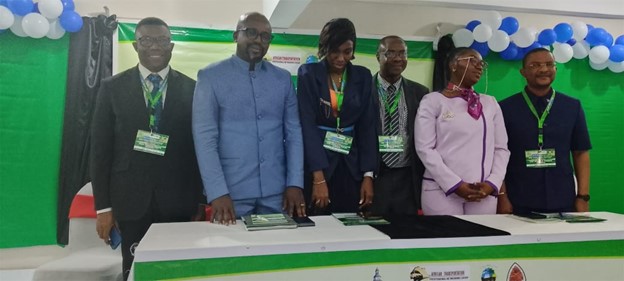
The Minister of Public Works, Roland Layfette Giddings, has declared that Liberia is ready to lead and shape the future of transportation on the continent, as the country officially opened the 10th International Conference on Sustainable Transportation in Africa (ICTA 2025).
By Jaheim T. [email protected]
The conference, held under the theme: “Resilient Transport Infrastructure and Improved Accessibility for Sustainable Development,” is being hosted in Monrovia through a collaboration between the Global Transportation Professional Network Group, the Ministry of Public Works, the Ministry of Transport, and the International Road Federation (IRF).
Minister Giddings told delegates from across Africa and around the world that Liberia’s transition from a participant in ICTA 2024 in Aouchi, Tanzania, to the proud host of the 2025 edition, speaks volumes about its rising influence and readiness.
“We returned from Tanzania inspired — by the innovations we saw, the partnerships we formed, and the energy of collaboration,” Giddings said. “Today, that inspiration has taken form. Hosting ICTA 2025 is not just an honor; it’s a demonstration of Liberia’s growing commitment to shaping inclusive and climate-resilient transport systems.”
He pointed to the ongoing infrastructure developments across Liberia, including road rehabilitation, bridge construction, and climate-sensitive urban planning, all aligned with the AREST Agenda for Inclusive Development — a national plan that prioritizes roads and energy as enablers of economic growth.
“The lack of road networks and sustainable energy has long constrained our development,” Giddings said. “ICTA 2025 allows us to engage with best practices, build new partnerships, and position Liberia as a strong voice in Africa’s sustainable mobility movement.”
KEYNOTE PRESENTATION: Prof. Charles Adams Urges African Countries to ‘Plan Smart, Act Bold’
Delivering the keynote address, Prof. Charles Adams, Associate Professor and Director of the Transport Research and Education Centre Kumasi (TRECK), delivered a powerful message about the urgent need for climate-resilient infrastructure that goes beyond big-ticket projects and addresses fundamental planning gaps.
His presentation, titled “Resilient Transportation Infrastructure and Improved Accessibility for Sustainable Development,” laid out a clear and practical roadmap for African countries struggling with infrastructure vulnerabilities amid growing climate threats.
“We need to ask: which infrastructure is at risk, and to what extent? Without that knowledge, we’re only reacting,” Prof. Adams emphasized. “The key is to act based on data — knowing where people live, where the risks are, and what can be done within our means.”
Prof. Adams proposed a four-part resilience framework that include a define the scope of infrastructure goals and risks.
Among the proposals were the collection and organize relevant data, exploring and prioritizing solutions based on resources and impact and establishing a monitoring and feedback system for long-term adaptation
He warned against waiting for perfect funding before taking action. Instead, Adams urged countries to identify “small wins” — simple, low-cost interventions like improved drainage systems and natural waste channels — that can drastically reduce long-term infrastructure failures.
“Too often, we overlook the simple things. But small fixes, well-planned, can prevent big disasters,” he added. “Without good planning and data, infrastructure development becomes wasteful and ineffective — especially under changing climate conditions.”
He also stressed the importance of protecting vulnerable populations, including women, children, and people in rural areas, who are often the most affected by poor transport infrastructure.
JOSETA NEUFVILLE-WENTO: ‘LIBERIA IS NO LONGER ON THE SIDELINES’
In a passionate presentation, Joseta Neufville-Wento, Manager of Liberia’s National Road Fund, said the conference marked a personal and national breakthrough.
“I have long advocated for Liberia to host a conference like this,” she said. “Today, that dream is reality. Liberia is no longer on the sidelines of global transport conversations — we are inside the room.”
Neufville-Wento highlighted the importance of data-driven planning, emphasizing that economists, engineers, and policy-makers must work hand-in-hand to ensure sustainable outcomes.
“For us economists, the numbers matter. Engineers may focus on design and materials, but we look at financing, economic returns, and long-term impact,” she said. “And none of that is possible without quality data.”
She described roads as “the arteries of the economy,” making the case that no other sector — health, agriculture, education — can thrive without a reliable transport network.
Neufville-Wento also announced that the National Road Fund has completed a Domestic Resource Mobilization Study for 2026, which includes plans for integrating electric vehicles (EVs) and tapping into innovative financing streams to support future transport needs.
“We’re working with the Ministry of Finance to ensure that domestic revenue generation supports sustainable mobility,” she explained. “But we’re also careful not to overburden citizens with high transport costs.”
She encouraged international guests and partners to continue collaborating with Liberia beyond the conference.
“This shouldn’t be your last visit,” she told the audience. “See this as a chance to plant a seed. Our road sector is evolving, and your research, innovation, and partnership can help it flourish.”
As ICTA 2025 continues in Monrovia, delegates say the message is clear: Liberia is ready- not just to host – but to lead. With momentum, vision, and collaboration across sectors, the country is steering toward a transport future that is sustainable, inclusive, and built to last.
Support Independent Journalism
Your support helps FrontPage Africa continue delivering independent, credible, and impactful journalism. Every contribution strengthens our ability to investigate, inform, and hold power accountable while keeping quality journalism accessible to our readers.
Support our journalism or subscribe to receive the latest FrontPage Africa stories and updates.