Monrovia – The prosecution’s attempt to tightly link the defendants to the December 2024 Capitol Building arson came under renewed scrutiny on Wednesday after its first witness admitted that investigators never conducted forensic fingerprint testing on the very items allegedly used to start the fire.
Testifying before Criminal Court “A,” Liberia National Police (LNP) investigator Rafael Wilson conceded under cross-examination that neither the Clorox bottle nor the matchbox recovered from the scene underwent scientific fingerprint analysis, raising fresh doubts about the investigative rigour behind one of the country’s most politically charged trials.
No Scientific Testing on “Key Physical Evidence”
Pressed by defense lawyers, Wilson told the court that LNP forensic technicians said the plastic Clorox bottle could not retain viable prints.
“The Clorox bottle and matchbox have raw surfaces. We could not conduct fingerprint testing. The forensic technician told us it was impossible to extract prints from that type of material,” Wilson testified.
The admission triggered aggressive questioning from the defence, who argued that investigators had failed to meet the basic standards required to tie any suspect to the evidence.
Defense lawyers insisted that any item allegedly handled by a perpetrator should be bagged, preserved, and tested, yet none of that was done.
Judge Blocks Defense Inquiry
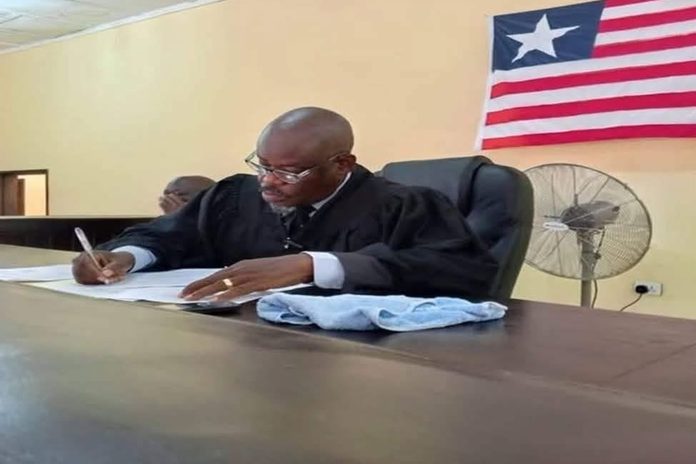
When the defense attempted to question how the State could lawfully connect the accused to the alleged arson without fingerprints, Presiding Judge Roosevelt Z. Willie shut down the line of questioning.
Judge Willie ruled that the witness had already referenced “other documentary and oral evidence” forming the basis for the indictment.
Earlier, prosecutors attempted to introduce the LNP charge sheet and investigation report.
Defense lawyers objected, asserting that the documents were never provided during discovery and were therefore “strange” and procedurally improper.
Despite the objection, Judge Willie allowed the documents into evidence but ordered that printed copies be supplied to the defense for review.
Clash Over Audio Recordings, Chain of Custody Challenged
Tensions escalated when the prosecution pushed to admit several audio recordings.
The defense responded, arguing the State failed to establish a chain of custody, offering no information about how, when, where, or by whom the recordings were made.
Again, the judge overruled the objection, relying on legal precedent that permits admission of evidence whose credibility will ultimately be judged by the jury.
“The fact that evidence is admitted does not mean it is true,” Judge Willie said. “It is the jury that determines its credibility.”
Defense Accuses Judge of Bias
The ruling triggered a rare confrontation.
Defense lawyer Cllr. Arthur Johnson accused the judge of crossing a line.
I “Your Honor, your ruling sounds as though you are arguing for the prosecution,” Johnson said, insisting the judge was interpreting evidence on behalf of the State in front of the jury, behavior he argued is prohibited by court rules.
The defense later moved to strike the witness’s testimony related to the audio recordings, arguing, that the jury had already listened to the clip, that the witness was not qualified as an audio expert, and reliance on the recording amounted to hearsay.
Court Dismisses Hearsay Claim
Wilson, however, stated that the recordings were generated during an LNP-led investigation with support from the National Security Agency (NSA).
Trial Continues Amid Mounting Questions
The repeated courtroom clashes, combined with the revelation that no fingerprint testing was conducted on items allegedly tied to the arson, have intensified scrutiny over the strength and credibility of the prosecution’s case.
The trial resumes later this week.
Support Independent Journalism
Your support helps FrontPage Africa continue delivering independent, credible, and impactful journalism. Every contribution strengthens our ability to investigate, inform, and hold power accountable while keeping quality journalism accessible to our readers.
Support our journalism or subscribe to receive the latest FrontPage Africa stories and updates.