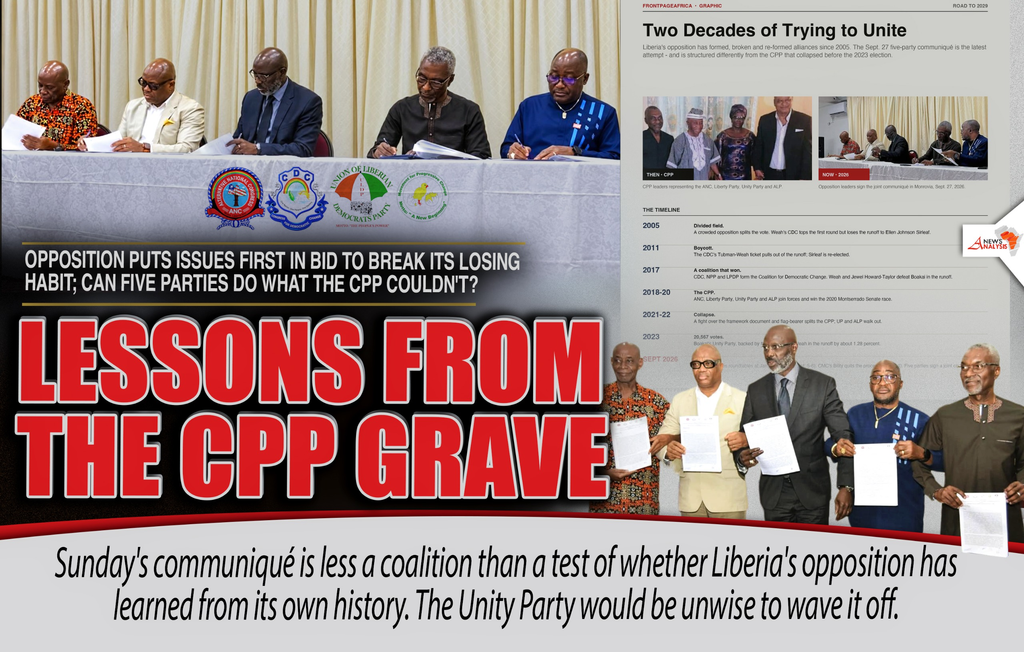
MONROVIA – For most of the last two decades, Liberia’s opposition has had a habit of losing to itself. Parties meet, pledge unity, sign documents, then split over who leads before the ruling party breaks a sweat. So when George Manneh Weah and four other political leaders (Alexander Cummings, Dee-Maxwell Saah Kemayah, Simeon Freeman and Jonathan Mason) put their names to an eight-page communiqué on Sunday, the question was not whether they could agree on grievances. That part is easy. The question is whether they have found a way to stay together long enough to matter in 2029.
By Rodney D. Sieh
What the Communiqué Actually Is
Read closely, the document is two things at once. The first is a charge sheet: Foya and the Guinea border, the US$10 million Foya project, the US$8 million SIB transfer, the drug busts, the Supreme Court, the Cybercrime Act, evictions, the EU ambassador, the US deportee deal. It is the most comprehensive attack on the Boakai-Koung government to come from the opposition since the 2023 transition.
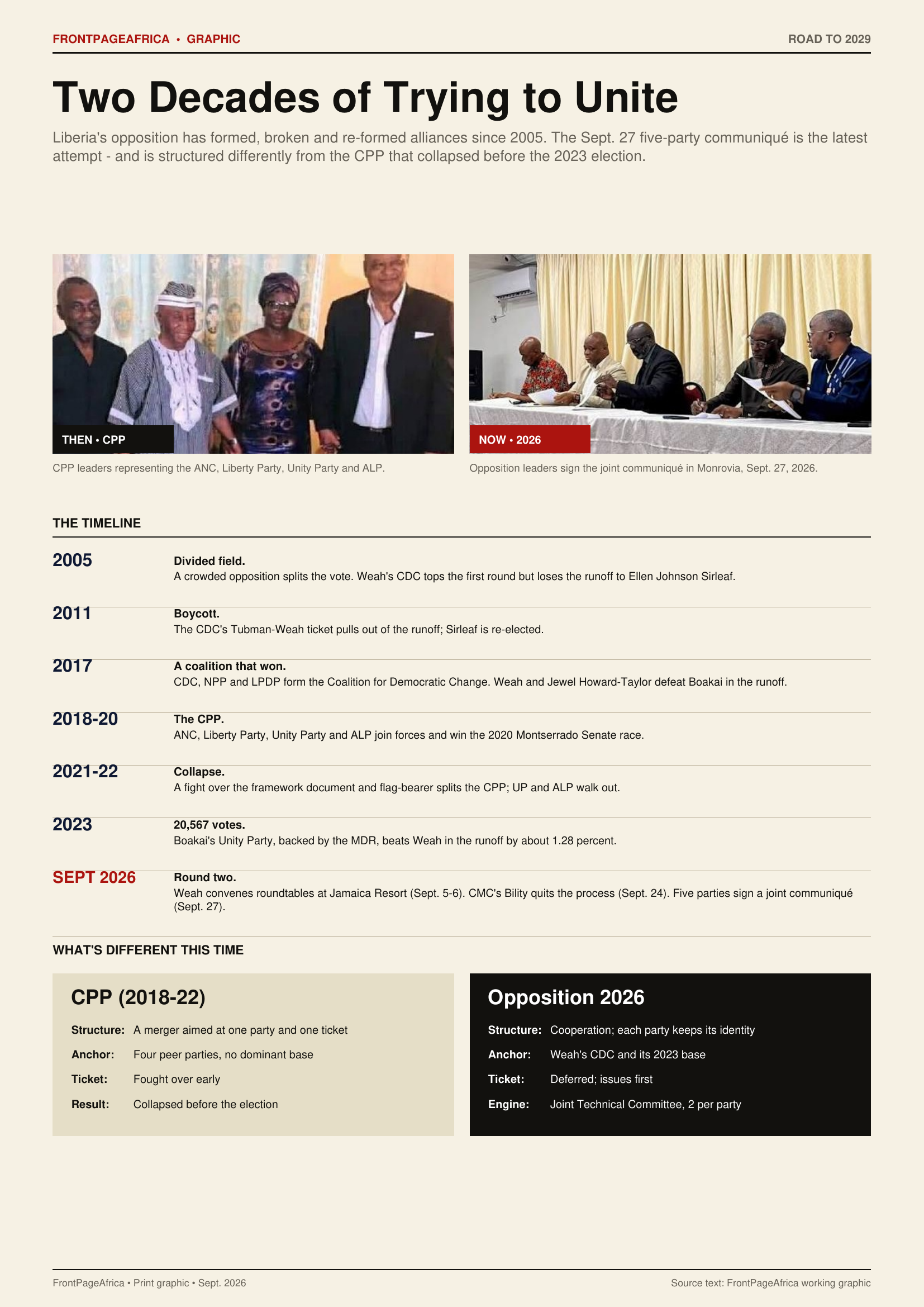
The second is a governance arrangement, and that is the more interesting part. The parties have not merged, have not named a leader, and have not touched the 2029 ticket. Instead, they have created a Joint Technical Committee, two members per party, to write policy positions and build county-level outreach. They say outright that they will not try “to manufacture opposition political unity by declaration.”
That line is aimed squarely at the ghost of the Collaborating Political Parties.
What Is Different This Time
The CPP brought together the ANC, Liberty Party, Unity Party and All Liberian Party with a framework that demanded a single standard bearer. It won the 2020 Montserrado senatorial seat, then tore itself apart over the framework document and the question of who would carry the flag. By 2023, its members were running against each other and Boakai rebuilt the Unity Party on his own terms. The lesson most opposition figures drew is that the ticket question, asked too early, destroys everything else.
This arrangement is built differently in at least four ways.
It has an anchor. The CPP was a gathering of roughly equal, mid-sized parties with no dominant base. This effort is organized around a former president who lost the 2023 runoff by about 20,000 votes and can still fill the road from RIA to Monrovia. That changes the arithmetic. The smaller parties bring policy credibility, regional contacts and technocratic names; the CDC brings the votes.
It puts the ticket last. By design, the parties have agreed on issues before structure, and structure before candidates. Cummings has spoken openly about drawing lessons from the CPP collapse, and the sequencing reflects that.
It is spreading ownership. The first roundtable was at Weah’s Jamaica Resort; the second was hosted by Freeman at the Sinkor Palace. Small as it sounds, rotating the host chips away at the charge, made loudly by Musa Bility before the first meeting, that this is a CDC project with a pre-appointed leadership.
It is issue-driven, not personality-driven. The communiqué reads like an opposition policy platform in draft. If the technical committee produces real positions on the economy, the courts, the NEC and the drug war, the group will have something the CPP never had: a reason to exist beyond beating the incumbent.
The Fault Lines
None of that guarantees survival, and the cracks are already visible.
The Citizens Movement for Change walked out three days before the signing, saying it would not endorse the draft and wanted cooperation tied to a clearly defined national reform agenda, including changes to the system of government. Bility’s objection, that hosting a meeting does not confer leadership over the opposition, has not gone away. It has simply left the room with him, and it may return from the others once the ticket question comes due.
Then there is the CDC’s own record. A communiqué that indicts selective justice, opaque procurement and pressure on the courts invites the obvious reply: what about 2018 to 2024? The Unity Party will point to missing money, the sanctions on CDC-era officials and the way the Weah government treated critics. The opposition’s claims will be judged partly on whether its lead party can answer that history.
The absences also matter. The Liberty Party is not at the table. The National Patriotic Party is divided, with its executive suspending partisans who endorsed the roundtable while its political leader, former Vice President Jewel Howard-Taylor, faces drug-related charges she denies. Senator Samuel Kogar attended the first round but is not a signatory.
And the hardest question has only been postponed. Weah remains constitutionally eligible for another term. Cummings has run twice and is unlikely to stand aside quietly. Kemayah signs as his party’s “Standard Bearer.” A structure that defers the ticket can hold only if it also agrees, sooner rather than later, on how the ticket will be chosen: a primary, a polling formula, a negotiated power-sharing deal. Without that, 2029 becomes 2023 again.
Can It Become a Viable Opposition?
It can, if it does three things over the next 18 months.
First, turn the charge sheet into policy. Liberians have heard grievances before. What they have rarely heard from an opposition is a costed answer to squatter settlements, health worker pay or border diplomacy. The technical committee is the vehicle for that, and its output will show whether this is a movement or a press release.
Second, go where the votes were decided. The 2023 runoff was lost in the northwest and the southeast swing counties, not in Montserrado. County-level structures, which the communiqué promises, matter more than Monrovia roundtables.
Third, settle the selection rule early, even if the name comes late. The CPP died over process, not personalities. A signed, public mechanism for choosing a standard bearer would be the clearest signal that this effort has learned something.
What the Unity Party Should Do
The ruling party’s first instinct has been dismissal. Secretary General Amos Tweh, launching the Boakai 2029 Reelection Movement, said the opposition gathering posed no serious threat. That may be good for morale at party headquarters, but it is weak strategy. The communiqué is not really asking voters to love Weah; it is asking them to doubt the government. Dismissing the messenger does nothing about the message.
The more durable response is to take the sharpest charges off the table:
• Publish the Foya file. Funding sources, contracts and the MRU question. A US$10 million project in the President’s hometown will be a campaign issue for three years unless it is fully explained now.
• Let the drug investigation breathe. The opposition’s proposal for a commission including the Bar, the Press Union, churches and mosques is not radical. Accepting some version of it would take the “selective justice” line away from the opposition.
• Stop fighting the courts and the critics. Compliance with Supreme Court opinions and restraint in using the Cybercrime Act cost the government little and deny the opposition its “police state” narrative.
• Explain the deportee arrangement and the EU rift. Both are foreign-policy stories that are becoming domestic ones.
• Show delivery. The communiqué itself concedes the US$1 billion revenue milestone. The Unity Party’s best argument is to make that number visible in salaries, clinics and resettlement for displaced families.
There is also an internal question the UP will eventually have to face. President Boakai would be 84 in 2029. A reelection movement launched this early suggests the party intends to run him again, but voters will ask about continuity, and an opposition built around renewal will make the most of it.
The Bottom Line
Sunday’s communiqué does not mean Liberia’s opposition is united. It means five parties have agreed on what they are against and have built a slower, looser structure designed to survive the fights that killed the CPP. That is a genuine change in approach. Whether it becomes a change in outcome depends on two things no document can settle: whether the lead party can carry its own past, and whether the leaders can agree on a way to choose one of themselves before 2029 chooses for them.
For the Unity Party, the warning is simpler. The margin in 2023 was barely 20,000 votes. An opposition that stops beating itself does not need to win many hearts to reverse that.
Support Independent Journalism
Your support helps FrontPage Africa continue delivering independent, credible, and impactful journalism. Every contribution strengthens our ability to investigate, inform, and hold power accountable while keeping quality journalism accessible to our readers.
Support our journalism or subscribe to receive the latest FrontPage Africa stories and updates.