MONROVIA – The Government of Liberia, in partnership with UN Women and with support from the Governments of Norway and Sweden, has officially launched the Liberia National Care Snapshot Report 2026.
By Patience M. Jones
Launched Thursday at the Kofi Annan Conference Hall in Monrovia under the theme, “Care Counts: Investing in Liberia’s Care Economy for Women’s Economic Empowerment and Inclusive Growth,” the event brought together senior government officials, development partners, civil society organizations, academia, youth leaders, and the media.
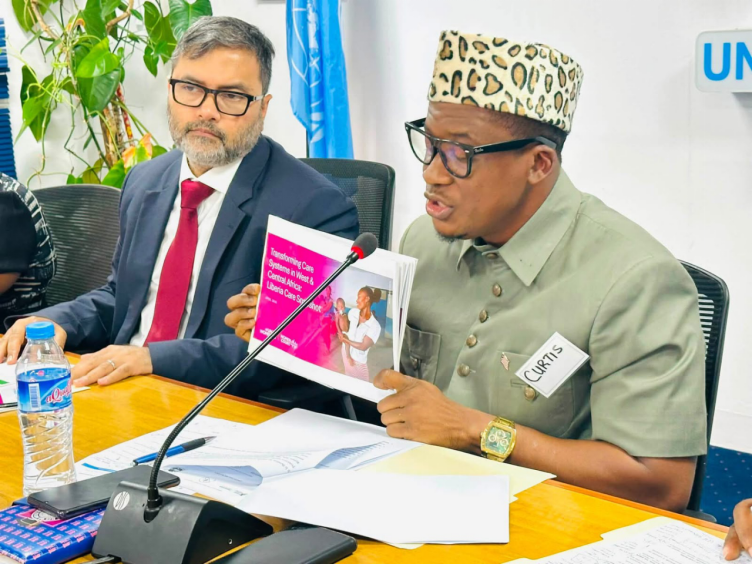
Officially unveiling the report, Deputy Minister for Research, Policy and Planning at the Ministry of Gender, Children and Social Protection, Curtis V. Dorley, described the report as more than just another publication, calling it a national roadmap for transforming Liberia’s economic and social development through evidence-based policies that recognize the value of care work.
“Today marks an important milestone in Liberia’s commitment to evidence-based policymaking, gender equality, social justice, inclusive economic transformation, and sustainable human development,” Dorley said. “This report reflects a national commitment to making care visible, measurable, valued and investable.”
He noted that for generations, women and girls have shouldered the overwhelming burden of unpaid care work raising children, caring for older persons, supporting people living with disabilities, preparing meals, collecting water and fuel, and maintaining households without recognition in national economic planning.
“Without care,” he emphasized, “there is no productive workforce, no healthy society, and no sustainable development.”
According to the report, Liberian women spend 2.1 times more hours on unpaid care and domestic work than men, a trend consistent across West and Central Africa where women continue to bear disproportionate caregiving responsibilities.
While globally women perform 2.5 times more unpaid care work than men, the burden is even higher in countries such as Senegal, where women perform eight times more unpaid care work.
The report warns that without decisive policy interventions, unpaid care responsibilities across the region could increase by 30 percent by 2050, driven by population growth, climate change, demographic shifts and economic pressures.
One of the report’s strongest findings is its economic argument. It estimates that eliminating gender inequalities linked to unpaid care responsibilities could increase Liberia’s Gross Domestic Product by 23.7 percent, while strategic investments in childcare, elder care and other care services could boost national economic growth, create decent jobs and reduce poverty.
Deputy Minister Dorley stressed that care should no longer be viewed as a social cost. “Care is not a social cost. Care is a productive investment,” he declared.
He said investments in childcare services, social protection, clean energy, water and sanitation, family-friendly workplace policies, and care infrastructure must become national development priorities under the Government’s ARREST Agenda for Inclusive Development.
The report, he added, should guide legislation, national planning, budget allocations and future development programming.
Delivering the opening remarks, UN Women Country Representative Abul Hasnat Monjurul Kabir described unpaid care work as “one of the greatest invisible challenges” facing societies worldwide.
He said while women sustain families, communities and economies through unpaid caregiving, their contributions remain largely unrecognized in economic planning.
“The invisibility of women in care work has become one of the greatest challenges of our lifetime,” Kabir said.
He noted that Liberia’s growing population from 5.7 million today to an estimated 9 million by 2050 will significantly increase demand for childcare, elder care and disability support, making investments in the care economy more urgent than ever.
The report also estimates that Liberian women contribute approximately US$530 million annually through unpaid care work, in addition to more than US$1 billion in market-based economic output.
Kabir said these enormous contributions remain largely invisible in public policy.
“These two figures are so powerful, yet so invisible,” he said. “Investing in care is not simply addressing a challenge it is a smart investment capable of generating significant economic and social returns.”
He called for collective action based on UN Women’s Five Rs Framework Recognize, Reduce, Redistribute, Reward and Represent care work and care workers.
Assistant Minister for Gender Ophelia J.S. Kennedy reaffirmed the Ministry’s commitment to advancing policies that improve the lives of Liberian women.
She described the initiative as fully aligned with the Ministry’s mandate to promote women’s empowerment and protection. “We want women not merely to be spectators,” Kennedy said. “They must become active participants from policy discussions to implementation.”
She urged stronger collaboration among government institutions, development partners and civil society to build a care system that creates lasting opportunities for women.
Representing the Liberia Institute for Statistics and Geo-Information Services (LISGIS), Bannel S. Dennis challenged stakeholders to move beyond discussions and begin implementing practical reforms.
“As statisticians, we ask ourselves whether care can truly be counted and valued,” Dennis said.
He highlighted ongoing national surveys including household and labor force surveys that will generate more gender-disaggregated data to inform policymaking.
“This issue has been discussed for decades,” he said. “Now is the time for action.”
Reading remarks on behalf of National Disaster Management Agency Executive Director Atty. Ansu Dulleh, Gender Director Tarlo Harrington Kekulah described the care economy as essential to building resilient communities.
She said recognizing and investing in unpaid care work would improve women’s participation in the labor market, strengthen social protection, reduce poverty and enhance Liberia’s capacity to respond to disasters and public health emergencies.
“By investing in care, we invest in stronger families, healthier communities, more productive workplaces and a more prosperous Liberia,” she said.
The Liberia Care Snapshot identifies several structural challenges affecting the country’s care economy: Liberia’s population is projected to increase from 5.7 million to 9 million by 2050, increasing demand for care services.
More than 58 percent of Liberians live below the poverty line. Women have one of the world’s highest labor force participation rates but over 90 percent work in vulnerable or informal employment.
Childcare services remain largely urban and privately operated, limiting access for poor families.
Rural women spend significantly more time collecting water and firewood due to inadequate infrastructure.
There is no comprehensive national care strategy, and several international labor conventions protecting care workers remain unratified.
The report recommends that Liberia:
Develop a national care strategy.
Expand affordable childcare and elder care services.
Improve access to clean water, sanitation, electricity and transportation.
Strengthen social protection systems.
Ratify key International Labour Organization conventions protecting care workers.
Increase investment in care infrastructure and collect better time-use data to properly measure unpaid care work.
Launching the report, Deputy Minister Dorley expressed hope that it would inspire bold reforms and lasting partnerships.
“May this report inspire bold policies, strengthen national partnerships, guide strategic investments, and contribute to building a Liberia where every woman, every child, every caregiver, every older person, and every vulnerable citizen can live with dignity, opportunity and hope,” he said.
Support Independent Journalism
Your support helps FrontPage Africa continue delivering independent, credible, and impactful journalism. Every contribution strengthens our ability to investigate, inform, and hold power accountable while keeping quality journalism accessible to our readers.
Support our journalism or subscribe to receive the latest FrontPage Africa stories and updates.