MONROVIA – The Liberia Agriculture Commodity Regulatory Authority (LACRA) has reaffirmed its commitment to ensuring that Liberia’s agricultural exports meet international sustainability standards following high-level discussions with officials of the European Union Delegation to Liberia on the country’s readiness to comply with the European Union Deforestation Regulation (EUDR).
By Selma Lomax, [email protected]
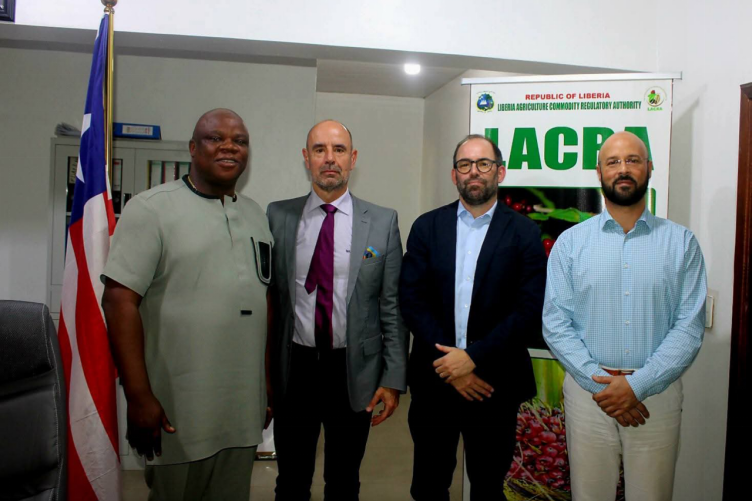
The meeting, held on Monday at LACRA’s headquarters, brought together Director General Christopher D. Sankolo and members of the European Union delegation, including Team Leader Gilles Matayron, Antonio Di Clemente, and Chargé d’Affaires Zoltan Szalai. The discussions centered on Liberia’s progress toward meeting the requirements of the EUDR, a regulation designed to prevent products linked to deforestation from entering the European market.
During the engagement, Director General Sankolo provided a comprehensive update on the measures LACRA has undertaken to strengthen Liberia’s compliance framework.
He emphasized that the Authority has intensified efforts to improve transparency, accountability, and traceability throughout the country’s agricultural value chains to ensure that Liberian commodities remain competitive in international markets.
Sankolo highlighted the development of the LACRA-TRACE digital platform as one of the Authority’s most significant achievements. According to him, the system is designed to accurately geolocate farms and verify the origin of agricultural commodities, allowing exporters and international buyers to confirm that products entering European markets comply with the EUDR’s environmental standards.
He disclosed that preparations for the pilot launch of the LACRA-TRACE platform have reached an advanced stage and expressed confidence that the system will become operational within the coming weeks. He described the initiative as a transformative step toward building a modern agricultural monitoring system capable of promoting responsible production while enhancing confidence among international trading partners.
“The development of LACRA-TRACE reflects our determination to position Liberia as a trusted supplier of agricultural commodities that meet the highest international standards,” Sankolo said. “We are investing in innovation because we understand that traceability and environmental responsibility are becoming indispensable requirements for global trade.”
He added, “Our objective extends beyond regulatory compliance. We want to create lasting opportunities for Liberian farmers and exporters by ensuring they have access to premium international markets through credible verification systems.”
Sankolo further noted that LACRA remains committed to working closely with farmers, exporters, cooperatives, and development partners to ensure that every stakeholder understands the new regulatory landscape and is equipped to meet evolving global expectations.
“We appreciate the continued partnership of the European Union as we strengthen Liberia’s agricultural governance systems,” he said. “Together, we can build an agricultural sector that promotes environmental sustainability while creating jobs, increasing exports, and improving livelihoods across the country.”

The Director General also stressed that public awareness and technical capacity-building will remain central to LACRA’s implementation strategy. He said the Authority intends to expand nationwide stakeholder engagements aimed at educating producers on the importance of traceability, responsible land use, and compliance with international environmental standards.
Speaking on behalf of the delegation, Team Leader Gilles Matayron said the European Union recognizes the important progress being made by LACRA and remains encouraged by the Authority’s commitment to transparency and innovation.
“We are impressed by the progress LACRA has demonstrated in developing practical solutions that will strengthen traceability and improve confidence in Liberia’s agricultural exports,” Matayron said. “The European Union remains committed to supporting Liberia as it advances toward full compliance with the EUDR.”
He added, “Achieving compliance is a shared responsibility, and we value the collaboration among LACRA, the Ministry of Agriculture, the Forestry Development Authority, and other national institutions working to promote sustainable supply chains that benefit both producers and consumers.”
The delegation reiterated that the European Union will continue collaborating with LACRA and other government institutions to strengthen technical capacity, improve institutional coordination, and promote sustainable agricultural practices that will allow Liberian products to remain competitive within European markets.
Support Independent Journalism
Your support helps FrontPage Africa continue delivering independent, credible, and impactful journalism. Every contribution strengthens our ability to investigate, inform, and hold power accountable while keeping quality journalism accessible to our readers.
Support our journalism or subscribe to receive the latest FrontPage Africa stories and updates.