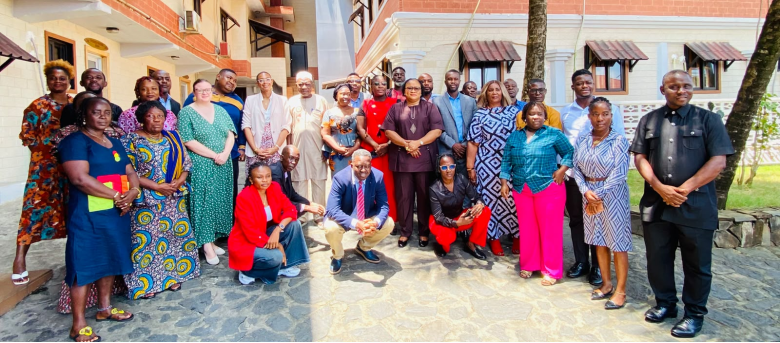
Monrovia— The Government of Liberia, in collaboration with the United Nations Human Rights Office, on Wednesday convened a high-level dialogue to advance national efforts on business and human rights compliance across the country.
By J.H. Webster Clayeh (0886729972)[email protected]
The event, held at the Mamba Point Hotel in Monrovia, brought together government officials, private sector players, civil society actors, and development partners to exchange views and develop key recommendations for strengthening the implementation of Liberia’s National Action Plan on Business and Human Rights.
Government Reaffirms Commitment to Enforcement
Speaking at the opening session, Labour Minister Cllr. Cooper W. Kruah said the Liberian Government remains committed to enforcing standards that ensure businesses uphold human rights principles.
“The Labour Ministry envisions that workplace environments be dignified and conducive, with a competitive workforce to promote social dialogue and decent economic empowerment in line with the Decent Work Act,” Minister Kruah stated.
He added that the National Action Plan reinforces the state’s responsibility to protect individuals from business-related human rights violations and compels business establishments to respect human rights.
Liberia adopted the National Action Plan in 2024. The five-year framework is the country’s first comprehensive blueprint developed jointly by the Ministry of Justice and the Ministry of Labour to guide responsible business conduct aligned with international human rights standards.
UN Recognizes Liberia’s Progress
Delivering remarks on behalf of the UN Resident Coordinator, the World Food Programme Country Director, Mary Njoroge, hailed Liberia’s progress and emphasized the need to balance economic growth with community protection.
“Liberia is rich in economic potential, with vast natural resources including iron ore, diamonds, gold, fertile soil, fisheries, and forestry. If managed appropriately, these can spur equitable growth that benefits all Liberians,” Njoroge said.
However, she cautioned that industrial growth often comes with human rights implications—particularly in areas such as land acquisition, labor conditions, environmental degradation, and community displacement.
She noted that Liberia’s current national development framework places strong emphasis on human rights and inclusivity and called for full alignment with the UN Guiding Principles on Business and Human Rights.
“The right to development is a human right that belongs to everyone,” she stressed.
Njoroge further praised Liberia for becoming the fourth African country—after Kenya, Uganda, and Nigeria—to adopt a National Action Plan on Business and Human Rights.
Implementation and Monitoring Efforts Underway
Deputy Justice Minister for Administration, Cllr. Ora Konowa, disclosed that government institutions are now actively monitoring business compliance across the country.
She said monitoring teams drawn from the Ministry of Justice, Ministry of Labour, Ministry of Mines and Energy, the Environmental Protection Agency, and other regulatory bodies are assessing labor practices, environmental safety, community rights, transparency in concession agreements, and overall compliance with international standards.
Calls for Collective Responsibility
Several speakers—including ECOWAS Resident Representative Ambassador Josephine Nkrumah and United Nations Human Rights Representative Christian Mukosa—expressed support for the national plan and urged business leaders to demonstrate full commitment to its implementation.
The Cuban Ambassador to Liberia, H.E. Dr. Indira Lopez Arguelles, pledged international support to sustain Liberia’s efforts.
Civil society groups present at the forum called for increased monitoring, including site visits to major concession companies—particularly those whose executives were not present at the dialogue.
Support Independent Journalism
Your support helps FrontPage Africa continue delivering independent, credible, and impactful journalism. Every contribution strengthens our ability to investigate, inform, and hold power accountable while keeping quality journalism accessible to our readers.
Support our journalism or subscribe to receive the latest FrontPage Africa stories and updates.