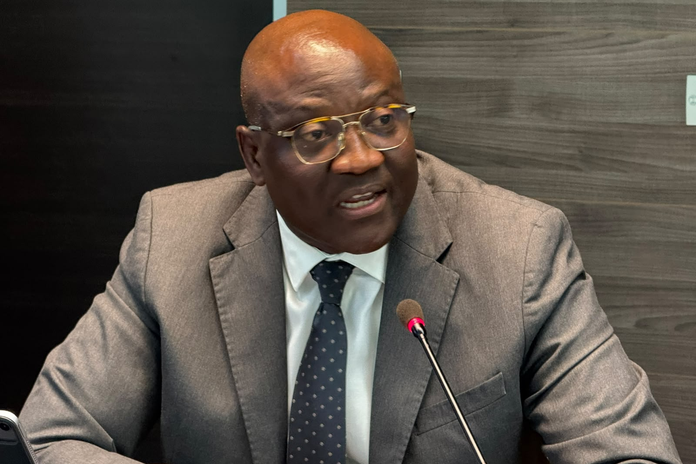
Monrovia – Auditor General P. Garswa Jackson has released the General Auditing Commission’s (GAC) audit of the Government of Liberia’s Consolidated Fund Account for the 2025 fiscal year, giving the government’s financial statements an unqualified opinion while urging lawmakers to urgently act on recommendations contained in the report.
By Gerald C. Koinyeneh, [email protected]
The audit, covering the period January 1 to December 31, 2025, examined the government’s statement of cash receipts and payments, comparison of budgeted and actual amounts, and accompanying financial notes.
In his report dated August 2026, Auditor General Jackson said the financial statements “present fairly, in all material respects” the government’s receipts and payments as of December 31, 2025, and conform with the 2017 International Public Sector Accounting Standards (IPSAS) Cash Basis of Accounting.
The audit was conducted in accordance with the International Standards of Supreme Audit Institutions (ISSAIs) and Section 2.1.3 of the General Auditing Commission Act of 2014.
GAC Urges Legislature to Act
Despite issuing a favorable audit opinion, Jackson warned that matters raised during the audit require the attention of the Legislature.
In a transmittal letter addressed to the Speaker of the House of Representatives and the President Pro-Tempore of the Liberian Senate, the Auditor General said the findings had been formally communicated to the Ministry of Finance and Development Planning through a Management Letter.
He said responses provided by the Ministry were reviewed and incorporated into the final audit report.
“Given the significance of the matters raised in this report,” Jackson urged lawmakers to consider implementing the audit recommendations with urgency.
The report now places responsibility on the Legislature to scrutinize the findings and follow up on the government’s implementation of the recommendations.
Government Managed US$955.2M in Cash Receipts
According to the financial statements, the government recorded US$955.20 million in total cash receipts during fiscal year 2025, a substantial increase from the US$685.56 million recorded in 2024.
The increase of approximately US$269.64 million, or 28 percent, was attributed largely to improvements in revenue administration, digital transformation and enhanced revenue collection and compliance.
The government said the integration of the Liberia Tax Administration System (LITAS) with commercial banks and mobile money platforms, along with the expansion of ASYCUDA and LITAS across major customs and tax offices, contributed to the improved performance.
Total cash expenditure also increased significantly, reaching US$902.77 million, compared with US$660.57 million in 2024.
That represents an increase of approximately US$242.20 million, or 27 percent.
The government attributed the increase partly to the settlement of outstanding commitments from the previous fiscal year’s 90-day window period and adjustments to budgeted expenditure.
US$76.89M Remained at Year-End
The financial statements show that Liberia closed fiscal year 2025 with a reconciled cash balance of approximately US$76.89 million.
The reported balance comprised funds held across government accounts, including consolidated accounts, escrow accounts, the Road Fund escrow accounts, mobile money accounts, and transitory and other accounts.
The report lists approximately:
- US$14.37 million in Consolidated Accounts;
- US$7.04 million in Other Escrow Accounts;
- US$902,000 in Road Fund Escrow Accounts;
- US$53,000 in Mobile Money Accounts;
- US$58 million in Transitory and Other Accounts; and
- approximately US$3.48 million in foreign currency gain/loss adjustments.
The government stated that the reconciled balances were controlled by the government and held at the Central Bank of Liberia, commercial banks and electronic platforms.
Revenue Outperformed Budget
The audit report also highlights stronger-than-projected revenue performance during the year.
The government had approved a US$880.66 million resource envelope for fiscal year 2025, representing a 19.2 percent increase over the FY2024 recast budget of US$738.86 million.
Actual overall revenue reached US$885.10 million, exceeding the approved budget by approximately US$4.44 million, or 0.5 percent.
Domestic revenue was particularly strong, reaching US$847.05 million against a budget projection of US$804.63 million—an overperformance of approximately US$42.43 million.
However, the government fell short of its projected external revenue after approximately US$40 million expected from the World Bank was not realized during FY2025 because of unmet disbursement conditions.
US$880.66M Expenditure Envelope
The FY2025 budget authorized total expenditure of US$880.66 million.
Of that amount, recurrent and non-PSIP capital expenditure accounted for US$773.95 million, or 87.9 percent, while the Public Sector Investment Program (PSIP) accounted for US$106.72 million, or 12.1 percent.
Actual cash spending, however, reached US$902.77 million, exceeding the approved expenditure envelope.
The government said the higher expenditure was influenced by the payment of outstanding commitments carried over from the previous fiscal year’s 90-day window and upward adjustments to expenditure during the reporting period.
Government Claims Stronger Financial Controls
In its statement of responsibility, the Ministry of Finance and Development Planning maintained that the government had upheld its obligations under the Public Financial Management Act and Regulations.
The government said it had systems of internal control and risk management designed to safeguard public resources against loss, misuse and fraud, ensure transactions comply with applicable laws and regulations, and maintain reliable financial records.
The Comptroller and Accountant General also certified responsibility for the accuracy, completeness and reliability of the financial information contained in the consolidated financial statements.
The financial statements were approved for issuance on April 30, 2026, while the Auditor General’s report was issued in August 2026.
Audit Opinion Does Not Mean No Problems
While the Auditor General’s unqualified opinion represents a positive assessment of the financial statements, the report makes clear that an audit opinion is not a guarantee that every instance of fraud, error or internal-control weakness will be detected.
Jackson noted that an audit provides reasonable assurance, rather than absolute assurance, that financial statements are free from material misstatement.
The Auditor General said the audit procedures were designed based on assessed risks of material misstatement, including those arising from fraud or error, and included an evaluation of accounting policies, estimates and the overall presentation of the financial statements.
The release of the report comes amid heightened public scrutiny of government spending, revenue collection and financial accountability, making the Legislature’s promised consideration of the GAC’s recommendations a key next step in determining whether the identified issues will result in corrective action.
Support Independent Journalism
Your support helps FrontPage Africa continue delivering independent, credible, and impactful journalism. Every contribution strengthens our ability to investigate, inform, and hold power accountable while keeping quality journalism accessible to our readers.
Support our journalism or subscribe to receive the latest FrontPage Africa stories and updates.