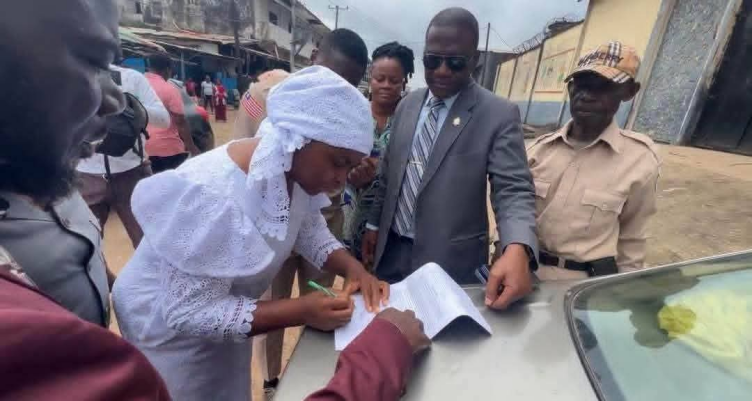
Monrovia – Former Executive Mansion Chief of Protocol Nora Finda Bundoo is making another legal effort to secure her temporary release, filing a new criminal appearance bond backed by two insurance companies after the Criminal Court “C” rejected two previous attempts to satisfy its bail requirements.
By Victoria G Wesseh and Willie N. Tokpah
The latest move places Bundoo’s constitutional right to bail and the State’s demand for adequate security at the center of a continuing legal battle before Criminal Court “C,” presided over by Assigned Circuit Judge Ousman E. Feika.
Court records show that Bundoo has not abandoned her effort to comply with the court’s requirements. Instead, following the rejection of two earlier bond arrangements, her legal team turned to insurance companies licensed to issue criminal appearance bonds in Liberia.
For Nora Finda Bundoo, the fight for temporary freedom has become a legal journey marked by repeated setbacks, escalating financial requirements, and yet another challenge from the State.
The former Executive Mansion Chief of Protocol is now before Criminal Court “C” seeking approval of a new criminal appearance bond after two previous attempts to secure her release were rejected.
This time, Bundoo has turned to two insurance companies, Accident and Casualty Insurance Company and American Undertakers Group International Insurance Company (AUG, in what appears to be another effort to meet the court’s requirements and regain her liberty while she awaits trial.
But once again, the prosecution has objected.
The development has placed Bundoo in an increasingly difficult position. She must defend herself against serious criminal allegations while simultaneously finding a way to satisfy a bond requirement that the court has set at US$8 million.
The situation is becoming bigger than the value of a bond for her defense.
It is about whether bail, which is intended to secure an accused person’s appearance in court, is being transformed into an obstacle so difficult to overcome that it effectively keeps an accused person behind bars before trial.
Two Attempts, Two Rejections
Bundoo’s present predicament follows two previous attempts to secure her release.
The first bond was set aside by Judge Ousman E. Feika after the court found that the proposed sureties were insufficient and did not meet the legal requirements to file the bond.
The court then gave Bundoo 72 hours to present another criminal appearance bond.
She did.
Two sureties, Kai Garlo Farley and John Moses Gbetee, submitted property valuation bonds on her behalf. Again, the prosecution objected.
On July 21, Judge Ousmam Feika ruled on the property-backed guarantees and set the bond threshold at US$8 million.
That ruling for Bundoo dramatically changed the challenge before her.
The issue is no longer simply finding individuals willing to stand as sureties. She is now confronted with a financial threshold running into millions of United States dollars.
However, rather than abandoning her effort to secure release, Bundoo’s legal team searched for another lawful mechanism, which produced the latest insurance-backed bonds.
A Different Route to the Same Goal
ACICO and AUG subsequently filed separate criminal appearance bonds for Bundoo.
The move can be viewed as an attempt to address concerns surrounding the earlier property valuation bonds by relying instead on insurance companies licensed by the Central Bank of Liberia to issue criminal appearance bonds, but the State has again objected.
The prosecution argued that the latest bonds remain inadequate and do not sufficiently satisfy the statutory objectives of bail under Section 13.2 of the Criminal Procedure Law.
Bundoo’s lawyers disagree, arguing that bail is intended to accomplish two fundamental things: to prevent unnecessary pretrial incarceration while ensuring that an accused person remains within the jurisdiction of the court and appears whenever required.
Bubdoo’s position goes to the heart of her struggle, and she is not asking the court to terminate the criminal case against her, but asking to face the allegations while temporarily outside detention.
The defense argued that if bail is intended to guarantee an accused person’s appearance, the amount should be set at a level that an accused person has little realistic ability to meet.
Bundoo’s lawyers argue that although the court has discretion in determining the sufficiency of bail, that discretion should not result in a bond so excessive that it exceeds the accused’s financial capacity.
For Bundoo, the US$8 million threshold is therefore not merely a number on a court document.
It represents a potentially formidable barrier between her and temporary liberty.
After two earlier bonds were rejected, the latest prosecution objection means she faces yet another hurdle in an already prolonged effort to secure release.
The State’s Pursuit Under Scrutiny
The government’s prosecution of Bundoo is being conducted through the Assets Recovery and Property Retrieval Task Force, AREPT, and the Ministry of Justice.
The State has a legitimate responsibility to prosecute allegations of financial crimes and to ensure that defendants appear before court.
But the intensity with which Bundoo’s release has been contested also raises questions about proportionality.
Bundoo stands indicted on allegations including money laundering, theft of property, misuse of public money and records, criminal conspiracy, forgery and criminal facilitation.
The allegations are serious, but an indictment is not a conviction.
Under Liberia’s legal system, Bundoo remains entitled to the presumption of innocence unless the prosecution proves the allegations against her beyond a reasonable doubt.
That principle becomes particularly important when an accused person is fighting for temporary liberty.
The purpose of bail is not to determine guilt.
It is to ensure that the accused remains available to answer the charges.
Bundoo’s lawyers said she can satisfy that obligation without remaining incarcerated, provided the court accepts an adequate and legally compliant bond.
A Woman Fighting Through the System
Whatever the outcome of the criminal prosecution, Bundoo’s latest legal maneuver demonstrates that she continues to use the judicial process available to her.
After the rejection of the first bond, she returned with another. After the second was challenged and rejected, her lawyers turned to licensed insurance companies, and after the latest bonds were challenged, she returned to court to justify them.
For Bundoo, the process has become a test of endurance as much as a legal contest, as each rejected bond means another delay, each new requirement means another financial and legal challenge, and each prosecution objection keeps the question of her temporary liberty alive.
Court Must Balance Both Sides
The court now faced the delicate task of balancing two competing interests.
On one side is the State’s responsibility to ensure that an accused person does not evade justice and that any criminal appearance bond provides meaningful security, and the other is Bundoo’s right to be presumed innocent and, where legally appropriate, to obtain bail on reasonable terms while defending herself.
The court’s decision on the ACICO and AUG bonds could therefore become another significant moment in Bundoo’s prolonged battle for release.
For now, the former Protocol Chief remains caught between a US$8 million judicial threshold and a State determined to challenge the latest attempt to meet it.
Support Independent Journalism
Your support helps FrontPage Africa continue delivering independent, credible, and impactful journalism. Every contribution strengthens our ability to investigate, inform, and hold power accountable while keeping quality journalism accessible to our readers.
Support our journalism or subscribe to receive the latest FrontPage Africa stories and updates.